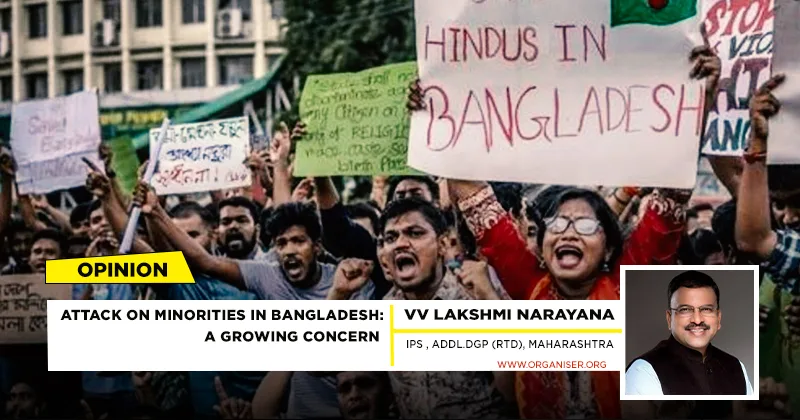
Attack on Minorities in Bangladesh: A growing concern
August 15, 2026
  • Read Ecopy
  • Circulation
  • Advertise
  • Careers
  • About Us
  • Contact Us
Android AppiPhone AppArattai
Organiser
  • ‌
  • Bharat
    • Assam
    • Bihar
    • Chhattisgarh
    • Jharkhand
    • Maharashtra
    • View All States
  • World
    • Asia
    • Europe
    • North America
    • South America
    • Africa
    • Australia
  • Editorial
  • International
  • Opinion
  • RSS @ 100
  • More
    • Op Sindoor
    • Analysis
    • Sports
    • Defence
    • Politics
    • Business
    • Economy
    • Culture
    • Special Report
    • Sci & Tech
    • Entertainment
    • G20
    • Azadi Ka Amrit Mahotsav
    • Vocal4Local
    • Web Stories
    • Education
    • Employment
    • Books
    • Interviews
    • Travel
    • Law
    • Health
    • Obituary
  • Subscribe
    • Subscribe Print Edition
    • Subscribe Ecopy
    • Read Ecopy
  • ‌
  • Bharat
    • Assam
    • Bihar
    • Chhattisgarh
    • Jharkhand
    • Maharashtra
    • View All States
  • World
    • Asia
    • Europe
    • North America
    • South America
    • Africa
    • Australia
  • Editorial
  • International
  • Opinion
  • RSS @ 100
  • More
    • Op Sindoor
    • Analysis
    • Sports
    • Defence
    • Politics
    • Business
    • Economy
    • Culture
    • Special Report
    • Sci & Tech
    • Entertainment
    • G20
    • Azadi Ka Amrit Mahotsav
    • Vocal4Local
    • Web Stories
    • Education
    • Employment
    • Books
    • Interviews
    • Travel
    • Law
    • Health
    • Obituary
  • Subscribe
    • Subscribe Print Edition
    • Subscribe Ecopy
    • Read Ecopy
Organiser
  • Home
  • Bharat
  • World
  • Operation Sindoor
  • Editorial
  • Analysis
  • Opinion
  • Culture
  • Defence
  • International Edition
  • RSS @ 100
  • Magazine
  • Read Ecopy
Home Politics

Attack on Minorities in Bangladesh: A growing concern

Leader of the Bangladesh Muktijoddha Parishad (BMP) and a retired senior army officer made provocative statements about annexing Bengal, Bihar, and Odisha into Bangladesh. Such remarks, though not reflective of official policy, underscore the need for India to remain alert to rhetoric that could stoke regional tensions

VV Lakshmi NarayanaVV Lakshmi Narayana
Dec 16, 2024, 10:30 pm IST
inPolitics, Bharat, Opinion, International Edition
Follow on Google News
Facebook
Twitter
WhatsAppTelegramEmail

The recent surge in attacks on minorities in Bangladesh, including the arrest of an ISKCON monk, highlights an alarming trend that threatens the country’s pluralistic ethos. Reports of vandalism at Hindu temples, targeted violence during festivals, and the shrinking Hindu population reflect a deteriorating environment for minorities. This has raised concerns both domestically and internationally, particularly in India, which shares deep historical, cultural, and strategic ties with Bangladesh.

India’s Role in the Liberation of Bangladesh

India played a pivotal role in the liberation of Bangladesh during the 1971 war. By providing military assistance, sheltering millions of refugees, and supporting the Mukti Bahini, India ensured the creation of a free and independent Bangladesh. This shared history of struggle and sacrifice has laid the foundation for the close ties between the two nations. However, maintaining these ties requires addressing contemporary challenges, including the treatment of minorities in Bangladesh.

The Declining Hindu Population and Role of Jamaat-e-Islami

The Hindu population in Bangladesh has been steadily declining, dropping from nearly 30% during partition in 1947 to less than 10% today. Systematic discrimination, forced conversions, and sporadic violence are contributing factors. Organisations like Jamaat-e-Islami, with their hardline Islamist agenda, have been accused of orchestrating attacks on minorities and propagating narratives that undermine the secular fabric of the nation. Despite periodic crackdowns, their influence persists, exacerbating communal tensions and posing a challenge to Bangladesh’s constitutional commitment to secularism.

India-Bangladesh Relations: A Balancing Act

India and Bangladesh share a unique relationship rooted in history, geography, and economic cooperation. Bangladesh is India’s largest trading partner in South Asia and plays a pivotal role in New Delhi’s “Act East” policy. However, incidents of communal violence against minorities in Bangladesh strain these relations, prompting New Delhi to adopt a cautious yet proactive approach.

India recognises the strategic importance of Bangladesh in ensuring regional stability. The country serves as a critical gateway for connectivity projects like the Bangladesh-Bhutan-India-Nepal (BBIN) initiative and offers a counterbalance to China’s growing influence in the region. Maintaining robust ties with Dhaka is thus imperative for India’s security and economic aspirations.

Remarks by Bangladesh’s Foreign Minister

Recent statements by Bangladesh’s Foreign Minister Younis, suggest that the strengthening ties with Pakistan, have added complexity to the bilateral relationship. While Bangladesh’s sovereignty allows it to foster relations with any nation, India must remain vigilant about potential geopolitical shifts that could impact the region’s stability. A balanced yet firm approach is essential to ensure that Bangladesh’s relations with Pakistan do not come at the cost of its historical ties with India.

Statements by BMP Leader and Retired Army Senior

Adding to the concern, a leader of the Bangladesh Muktijoddha Parishad (BMP) and a retired senior army officer recently made provocative statements about annexing Bengal, Bihar, and Odisha into Bangladesh. Such remarks, though not reflective of official policy, underscore the need for India to remain alert to rhetoric that could stoke regional tensions. India must continue to advocate for a stable and cooperative neighbourhood while addressing any narrative that undermines its territorial integrity or sovereignty.

Measures India Should Consider

  • To address the plight of minorities in Bangladesh and safeguard its strategic interests, India must adopt a multifaceted approach:
  • Diplomatic Engagement: India should intensify diplomatic dialogue, urging Bangladesh to uphold its commitment to secularism and protect minorities. The recent visit by India’s Foreign Secretary to Dhaka was a step in the right direction, emphasising mutual cooperation and conveying India’s concerns over minority rights.
  • Strengthening People-to-People Ties: Initiatives to promote cultural and educational exchanges can foster goodwill and enhance mutual understanding.
  • Regional Collaboration: Leveraging platforms like SAARC and BIMSTEC to address cross-border communal issues can create a collective framework for minority protection.
  • Economic Cooperation: India can incentivise positive reforms in Bangladesh by deepening economic ties, ensuring that investments align with social inclusivity.

The challenges faced by minorities in Bangladesh are not just a domestic issue but a regional concern with far-reaching implications. India, as a close neighbour and partner, has a responsibility to engage constructively, ensuring that communal harmony and democratic values prevail in Bangladesh. As the two nations navigate their intertwined destinies, safeguarding minority rights and fostering mutual respect will be crucial for regional stability and prosperity.

 

Topics: Persecution of HindusIslamic nationBangladesh
Share
Tweet
SendShareSend
✮ Subscribe Organiser YouTube Channel. ✮
✮ Join Organiser's WhatsApp channel for Nationalist views beyond the news. ✮
Previous News

Conversion Racket Exposed in Ghaziabad: Teacher & govt employee accused of luring 150 Hindu families to Christianity

Next News

India’s Revolution in Brain Science: IIT-Madras unveils high-resolution foetal brain images

Related News

Indian Ambassadors to Bangladesh and Nepal meet respective Prime Ministers; Neighbourhood First policy in action

India’s Neighbourhood First Diplomacy in Action: Envoys meet Bangladesh, Nepal PMs; Pushes shared growth & prosperity

Prime Minister of Bangladesh Tarique Rahman and Former Prime Minister Sheikh Hasina

Bangladesh: BNP govt sharply reacts to Sheikh Hasina’s live interaction; Seeks mutually benificial ties with India

Illegal Bangladeshis deported (This image is generated by AI)

Odisha Police deport 42 illegal Bangladeshi nationals; Six more await repatriation

Exiled Bangladeshi writer Taslima Nasrin speaks during a citizens felicitation programme titled 'Returning to a Free West Bengal After 19 Years'

‘One of the longest nights of my life’: Taslima Nasreen recalls forced exit from Kolkata after 2007 protests

Former Prime Minister of Bangladesh Sheikh Hasina

Sheikh Hasina’s first public appearance since leaving Bangladesh; Will she hint at return to Dhaka & political future?

Representative Image

India to set up 40 Intelligence Bureau units in Bangladesh border; Shield against infiltration & organised crimes

Load More

Latest News

Independence Day 2026: World leaders wish India, hail its global rise & growth story; Signals deeper strategic ties

Kerala: Halal Fayida Islamic Banking Cooperative Society depositors stranded as crores remain unaccounted for

Abusive language used during recent protest in Delhi cannot be the language of Bharatiya youth. It is time to introspect yourself where are we making mistakes in guiding our future generation

80th Independence Day: Youth and Nation – Change begins with responsibility

The Tiranga embodies India’s freedom, unity and values, inspiring us to turn patriotism into responsible action

From Tiranga in Every Home to Tiranga in Every Heart: Turning national pride into everyday patriotism

Atul Limaye, Sah Sarkaryavah, RSS, while addressing at an Akhil Bharatiya Vidyarthi Parishad (ABVP), the student wing of the RSS, event held in Chhatrapati Sambhajinagar in Maharashtra, on August 2

Independence Day 2026: Youth and Nation – The Anarchic alternative

Keralam: CM Satheeshan omits Vande Mataram on Independence Day at govt offices; BJP events render full version

Decolonisation saw nations across Africa and Southeast Asia reclaim their cultures, languages and identities after independence (This image is generated by AI)

From Colonial Rule to Cultural Revival: How African and Southeast Asian nations shed their colonial legacies

Rashtriya Swayamsevak Sangh (RSS) Sarsanghchalak Dr Mohan Bhagwat went viral by adopting the Gen Z slang phrase "clock it" and making the corresponding hand gesture during a youth conference in Mumbai on August 6

Independence Day 2026: Anarchy vs Freedom – Revisiting Ambedkar on protest in democracy

The Pakistan-Saudi Arabia-Türkiye defence pact faces an early test amid rising regional tensions and security challenges

Pakistan-Saudi Arabia-Turkiye Defence Pact: A shaky beginning and growing questions over its strategic credibility

India’s journey from Swadhinta to Swatantrata begins with decolonising minds and embracing Bharatiya values (This image is generated by AI)

Decolonising the Mind: How citizens can embrace Bharatiya languages, traditions & values to realise absolute freedom

Load More
  • Privacy
  • Terms
  • Cookie Policy
  • Refund and Cancellation
  • Delivery and Shipping

© Bharat Prakashan (Delhi) Limited.
Tech-enabled by Ananthapuri Technologies

  • Home
  • Search Organiser
  • Bharat
    • Assam
    • Bihar
    • Chhattisgarh
    • Jharkhand
    • Maharashtra
    • View All States
  • World
    • Asia
    • Africa
    • North America
    • South America
    • Europe
    • Australia
  • Editorial
  • Operation Sindoor
  • Opinion
  • Analysis
  • Defence
  • Culture
  • Sports
  • Business
  • RSS @ 100
  • Entertainment
  • More ..
    • Sci & Tech
    • Vocal4Local
    • Special Report
    • Education
    • Employment
    • Books
    • Interviews
    • Travel
    • Health
    • Politics
    • Law
    • Economy
    • Obituary
  • Subscribe Magazine
  • Read Ecopy
  • Advertise
  • Circulation
  • Careers
  • About Us
  • Contact Us
  • Policies & Terms
    • Privacy Policy
    • Cookie Policy
    • Refund and Cancellation
    • Terms of Use

© Bharat Prakashan (Delhi) Limited.
Tech-enabled by Ananthapuri Technologies