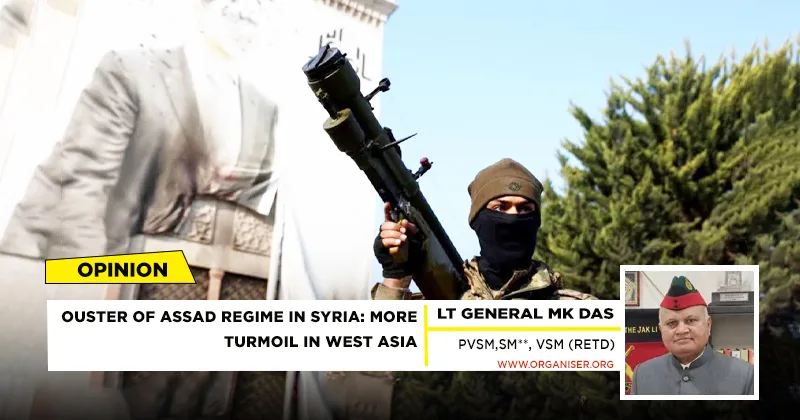
The ouster of President Assad from Syria is one of the most dramatic regimes change in recent times. In fact, Syria has not been much in the news recently, except for some minor aerial incursions by Israel in the ongoing conflict with Hamas, Hezbollah and Iran. But suddenly, the situation in Syria turned grim recently with continued friction between Syrian forces, multiple rebel groups and non-state actors. Initial reports indicated that the rebels had captured 30 per cent of the Syrian territory after a week’s fighting. In just the next two days, the rebels entered the capital city of Damascus on 8 December, early Sunday, bringing an end to the civil war which was ongoing for the last 13 years. While the regime may have changed, the conflict in the region is far from being over.
Syria is a relatively larger country in the West Asia with an area of 1.85 lakh sq km and an estimated population of 2.5 crore. It is bounded by Turkey to the north, Iraq to the east, Jordan to the south and Lebanon & Israel to its southwest, with Mediterranean Sea as the western coastline. Rich in oil resources and natural gas, Syria has always attracted major powers like the US, Russia and Iran. Ruled by the President Bashar al-Assad since the year 2000 onwards with an iron hand, the regime has survived largely on the support extended by Russia and Iran. Since the Arab Spring in 2011, Syria has been embroiled in a multi-sided civil war leading to displacement of more than 60 lakh people from the country. Turkey has opposed the Assad regime and it is a key player to support the anti-government forces.
Syria went through a most difficult phase in the period between 2014-15 when Islamic State (IS) captured many cities in Syria, particularly in the north and the east. Islamic State of Iraq and Syria (ISIS) caused havoc for almost two years and the videos of their public beheadings is still fresh in our minds. The brutal dimension of the terror forced the US to launch an international coalition that finally defeated the ISIS in 2016. Since then, three political entities namely Syrian Interim Government, Syrian Salvation government and Rojava have challenged the Assad government. These three political entities have their armed wing and control territories in the northern and eastern part of Syria. Since then, Syria has witnessed violent conflict between Syrian forces loyal to Assad and the rebels, with minor gains and losses from time to time.
The last week saw offensive of greater magnitude which caught the Syrian forces by surprise. It has emerged that the rebels have formed a new coalition called the ‘Military Operations Command’ with the sole aim of overthrowing the Assad government. The rebels quickly captured the northern city of Aleppo, thereafter moved southwards to capture the strategically important town of Hama. The rebels are reported to be moving further south to capture the city of Homs. The direction of their offensive to capture the capital city of Damascus is obvious. Syrian forces suffered more than 700 casualties and have withdrawn from the captured areas. Syrian Army spokesperson described the withdrawal as strategic retreat, for the forces to regroup and recapture lost territory. But it was too late.
In the meantime, Russia had stepped up military assistance to Syria. Russian Airforce along with Syrian counterparts pounded the area captured by the rebels. As it happens in such crisis, the air attacks kill civilians more than the rebels. The Syrian forces were said to regrouping, assisted by the Hezbollah. Hezbollah chief has publicly stated their support to the embattled Syrian forces. The conflict had given the control of almost 30% of the Syrian territory to the rebels in quick time, indicating their military preparedness. The momentum of operations was clearly with the rebels and the Assad’s Army appeared to be in disarray. That the Syrian Army would surrender so meekly came as a surprise to many. The ouster of Assad’s regime after family’s 50 years of iron rule is also a stern reminder to dictatorial rulers.
US which has some presence in the country through outsourced militia should be concerned. The leading group of the rebels is Hayat Tahrir al-Sham (HTS), a former al Qaeda affiliate. The group is led by Abu Mohammed al-Golani, labelled as a terrorist by the United States. The IS has also morphed into various splinter groups and is making a comeback. The emergence of al Qaeda and other major Islamic groups in the region is something the US led coalition may have to contend with in the middle east. US had plans to build major oil supply pipelines through the region and that idea is unlikely to move ahead, for the time being. US also may have to keep Turkey in check, as Turkey would like to consolidate its position in Syria through its hold on HTS. President Assad and his family has taken refuse in Russia and Russia has lost a huge military base with the ouster of Assad regime. Russia may have to recalibrate its footprint in the middle east.
An embroiled Syria gives some breather to Israel too. Israel has taken the credit for the regime change courtesy the weakening of Iran and Hezbollah. With attention of Iran divided towards Israel and Syria, we may see a relatively less violence to the north of Israel. Israel may be in a position to intensify offensive against the Hamas in Gaza. With adequate pressure on Hamas, they may be constrained to release the Israeli hostages. With Trump 2.0 government assuming office on 20 January 2025, there is a glimmer of hope to end Israel’s conflict in the middle east or at least lead to a lasting ceasefire with the adversaries.
Though India maintains cordial relations with the Assad government in Syria, the Indian presence in Syria is minimal. India had issued advisory to the Indians to vacate Syria or restrict their movement. Thankfully, all the Indians are reported to be safe in Syria and our embassy is functional. But the unrest in the middle east impacts 9 million Indian diasporas residing there, largely as a workforce. India still depends on the oil and natural gas from the gulf countries and continued conflict may impact the regular supply. The oil prices also rise during such conflict and have cascading influence on the economy of India.
The larger issue is about the capture and rule of a country by rebel and terrorist organisations. We already have the example of Afghanistan being ruled by the terror outfit Taliban since August 2021. How Syrian people manage their affairs under a democratic setup is something that would indicate the future course for the region. The failure of conventional modes of governance, particularly under the dictatorial regimes is emerging as a pattern in many parts of world, including Africa and the middle east. At the same time, rise of large terror outfits like al Qaeda, even in a different avatar, is a cause of concern for the global peace. Time has come to prepare for an international coalition to fight global terror once again. India too has an important role to play as the leader of the Global South. I am sure that Mr. Donald Trump and his advisors are closely monitoring the situation developing in Syria and its neighbourhood.