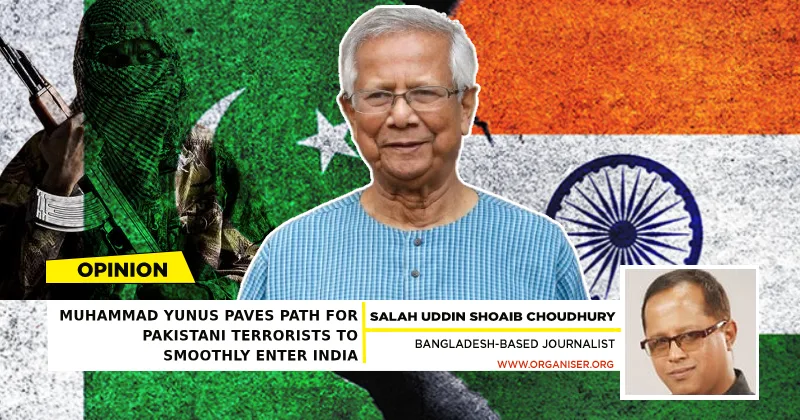
In a move that has sparked alarm across South Asia, Bangladesh, under the leadership of Muhammad Yunus, has dismantled critical safeguards designed to protect the region from terrorism and organised crime. By abruptly withdrawing mandatory security clearance for Pakistani nationals and exempting Pakistani cargo from customs inspections, the Yunus regime has created an open gateway for threats to infiltrate the subcontinent. This controversial policy shift not only undermines Bangladesh’s own security but also paves the way for Pakistani terrorists, smugglers, and narco-lords to target neighbouring India, raising serious concerns about regional stability and global security.
Pakistan has long been branded globally as a “terror-patron nation”, with many countries outright banning the issuance of visas to its nationals due to security concerns. In stark contrast, Bangladesh, under the current regime of Muhammad Yunus and his team of Islamists, jihadists, caliphate-mongers and religious bigots, appear to be dismantling safeguards that previously curtailed potential threats from Pakistan. This regime, criticised for its Islamist, jihadist, and caliphate-driven ideology, has exhibited an overtly anti-India, anti-Hindu, and pro-Pakistan stance. A glaring example of this is the abrupt withdrawal of mandatory security clearance for Pakistani citizens seeking Bangladeshi visas, effective from December 2, 2024.
The dangerous policy shift
A classified communique from Bangladesh’s Ministry of Foreign Affairs (MOFA) reveals that the Head of Chancery at the Bangladesh High Commission in Pakistan, along with other Bangladeshi missions, has been directed by the Security Services Division (SSD) of the Ministry of Home Affairs to end the provision requiring security clearance for Pakistani citizens or individuals of Pakistani origin. This directive overturns a policy enacted on February 19, 2019, that mandated security clearance to mitigate potential threats.
This development comes amidst a backdrop where nations like the United Arab Emirates and Kuwait have implemented or maintained strict visa restrictions on Pakistanis, citing security concerns. Saudi Arabia, too, has regularly deported Pakistani nationals over allegations of criminal activities. By contrast, the Yunus administration seems to be inviting risk by relaxing such measures.
Customs exemptions and increased risk
On September 29, 2024, the Yunus regime issued a gazette notification instructing customs authorities to exclude shipments from Pakistan from mandatory inspection under the “National Selectivity Criteria”. This decision effectively allows goods arriving from Pakistan to bypass thorough customs checks, creating a glaring loophole that could be exploited by Pakistani terrorists, smugglers, and organised crime networks.
This dual policy shift – removing security clearance requirements and customs inspection for Pakistani cargo – has far-reaching implications. It opens the floodgates for members of Pakistani terrorist organisations such as Lashkar-e-Taiba (LeT), Sipah e Sahaba Pakistan, Lashkar-e-Jhangvi, Tehreen-e-Jaferia Pakistan, Tehreek e Taliban Pakistan (TTP), Hizb Ul Mujahedin, Harkat Ul Ansar, Ansar Ul Islam, Tehrik-e-Jihad-e-Islam, Al Qaeda, ISIS, Hizb Ut Tahrir, Hizb Ul Ahrar, Islamic Jihad Union, Haqqani Network and other terrorist groups to enter Bangladesh undetected. These groups, already linked to global terror networks, now have an easier path to infiltrate India through its porous borders with Bangladesh.
Additionally, Pakistani terrorist groups, narco-lords such as Dawood Ibrahim’s D-Company and Pakistani spy agency Inter-Service Intelligence (ISI) shall onwards avail opportunity of the lifting of mandatory provisions of customs inspection for any cargoes arriving from Pakistan, in sending weapons, explosives, narcotics (including opium, processed opium and cocaine) as well as counterfeit Indian currency, which are produced at ISI-controlled sophisticated security printing facilities in Pakistan’s frontier areas.
Facilitating terrorism and smuggling
The implications of these policy changes extend beyond Bangladesh. Once inside the country, Pakistani terrorists can seamlessly cross into India, exploiting weak border security measures. This poses a significant threat to India’s national security. Such operatives could:
Establish training bases: Using Nepal’s mountainous regions as a haven, Pakistani terrorists could train recruits from India’s northeastern states and West Bengal, bolstering insurgency movements within the country. Al-Qaeda’s previous establishment of training camps in Nepal exemplifies this risk.
Undermine India’s image: Terrorists entering India via Bangladesh could acquire Indian Aadhaar cards and passports, allowing them to carry out attacks abroad. In the event of such incidents, India would face blame, tarnishing its international reputation.
Support insurgency movements: Pakistani operatives could strengthen ties with insurgent and separatist groups within India, orchestrating deadly attacks, including suicide bombings.
Simultaneously, the customs exemption granted to Pakistani cargo opens avenues for smuggling weapons, explosives, counterfeit currency, and narcotics. Pakistani intelligence agency ISI has a long history of producing counterfeit Indian currency, often used to fund terror activities. The unchecked flow of goods from Pakistan raises the spectre of such contraband flooding India.
The narcotics threat
The removal of customs checks also facilitates the trafficking of narcotics. Organized crime syndicates, including Dawood Ibrahim’s D-Company, could exploit this policy to smuggle drugs like heroin, cocaine, and synthetic opioids into India. These narcotics would then find their way to Indian youth, exacerbating the drug abuse crisis and destabilizing communities.
Furthermore, smuggled drugs could be rerouted to Western nations through Indian networks. If these consignments are intercepted, it would implicate India, damaging its credibility and trade relationships. A surge in drug trafficking cases could also lead to stricter scrutiny of Indian exports, potentially harming the country’s economy.
Strategic implications for India
The implications of the Yunus regime’s policies are dire for India on multiple fronts:
National security: The unregulated movement of terrorists and contraband into India jeopardises its internal security. Insurgent activities could intensify, destabilising sensitive regions.
Economic consequences: The proliferation of counterfeit currency and narcotics could disrupt India’s financial and social stability.
Diplomatic Repercussions: If terrorists or contraband originating from Bangladesh are linked to incidents abroad, India risks being unfairly blamed. This would strain its relations with global partners and undermine its international standing.
A calculated strategy?
The actions of the Muhammad Yunus regime seem to align with Pakistan’s strategic objectives of destabilising India. By facilitating the unchecked entry of terrorists and illicit goods, Bangladesh under Yunus effectively becomes a conduit for Pakistan’s proxy war against India. The calculated removal of security and customs checks serves not only to embolden Pakistani networks but also to erode India’s regional dominance and global reputation.
The withdrawal of security clearance requirements and customs checks for Pakistan-origin entities by Bangladesh is a move fraught with peril. It provides a pathway for terrorists, smugglers, and organised crime syndicates to exploit the region, posing an unprecedented threat to India’s national security and global image. In the face of these developments, India must bolster its border security, enhance intelligence-sharing mechanisms, and engage diplomatically to counteract these risks. The actions of the Muhammad Yunus regime warrant close scrutiny, as they have the potential to destabilise the entire region and embolden forces intent on undermining peace and security.
The policy changes implemented by the Muhammad Yunus regime pose a grave threat not only to India but to the broader region’s stability. By dismantling safeguards against the infiltration of terrorists and the unchecked flow of contraband, Bangladesh risks becoming a conduit for Pakistan’s long-standing strategy of destabilising its neighbours. The consequences – ranging from heightened security threats to tarnished global reputations – are dire and demand immediate attention from both regional and international stakeholders.
India, as the primary target of these policies, must respond with heightened vigilance. Strengthening border security, enhancing intelligence-sharing networks, and leveraging diplomatic channels to address the risks posed by these developments are essential. The international community, too, must scrutinise the actions of the Yunus regime, recognising their potential to fuel terrorism and organised crime. Only through collective action can these escalating threats be mitigated, ensuring peace and security in a region already fraught with challenges.