The recent violence in Sambhal, Uttar Pradesh, has reignited discussions about the region’s troubled past and the controversial handling of its history by platforms like Wikipedia. Sambhal’s violent history, especially targeting its Hindu community, has long been a subject of anguish for survivors and their families. Yet, the narrative surrounding recent incidents is being systematically altered to fit a specific agenda, obscuring the truth of these events.
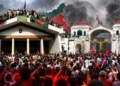
On November 24, the local administration, acting on court orders, began surveying a disputed property in Sambhal. By 9:30 AM, masked rioters were caught on police-recovered footage, dismantling surveillance equipment and stockpiling bricks and stones. This pre-planned aggression escalated into violent stone-pelting, targeting security forces.
Contrary to claims now echoed on Wikipedia, slogans of “Jai Shri Ram” were not raised until after 11 AM, long after advocate Vishnu Jain and other officials had left the premises. This timeline, supported by multiple media reports and video evidence, directly contradicts Wikipedia’s narrative that these slogans “provoked” the violence. The evidence points not to provocation but to a well-orchestrated attack.
The Forgotten Pogrom of 1978
A pogrom erupted, leaving 23 Hindus dead, 14 of whom were burnt alive in a mill owned by Banwari Lal Goel, a respected community leader and president of the Vishva Hindu Parishad (VHP) in the area. This incident remains one of the most gruesome examples of communal violence in independent India—a tragedy shrouded in the fog of time, forgotten by mainstream narratives and justice alike.
The massacre was triggered by an incendiary mix of rumors and pre-existing communal tensions. Reports suggest that false claims about a Hindu killing an imam and a sadhu performing puja near the disputed mosque in Sambhal fanned the flames of violence. The role of Muslim League leader Manzar Shafi’s followers in orchestrating the unrest has also been highlighted, as they allegedly unleashed terror across the town.
At the heart of the violence was Banwari Lal Goel’s mill, an ahaata spread over four beeghas in the bustling Nakhasa Bazaar. Known for his fairness and integrity, Goel was a well-respected figure in Sambhal, sought out by families across communities for conflict resolution. Despite his stature, the mill became the target of mob aggression, a harrowing episode that annihilated an entire group of innocents who sought refuge within its compound.
Violence erupted in Sambhal around 10 a.m., and within two hours, the mob turned its fury toward the mill. People, including Banwari Lal’s workers and their families, had sought safety within the compound, hoping that Goel’s reputation would shield them from harm. Tragically, their faith was misplaced.
The rioters, armed and determined, used a tractor to repeatedly ram into the mill’s front wall until it collapsed. They then set the mill ablaze by throwing burning tyres inside. Escape routes were blocked, ensuring no one could survive the inferno.
By the end of the attack, 14 Hindus were burnt alive in the mill, their bodies consumed entirely by the flames. The rest of the town witnessed widespread arson and killings, culminating in an official death toll of 25, of which 23 were Hindus.
Banwari Lal’s sons, Navneet (18) and Vineet (16), arrived at the mill compound six hours later. What awaited them was a scene of utter devastation. The mill had been reduced to ashes, with no identifiable remains of the victims. The only piece of evidence confirming Banwari Lal’s death was a part of his glasses found amidst the rubble.
One survivor, Hardwari Lal, had hidden inside a drum and watched the massacre through a small hole. His testimony provided critical details about the attack and helped identify the victims.
The Goel family, left devastated by the loss of their patriarch and their livelihood, faced penury. The brothers—Navneet, Vineet, and their youngest sibling Suneet—had to rebuild their lives from scratch. Despite receiving support from the Hindu community in Sambhal, they eventually moved to Delhi in 1993.
In the wake of the tragedy, local Muslims silently disclosed the names of the perpetrators to the Goel family. Shockingly, it was revealed that the attackers included Banwari Lal’s business associates, people he had trusted. This betrayal left an indelible mark on the family, which severed all future business ties with members of the other community.
Vineet Goel, now a peppermint producer in Delhi, reflects on the loss with anguish. He recalls the complicity of the then District Magistrate Farhat Ali, who is accused of siding with the rioters and failing to protect the Hindu community.
The family sold most of the mill property but retained a small portion that has since become a site for major Hindu religious events, including the Ram-Bharat Milaap episode of the annual Ramlila. This space serves as a symbol of resilience and remembrance, with the local Hindu community ensuring its traditions continue unabated.
Despite the gravity of the incident, there appears to be no record of a court trial. Historical accounts, including those in books like Mob Violence in India, document the massacre, but international media outlets like BBC and New York Times did not report on it at the time. The absence of sustained legal action or media attention reflects a broader systemic failure to address communal violence in India.
Wikipedia’s role in erasing history
Wikipedia, known as a repository of “free knowledge,” has described the Sambhal violence in a manner that shifts blame to Hindu groups, citing unverified claims that slogans were raised to “irritate Muslims.” This narrative not only ignores video evidence but also omits key facts about the premeditation evident in the rioters’ actions. The site’s editorial process appears to have selectively favored narratives that align with a particular ideological slant, rather than reflecting verified accounts.
Such distortions are not new for Wikipedia. The platform has long faced criticism for its bias, particularly against Hindu and Indian interests. On November 5, the Modi government formally issued a notice to Wikipedia, pointing out its biased and inaccurate coverage of Indian events. The Ministry of Information and Broadcasting (I&B) has raised concerns about Wikipedia functioning as a publisher rather than an intermediary—a claim that has far-reaching legal implications.
The deliberate distortion of Sambhal’s violent history on Wikipedia adds another layer of injustice. While Wikipedia claims to be a neutral repository of information, research by institutions like the Manhattan Institute has revealed its pronounced Left-leaning bias. This bias, reinforced by a small group of editors with unchecked power, has enabled the platform to selectively present facts that align with its ideological stance.
Recognising the danger of such distortions, the Modi government recently issued a notice to Wikipedia, questioning its role as an intermediary and highlighting numerous inaccuracies in its content. Media exposed Wikipedia’s systemic biases, including its financial ties to organizations with anti-India and anti-Hindu agendas.
The dossier revealed startling facts:
- Centralised Control: Only 435 active administrators globally wield disproportionate power over Wikipedia’s content.
- Ideological Funding: Donations from entities like the Tides Foundation and George Soros enable Wikipedia to support organizations with anti-India leanings, including groups linked to Khalistani and Islamist elements.
- Legal Evasion: Despite soliciting and spending millions in India, Wikimedia Foundation refuses to comply with Indian laws, shielding itself under the guise of being a foreign entity.
The financial practices of the Wikimedia Foundation add another layer of concern. While the platform constantly solicits donations under the pretense of keeping “knowledge free,” it has amassed enough resources to sustain operations for decades without further contributions. Instead of being reinvested into the platform, much of this money is directed toward grants and projects that align with Leftist ideologies.
Entities like the Tides Foundation, which donates to Wikimedia, also fund anti-India organizations such as Hindus for Human Rights (HfHR) and the Association for India’s Development (AID). These groups have supported Naxalite sympathisers, Khalistani activists, and other elements hostile to India’s sovereignty.
Wikimedia Foundation’s actions in India exemplify its disregard for Indian laws. Despite raising millions of dollars in donations from Indian citizens and spending extensively within the country, Wikimedia refuses to establish a legal presence in India. This allows the organization to sidestep Indian regulations, claiming immunity as a foreign entity.
The platform’s selective editorial practices further compound the problem. For instance, during the Citizenship Amendment Act (CAA) protests, Wikimedia-funded organizations such as Arts+Feminism spread false narratives that inflamed tensions, leading to violence in multiple cities.