Truth Behind Sambhal: Kalki Hari Har Mandir and the Shahi Jama Masjid controversy
September 14, 2026
  • Read Ecopy
  • Circulation
  • Advertise
  • Careers
  • About Us
  • Contact Us
Android AppiPhone AppArattai
Organiser
  • ‌
  • Bharat
    • Assam
    • Bihar
    • Chhattisgarh
    • Jharkhand
    • Maharashtra
    • View All States
  • World
    • Asia
    • Europe
    • North America
    • South America
    • Africa
    • Australia
  • Editorial
  • International
  • Opinion
  • RSS @ 100
  • More
    • World Hindu Congress 2026
    • Op Sindoor
    • Analysis
    • Sports
    • Defence
    • Politics
    • Business
    • Economy
    • Culture
    • Special Report
    • Sci & Tech
    • Entertainment
    • G20
    • Azadi Ka Amrit Mahotsav
    • Vocal4Local
    • Web Stories
    • Education
    • Employment
    • Books
    • Interviews
    • Travel
    • Law
    • Health
    • Obituary
  • Subscribe
    • Subscribe Print Edition
    • Subscribe Ecopy
    • Read Ecopy
  • ‌
  • Bharat
    • Assam
    • Bihar
    • Chhattisgarh
    • Jharkhand
    • Maharashtra
    • View All States
  • World
    • Asia
    • Europe
    • North America
    • South America
    • Africa
    • Australia
  • Editorial
  • International
  • Opinion
  • RSS @ 100
  • More
    • World Hindu Congress 2026
    • Op Sindoor
    • Analysis
    • Sports
    • Defence
    • Politics
    • Business
    • Economy
    • Culture
    • Special Report
    • Sci & Tech
    • Entertainment
    • G20
    • Azadi Ka Amrit Mahotsav
    • Vocal4Local
    • Web Stories
    • Education
    • Employment
    • Books
    • Interviews
    • Travel
    • Law
    • Health
    • Obituary
  • Subscribe
    • Subscribe Print Edition
    • Subscribe Ecopy
    • Read Ecopy
Organiser
  • Home
  • Bharat
  • World
  • Operation Sindoor
  • Editorial
  • Analysis
  • Opinion
  • Culture
  • Defence
  • International Edition
  • RSS @ 100
  • Magazine
  • Read Ecopy
Home Bharat

Truth Behind Sambhal: Kalki Hari Har Mandir and the Shahi Jama Masjid controversy

Sambhal, a town in Uttar Pradesh, has become the centre of a heated debate over its historical and religious significance. While some claim it was a mosque built by Babur, evidence points to its origins as a Hindu Mandir, raising critical questions about cultural heritage and religious identity

WEBDESKWEBDESK
Nov 28, 2024, 11:30 am IST
inBharat, Uttar Pradesh
Follow on Google News
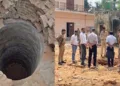
Representative image

Representative image

Facebook
Twitter
WhatsAppTelegramEmail

Sambhal, a town in the Moradabad district of Uttar Pradesh, has recently become a point of contention in India’s ongoing debate over religious history and cultural heritage. While some Muslims and liberals assert that the Sambhal Masjid was built by the Mughal emperor Babur in the 16th century, historical and archaeological evidence contradicts this claim. The story of Sambhal is much older and richer than what has been portrayed in recent times, and the dispute over the mosque’s origins raises significant questions about the preservation of historical sites, religious identity, and the erasure of indigenous cultural landmarks.

The Claim: Babur’s Masjid

The most common claim regarding the Sambhal Masjid is that it was constructed by Babur, the founder of the Mughal Empire, in the early 1500s. This claim is often cited by those who argue that the mosque should be protected under the Places of Worship Act, 1991, which prohibits the conversion of any place of worship from one religion to another.

However, upon closer examination, this assertion falls apart. The Masjid’s history does not align with the traditional narrative of Babur’s architectural ventures. In fact, there is no credible evidence in pre-colonial literature or from Babur’s own writings, the Baburnama, that even mentions a mosque in Sambhal. Furthermore, the town of Sambhal was not known for any significant Islamic structures until much later, making the claim that Babur built the Masjid highly dubious.

Mahabharata and Skanda Purana: Religious significance of Sambhal

To understand the true importance of Sambhal, it is crucial to look at its deep roots in Hindu religious tradition. Sambhal is often linked to the prophecy of Vishnu’s future incarnation as Kalki, the final avatar of the god, who will appear in the future to destroy evil and restore righteousness. This prophecy is recorded in texts like the Mahabharata (3.189) and the Skanda Purana, which identify Sambhal as the place where Kalki will be born.
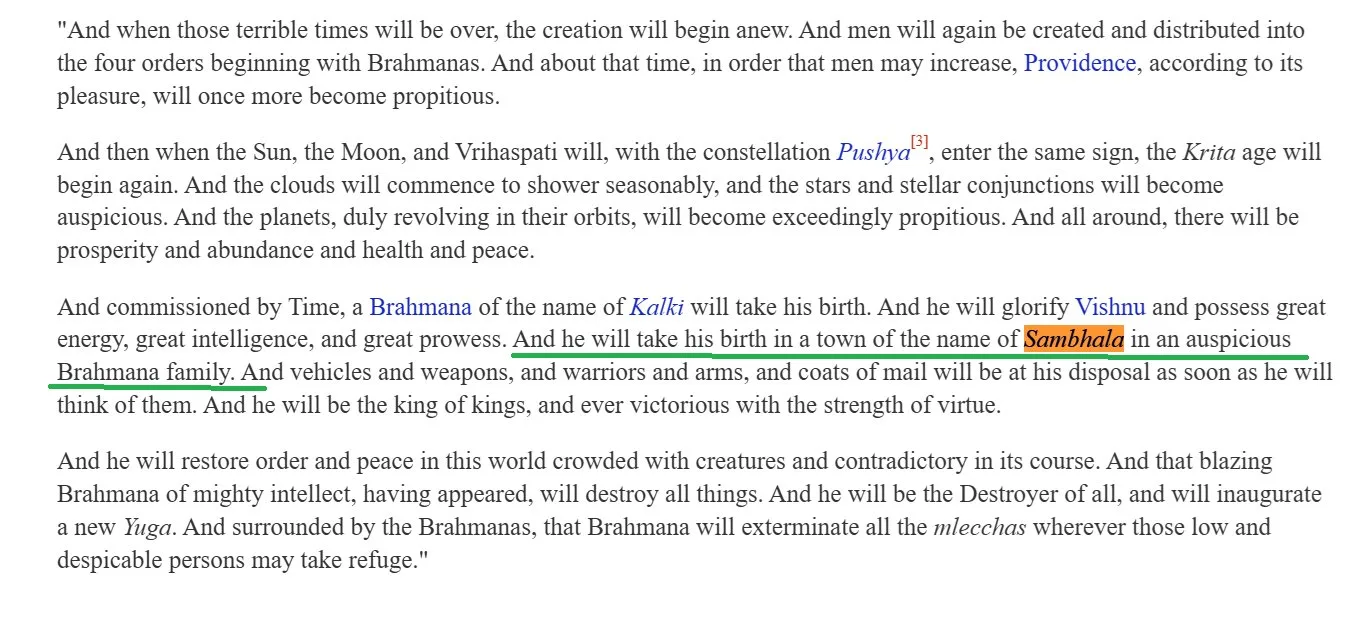
Such references underscore the profound religious significance of Sambhal for Hindus, placing it on par with other revered sites such as Ayodhya and Mathura. The fact that the town held such importance for Hindus for centuries, long before the rise of Mughal rule, casts doubt on the claims of the Masjid’s antiquity.

Abul Fazl and the Evidence of a Mandir

The 16th-century historian Abul Fazl, a chronicler of Emperor Akbar’s reign, provides a crucial account of Sambhal in his Ain-i-Akbari. While he does mention the town and its landmarks, he makes no reference to a Masjid built by Babur or any other Islamic structure in the area. Instead, he notes the presence of a Hindu Vishnu Mandir in Sambhal, clearly indicating that the region retained its Hindu religious character even in the Mughal period.
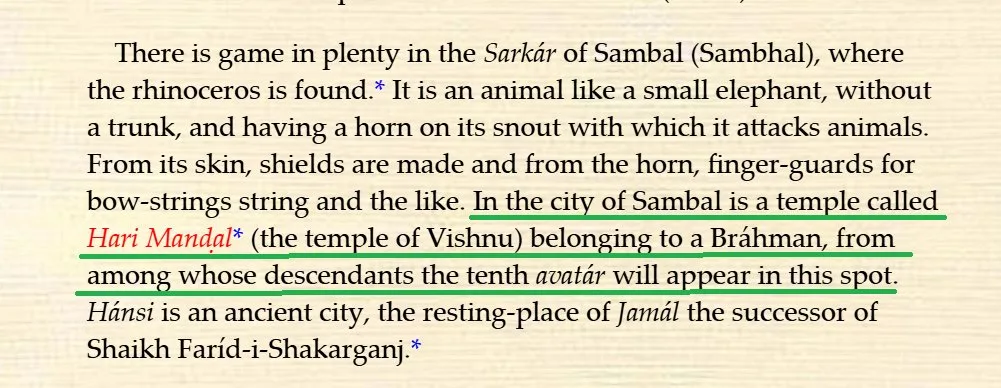
Abul Fazl’s description offers an important glimpse into the religious landscape of Sambhal during the Mughal era, revealing that, at the time, the town was still home to a thriving Hindu community and a significant Vishnu Mandir. There is no mention of any Masjid or Islamic religious structure, further weakening the argument that Babur had built a Masjid there.

Archaeological Survey: Revealing the truth

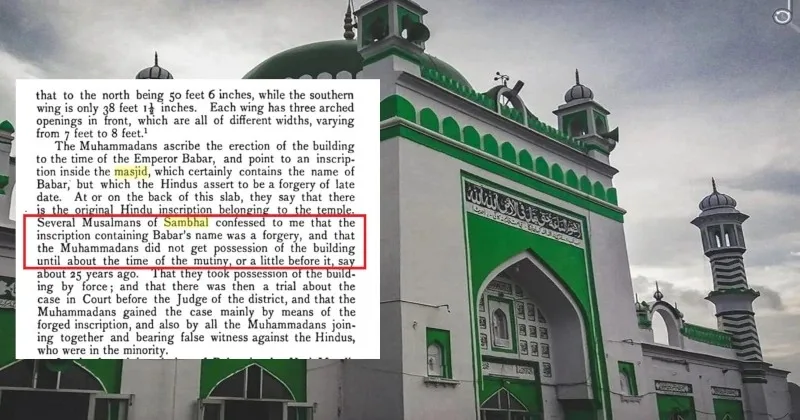
In the late 19th century, an important archaeological survey conducted by Campbell Carlyle, an English archaeologist active in India, provided a thorough examination of the site. The findings from this survey were published by the Archaeological Survey of India (ASI) in 1879 and became a crucial source of historical information about Sambhal’s religious heritage.

According to Carlyle’s report, while the Jami Masjid in Sambhal was the most prominent building in the town, it was not built by Babur, as claimed by Muslims. Carlyle found that the so-called Babur inscription, which supposedly identified the mosque as Babur’s construction, was a fabrication. Multiple Muslim sources admitted that the inscription was a forgery and the mosque was actually built on the site of an older Hindu Mandir.

Carlyle’s research also revealed that the mosque had been extensively remodelled, with Hindu sculptures and architectural elements hidden under layers of plaster. Some of these Hindu elements were still visible where the plaster had broken, including fluted pillars that could have originated from a Hindu Mandir dedicated to deities such as Krishna. Carlyle noted that the Masjid’s structure had been significantly altered, with many of the original materials stripped away, leaving the building in a much poorer condition than it would have been in its original form as a Hindu Mandir.

Theft and Legal Struggles: Hindus fight for their heritage

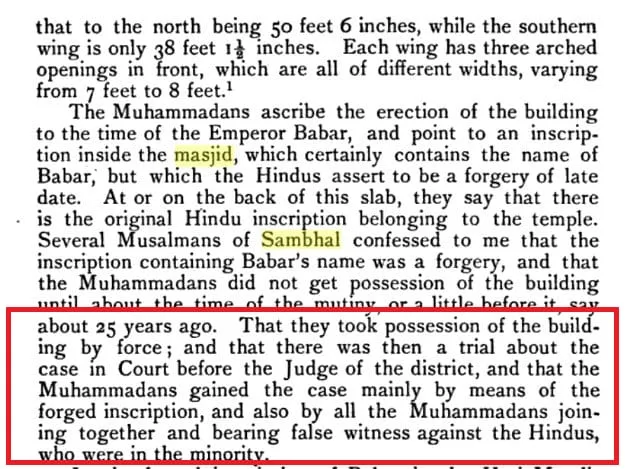
Historical records and archaeological evidence suggest that the Sambhal mosque was not always a Masjid. Rather, it was originally a Hindu Mandir, built likely during the reign of the Rajput king Prithviraj Chauhan. The building was later repurposed for Muslim worship, and its conversion was accompanied by fraud, including the creation of a forged inscription falsely attributing its construction to Babur.
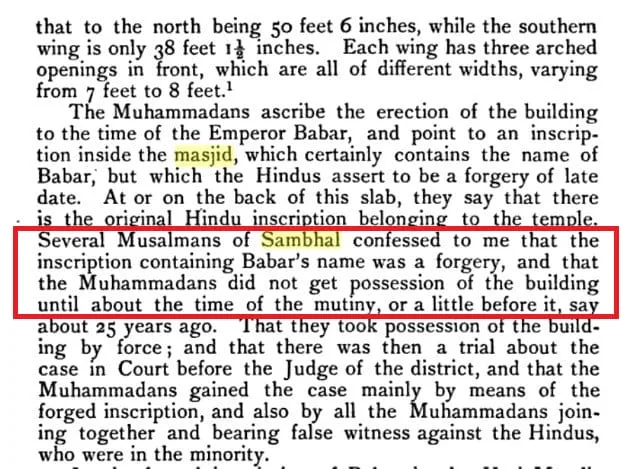
In the 19th century, Hindus sought to reclaim the site, filing legal cases to return the Mandir to its original custodians. However, Muslims won the legal battles by presenting false testimony, capitalising on the fact that the Hindu population in Sambhal was a minority.
Global Significance of Sambhal
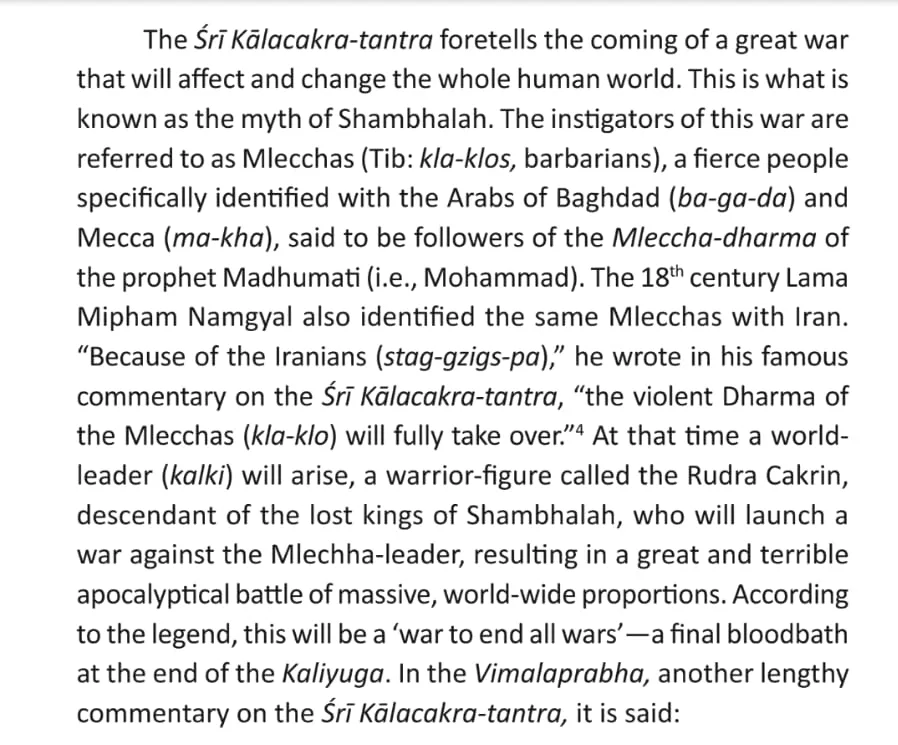
Sambhal’s historical importance extends beyond India’s borders, with references to the town found in Mahayana and Vajrayana Buddhist texts, particularly the Kalachakra Tantra. These texts predict the coming of the Kalki avatar, who will arise from the mythical land of Shambhala (often identified with Sambhal). The town was believed to be so significant that even the emperor of China sent an embassy to the Delhi Sultanate in the 14th century, asking for permission to rebuild the idol Mandirs that had been destroyed by Muhammad bin Tughlaq. However, Tughlaq rejected the request, citing his religious obligations as a Muslim and demanding that the Chinese emperor pay jizya instead.

 

Topics: SambhalShahi Jama MasjidSambhal ControversyKalki MandirBabur’s MasjidArchaeological evidenceUttar Pradesh
Share3
Tweet
SendShareSend
✮ Subscribe Organiser YouTube Channel. ✮
✮ Join Organiser's WhatsApp channel for Nationalist views beyond the news. ✮
Previous News

US Embassy warns its citizens of imminent threats in Pakistan’s Khyber Pakhtunkhwa; Serena hotel under security alert

Next News

Human Trafficking Case: NIA raids 22 locations across 6 states

Related News

Sambhal Land Dispute: Rs 50 crore row takes major turn as SDM court orders restoration of Arya Samaj Temple

An ancient well found beneath the demolished Saharanpur mosque has revived questions over whether a Hindu temple once stood at the site

Was a Hindu Mandir once standing here? ASI probes ancient well beneath demolished Saharanpur mosque

UP Cabinet has cleared Rs 5,507 crore investment for 11 industrial units across nine districts

Uttar Pradesh Cabinet clears Rs 5,507 crore investment in single day for 11 industrial units across nine districts

Prakriti Gyan Dham: A Living Classroom of Indian Botanical Legacy

Prakriti Gyan Dham: Where Indian heritage meets modern plant science

UP CM Yogi Adityanath

“No one could erase Sanatan Dharma”: Uttar Pradesh CM Yogi Adityanath celebrates Janmashtami in Mathura

Uttar Pradesh launches UPCOS to strengthen transparency, security and opportunities for outsourced workers

UPCOS: Building an organised, skilled, secure & dignified future for the outsourced workforce of Uttar Pradesh

Load More

Latest News

RSS Akhil Bharatiya Sah-Bauddhik Shikshan Pramukh Deepak Vispute addressing the gathering

‘Nation First’ should be the guiding principle for every individual, regardless of their Field: Deepak Vispute

‘India was not poor; it was made poor’: The truth re-emerges through Jema Ferrer’s perspective

Six years after talent manager Disha Salian was found dead, her father Satish Salian on September 11 recorded a detailed statement with the Central Bureau of Investigation (CBI), naming Shiv Sena (UBT) leader Aaditya Thackeray, actors Dino Morea and Sooraj Pancholi, and others.

Disha Salian Murder Case: Father names Aaditya Thackeray in CBI statement; Lawyer claims gang rape, murder cover-up

Release of a book at Vishwa Bandhutva Diwas programme that was organised in Ujjain

Bharat’s youth rooted in sacrifice, service & discipline can give new direction to World: Parag Abhyankar

AI Generated Representative Image

“Let Go” — But only when it suits you? Exposing the double standards of Kashmir’s political leadership

Bharatiya Kisan Sangh distributed free school uniforms, notebooks, pen bundles, bags to 7,000 students in flood-affected areas of Assam

Assam: Bharatiya Kisan Sangh distributes free school uniforms, notebooks & bags to 7,000 flood-affected students

Chinmoy Prabhu

When a Bengali Hindu suffers in Bangladesh, where does ‘Bangali-Prem’ go?

AI Generated Representative Image

BRICS Summit: Not de-dollarisation, but derisking from dollar; India scripts pragmatic shield against external shocks

RSS Sarsanghchalak Dr Mohan Bhagwat, attended the 37th annual prize distribution ceremony ‘Swaraj’ at L.K. Singhania Education Centre

Education must go beyond livelihood and focus on holistic human development: Dr Mohan Bhagwat

(Left) Prime Minister Narendra Modi and Russian President Vladimir Putin (Right) Prime Minister Narendra Modi and Chinese President Xi Jinping in the backdrop of the Rameshwaram temple corridor in the backdrop of the BRICS 2026 summit

Bharat’s civilisational pride at BRICS 2026: Rameswaram temple corridor frames world leaders

Load More
  • Privacy
  • Terms
  • Cookie Policy
  • Refund and Cancellation
  • Delivery and Shipping

© Bharat Prakashan (Delhi) Limited.
Tech-enabled by Ananthapuri Technologies

  • Home
  • Search Organiser
  • Bharat
    • Assam
    • Bihar
    • Chhattisgarh
    • Jharkhand
    • Maharashtra
    • View All States
  • World
    • Asia
    • Africa
    • North America
    • South America
    • Europe
    • Australia
  • Editorial
  • Operation Sindoor
  • Opinion
  • Analysis
  • Defence
  • Culture
  • Sports
  • Business
  • RSS @ 100
  • Entertainment
  • More ..
    • Sci & Tech
    • Vocal4Local
    • Special Report
    • Education
    • Employment
    • Books
    • Interviews
    • Travel
    • Health
    • Politics
    • Law
    • Economy
    • Obituary
  • Subscribe Magazine
  • Read Ecopy
  • Advertise
  • Circulation
  • Careers
  • About Us
  • Contact Us
  • Policies & Terms
    • Privacy Policy
    • Cookie Policy
    • Refund and Cancellation
    • Terms of Use

© Bharat Prakashan (Delhi) Limited.
Tech-enabled by Ananthapuri Technologies