





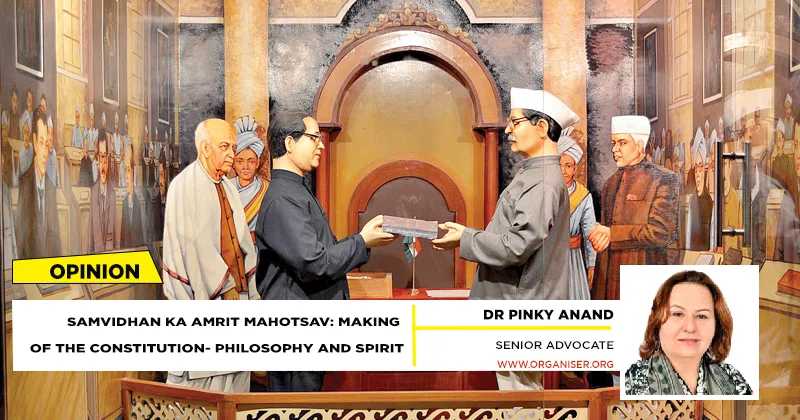
The Constitution of India is the mainstay of Democracy. First adopted on November 26, 1949, it came into effect on January 26, 1950. It is the lengthiest written Constitution in the world and took two years, 11 months and 18 days to be completely written.
The Constitution originally consisted of 395 Articles, but following multiple amendments the number has now increased to 470 Articles, 12 Schedules and 25 Parts. The amendments were the result of wide-ranging deliberations. The entire text is a testimony to India’s rich historical, cultural, and legal heritage and has been inspired from a multitude of sources and influences, both domestic and international. The Indian Constitution harmonises diverse elements into a cohesive whole, ranging from the Government of India Act, 1935, which laid the groundwork for the Federal structure and administrative machinery to the British Constitution, which provided the framework for Parliamentary democracy and the rule of law.
The scheme of the Constitution was not merely the product of a great number of sittings of Constituent Assembly. It can be said to be an offshoot of a long freedom struggle of the great freedom fighters, struggle for social justice for Dalits, led by Dr BR Ambedkar, and balancing the immediate disturbances arisen from the Partition of India on the ground of religion. The Constituent Assembly comprised members from diverse backgrounds in terms of region, religion, caste, language, social status, etc. to accommodate the varied opinions with the clear intention to protect India’s diversity and at the same time providing protection from inequality. The long history of Colonisation had shadowed the very pride of the people and the job of the Constituent Assembly was not only to eliminate the mental Colonisation but also to introduce appropriate short-term and long-term reforms which would fulfil the aforesaid purpose.
The philosophy and spirit of the Indian Constitution cannot be described in one word. It withstands any single label because it is liberal, democratic, egalitarian, and federal, open to community values
The Constituent Assembly utilised the references from the rich ancient past of India as well as from the experiences and struggles of other nations. The intention was to cull out the most effective and suitable approach of governance. Undoubtedly, the forefathers of the Constitution worked to bring out the best possible document in afore-mentioned circumstances, providing foundational principles and road for governance. Although the Constituent Assembly borrowed from the best of constitutions of different countries, the basic framework of the Indian Constitution was the Government of India Act, 1935. At the same time, the values which were at the core of India, were given importance to match this newly framed distinctive document with the socio-legal understanding of the people of India.
Majorly, the division of powers between the Centre and States, in the form of lists under Seventh Schedule, the concepts of States’ autonomy under the head of federalism and idea of Bi-cameralism were taken from the Government of India Act, 1935. The US Constitution contributed the principles of fundamental rights, independence of the judiciary, removal of judges, principles of judicial review, impeachment of the President, etc. Single Citizenship, Parliamentary form of government, principles of Rule of law, Legislative procedure, prerogative writs, etc. were taken from the British Constitution. Ideas of the Directive Principles of State Policy, Nomination of Rajya Sabha Members, etc. were taken from Irish Constitution. The ideals of justice i.e. social, economic and political justices in the Preamble and fundamental duties were brought from the Soviet Constitution. Apart from the above major resources; Australian, Weimar, French, Canadian, South African and Japanese Constitutions also played important roles in framing of the Indian constitution.
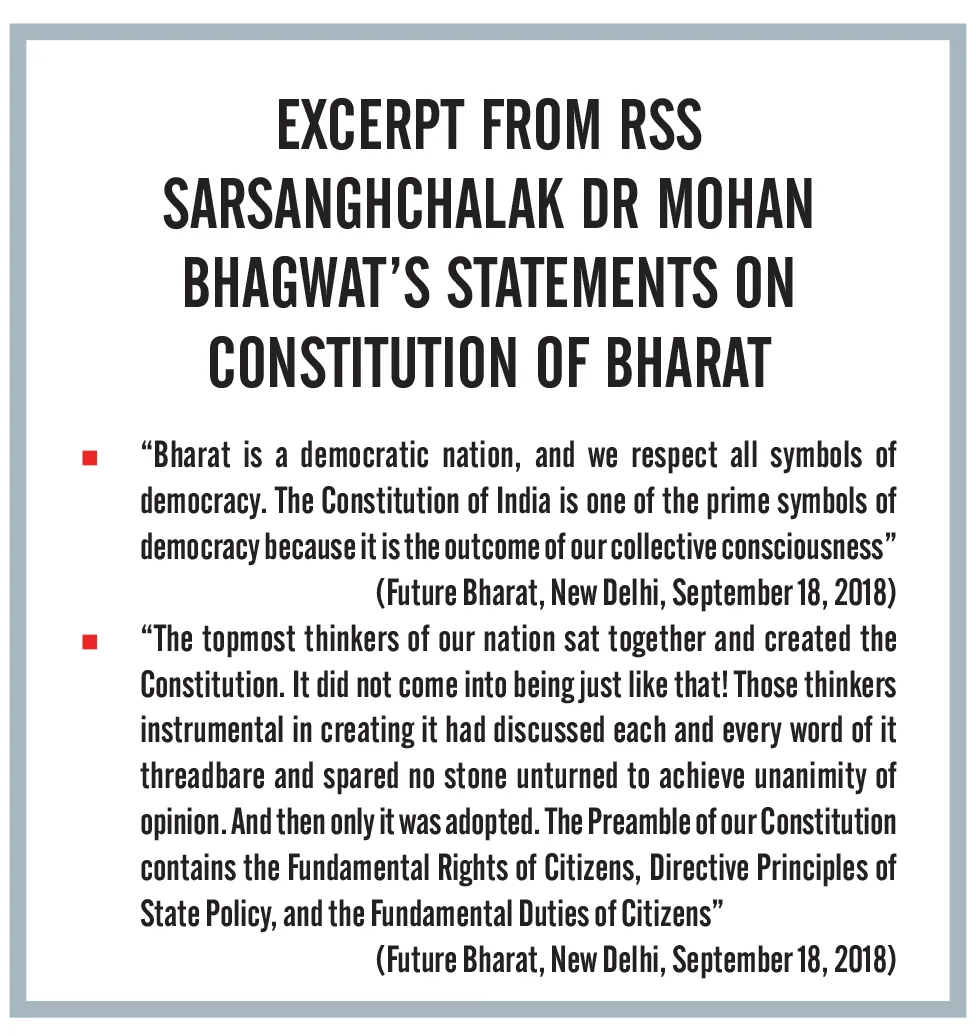
The Constitution also found inspiration from Mahatma Gandhi and Dr BR Ambedkar in view of their thoughts for development of India. Gandhi’s ideas of Gram Swarajya, decentralisation of powers, promotion for cottage industries, educational and economic interests of weaker sections/minorities, prohibition on slaughter of cows, prohibition on intoxicating drinks and drugs were introduced in the Constitution. In fact, most of the Gandhian philosophies find their place in Directive Principles of State Policy. Dr Ambedkar, apart from being the architect of Indian Constitution, was also an advocate of social justice, fundamental rights; promoter of women rights and uniform civil code. The role of Dr Ambedkar is unforgettable in accommodating principles of reservations for the socially-weaker sections of the society in the Constitution.
While framing the Constitution, different committees were framed with specific purposes. Sardar Vallabh Bhai Patel, Pandit Jawaharlal Nehru, Dr Rajendra Prasad and Dr Ambedkar presided over such Committees to ensure incorporation of all significant aspects of governance.
The Constituent Assembly had also received significant involvement of, and contributions by the women. Ammu Swaminathan, Sarojini Naidu, Sucheta Kripalani, Pandit Vijayalakshmi, Rajkumari Amrit Kaur, Leela Roy, Dakshayani Velayudhan, Begum Aizaz Rasul, Durgabai Deshmukh, Kamla Chaudhary, etc., being the members of Constituent Assembly, had played an important role in framing of the Constitution.
Dr Ambedkar also embedded some caution in implementation of the Indian Constitution. The wisdom of Dr Ambedkar is reflected in one of his speeches where he highlighted the role of the citizens in working of Constitution:
“…however good a Constitution may be, it is sure to turn out bad because those who are called to work it, happen to be a bad lot. However bad a Constitution may be, it may turn out to be good if those who are called to work it, happen to be a good lot.
…The Constitution can provide only the organs of State such as the Legislature, the Executive and the Judiciary. The factors on which the working of those organs of the State depends are the people and the political parties they will set up as their instruments to carry out their wishes and their politics.”
The philosophy and spirit of the Indian Constitution cannot be described in one word. It withstands any single label because it is liberal, democratic, egalitarian, and federal, open to community values, sensitive to the needs of religious and linguistic minorities as well as historically disadvantaged groups, and its commitment to building a common national identity. It is committed to freedom, equality, social justice, and national unity. But underneath all this, there is a clear emphasis on peaceful and democratic measures for putting this philosophy into practice.
The window into the philosophy and spirit of the Indian Constitution is its Preamble. The Preamble to Constitution of India is not just 63 words which are set out perfectly and listed in regulating sentences. Above all, the Indian Constitution is all about the democratic aspirations and ideals of its people [IC Golaknath & Ors. Vs State of Punjab & Anr., 1967 SCR 2]. It is pertinent to note that the Preamble to Constitution of India does not subscribe to the ideology and philosophy practised by one section of the society, even if that section happens to be in a majority.
The Drafting Committee of the Constitution of India deliberately intended the Preamble to lay down and define the important features of new India and to ensure that that the socio-political objectives are clearly reflected. Hence, a cursory reading of the Preamble makes it evident that the ultimate and conclusive objective of the framers of the Constitution of India was to give birth to an introduction to the Constitution which reflects the possible and definitive ideals of a Welfare State and an egalitarian society. By necessary implication, the text of the Preamble had to include in itself the aims and aspirations of the people of India. The Preamble reflects the core constitutional values that embody the Constitution. It declares India to be a Sovereign, [Socialist, Secular] , Democratic Republic committed to Justice, Equality and Liberty for the people.
















Comments