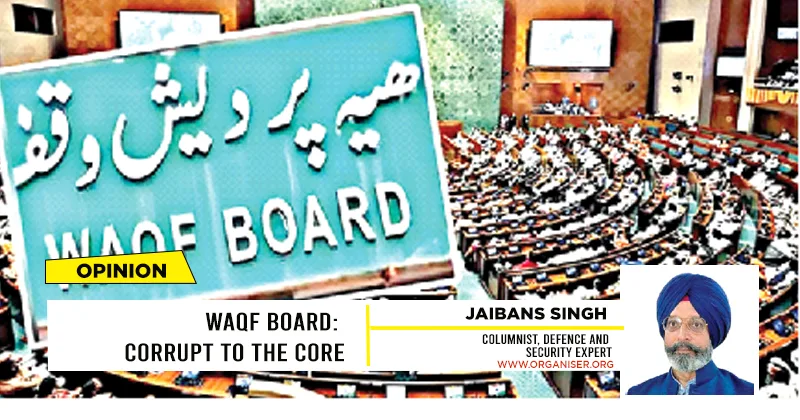
Waqf is a Muslim donor as per Islamic Hadith (directive), a person who makes an endowment of property for utility in religious and charitable causes as per Islamic law. The donation may be immovable property (building, land etc.) or moveable property (fixed deposits and shares etc.). Once donated, the asset becomes the property of Allah (SWT), and, as such, it cannot be claimed by any human being. Its usage is defined by Islamic law (Sharia). It is, therefore, held in trust by a Mutawalli (trustee) or a charitable trust that manages it in exchange for a share of the revenue generated.
The Waqf Law in the Indian subcontinent was formulated in 1913, during British rule. The British, at that stage, controlled the remnants of the Ottoman Empire and Palestine among other Muslim dominant areas. Since this Islamic practice was prevalent there, it was introduced in India too. The initial dispensation was quite negligible in nature.
Cong Empowers Waqf Boards
The Indian version of the Waqf law was introduced by the Congress Government in the form of the “United Waqf Management, Empowerment, Efficiency and Development Act, 1995.” It gives sweeping and draconian powers to the Waqf Boards, wherein, the board can take over any property without any intimation to the person who holds/resides on the same. It is so because the Waqf Act, in direct contravention to the Limitation Act of 1963, is not subject to the statute of limitations. The second draconian provision is that if a person wishes to contest the takeover, the only recourse is to approach the Waqf Tribunal. Strangely, in a pluralistic democratic country like India, Section 83 of the Waqf Act of 1995 mandates that the Waqf Tribunal will comprise only of Muslims and will be governed by Sharia law.
The monitoring of the Government was instituted in the form of a Central Waqf Council, a statutory body operated by the Government of India under the Ministry of Minority Affairs. Waqf Boards were instituted at the State level with the organisation going down to districts and mandal’s in the form of Waqf Committees. Presently, there are about 30 Waqf Boards across the country in the States as well as Union Territories.
The Waqf Boards and committees have been enjoying unbridled power since the application of the Waqf Act of 1995, to the extent that the Waqf Boards are today the biggest landholders in India after the Ministry of Railways and the Ministry of Defence.
Claiming Properties Sans Documentation
Waqf Boards often claim properties without proper documentation. This undermines the rights of the property owners and leads to legal disputes while also creating a climate of fear, uncertainty and public unrest.
Some strange decisions have been implemented by Waqf Boards and those political establishments which play the Muslim card for political considerations. In December 2006, then Prime Minister of India, Dr. Manmohan Singh of the Congress party said, “Minorities, especially Muslims, must have the first claim on resources so that benefits of development reach them equitably.” Buoyed by this statement, the Congress State Government of Delhi transferred 123 prime properties in Delhi to the Waqf Board. There is official data available to substantiate that over 200 properties in Delhi, which are under the control of two different Central Government agencies, have been declared as Waqf properties. Further, in the national capital region, several Waqf properties meant for public welfare have been leased to private entities under non-transparent agreements.
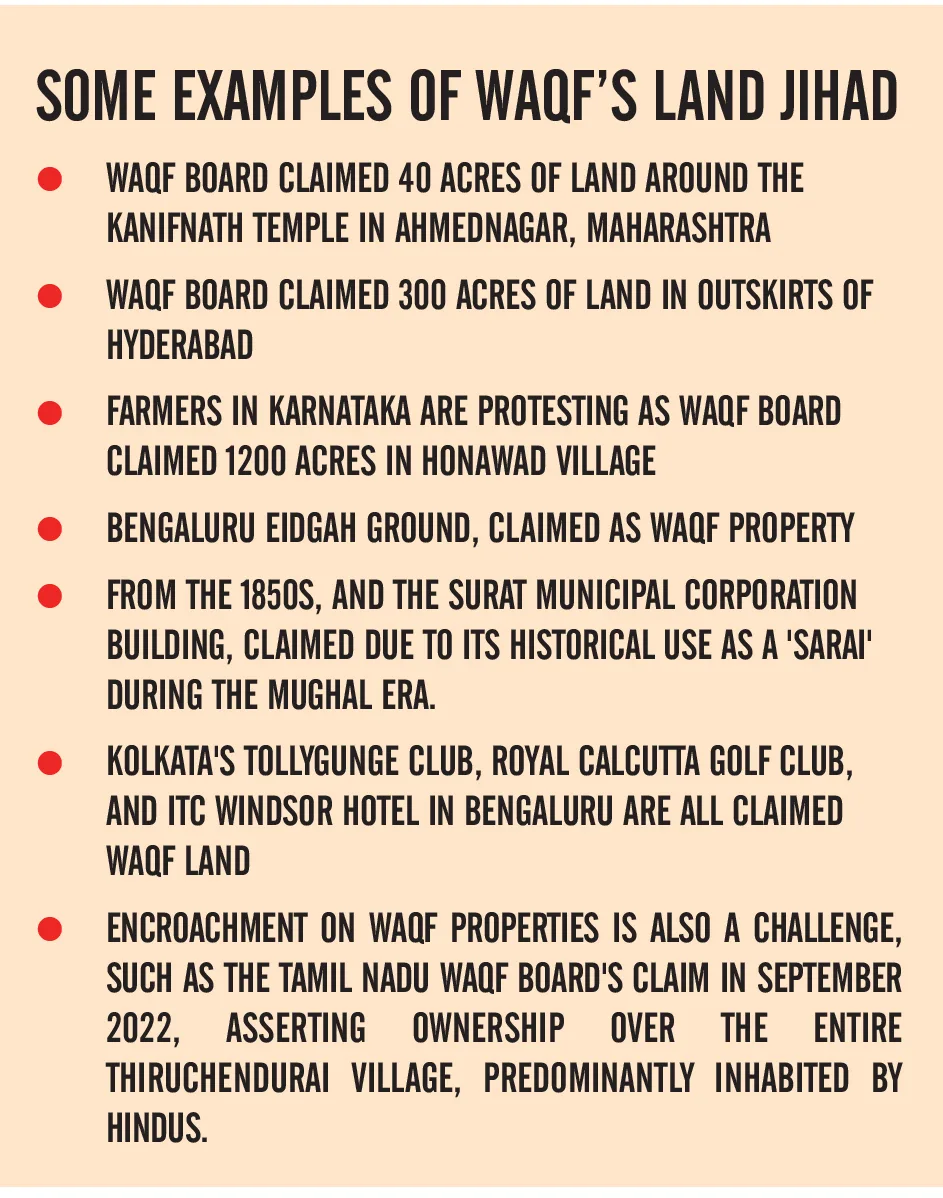
Recently, a Hindu village in Tiruchendurai, Tamil Nadu, which includes an over 1500-year-old Hindu temple, has been declared as Waqf property. The claim defies all logic since the temple has been in existence much before Islam came to the sub-continent. A similar seizure attempt has been reported in Bihar also.
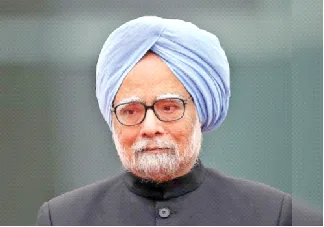
In 2006, then PM Manmohan Singh said, “Minorities, especially Muslims, must have the first claim on resources so that benefits of development reach them equitably.” Buoyed by this statement, Congress State Government of Delhi transferred 123 prime properties in Delhi to Waqf Board
The management of Waqf properties is marred by corruption at various levels. Properties meant for public welfare are being misused, sold, or leased under questionable circumstances. The absence of transparency and accountability has only exacerbated these issues.
This illegal sale of Waqf land and properties by corrupt Board members, mostly at undervalued rates, has created a complex land holding situation in various places. In some instances, normal land is surrounded by Waqf land making it impossible for the people to reside there due to logistics and other inconveniences. In other instances, the opposite is the case. Very clearly the Waqf concept in India is not standing up to the high ideals that it is meant to be. The poor, deprived and marginalised Muslims are not accruing the benefits that are due to them from such a huge resource. Instead, it had become a cesspool of corruption with Government officials receiving significant kickbacks. Naturally, there is gross mismanagement of funds and questionable accountability. Often the resource is leveraged by unscrupulous political entities to accrue huge political gains. There is a need to streamline the process and lay out a system of periodic review of Waqf properties by an independent source.
In today’s context, the objectives of the Waqf Act can be better achieved through modern, transparent and accountable institutions. The existence of separate Waqf Boards in their present form has become redundant, especially given their track record of inefficiency and corruption. It is with the objective of regulating the Waqf property in India and modernising the Waqf concept by making it more transparent, accountable and effective that the Waqf (Amendment) Bill, 2024 was introduced in Lok Sabha on August 8, 2024.
The Parliament has instituted a Joint Committee of Parliament on the Waqf (Amendment) Bill, 2024. The committee has invited views and suggestions from the public, NGOs, experts, stakeholders and institutions. The Lok Sabha Secretariat, in a press communique in this regard, said that those desirous of submitting written suggestions to the Committee can send two copies either in English or in Hindi to Joint Secretary (JM), Lok Sabha Secretariat, Room No. 440, Parliament House Annexe, New Delhi- 110001 and also email to [email protected]. In consideration of the great significance of this bill, all those who have something to say about the same, should approach the Joint Parliamentary Committee.
The introduced bill proposes that only a person practicing Islam for at least five years may declare a Waqf and he should be the direct owner of the property being declared. Further, a declared Government property will cease to be Waqf and necessary updating of Government records will be carried out. The Bill proposes to empower collectors to do the survey to determine the authenticity of a Waqf property instead of the Waqf Board.
The existing Act requires that all members of the Central Waqf Council be Muslims, and at least two must be women. The Bill, instead, provides that two members must be non-Muslims and one member each be incorporated from Shias, Sunnis, and Backward classes of Muslims. It must also have one member each from Bohra and Agakhani communities, if they have Waqf in the State.
Under the Act, decisions of the Tribunal are final and appeals against its decisions in Courts are prohibited. The High Court can consider matters on its own accord, on an application by the Board, or an aggrieved party. The Bill omits provisions deeming finality to Tribunal’s decisions. Tribunal’s orders may be appealed in the High Court within 90 days. The Bill proposes to empower the Central Government to make rules regarding registration and publication of accounts of Waqf, and publication of the proceedings of Waqf Boards. Clearly, the proposed Bill is a document that is more tuned to modern times. It will safeguard the rights of all without diluting the facilities provided to a Waqf. Most importantly, it will safeguard the rights of those who are supposed to benefit from the concept which includes the poor and marginalised from among the Muslim community.
The redesigned board will be accountable and better equipped to manage public assets and will limit their misuse for personal ends to a great degree. It will also reduce political interference and the build-up of tensions between communities.
Once the new law is in place, there will be a need to extend justice to those who have suffered and continue to suffer due to the draconian provisions of the existing Waqf law. A thorough investigation into the functioning of Waqf Boards across India should be conducted to probe every such property so that it can be returned to their rightful owners or heirs. This should be followed by institutions of methodologies that ensure the establishment of a centralised registry of Waqf properties, regular audits, and stricter penalties for misuse or corruption. The system should be such that it actually benefits the community.