Saraswati Shishu Mandir: Shaping the patriotic future
July 27, 2026
  • Read Ecopy
  • Circulation
  • Advertise
  • Careers
  • About Us
  • Contact Us
Android AppiPhone AppArattai
Organiser
  • ‌
  • Bharat
    • Assam
    • Bihar
    • Chhattisgarh
    • Jharkhand
    • Maharashtra
    • View All States
  • World
    • Asia
    • Europe
    • North America
    • South America
    • Africa
    • Australia
  • Editorial
  • International
  • Opinion
  • RSS @ 100
  • More
    • Op Sindoor
    • Analysis
    • Sports
    • Defence
    • Politics
    • Business
    • Economy
    • Culture
    • Special Report
    • Sci & Tech
    • Entertainment
    • G20
    • Azadi Ka Amrit Mahotsav
    • Vocal4Local
    • Web Stories
    • Education
    • Employment
    • Books
    • Interviews
    • Travel
    • Law
    • Health
    • Obituary
  • Subscribe
    • Subscribe Print Edition
    • Subscribe Ecopy
    • Read Ecopy
  • ‌
  • Bharat
    • Assam
    • Bihar
    • Chhattisgarh
    • Jharkhand
    • Maharashtra
    • View All States
  • World
    • Asia
    • Europe
    • North America
    • South America
    • Africa
    • Australia
  • Editorial
  • International
  • Opinion
  • RSS @ 100
  • More
    • Op Sindoor
    • Analysis
    • Sports
    • Defence
    • Politics
    • Business
    • Economy
    • Culture
    • Special Report
    • Sci & Tech
    • Entertainment
    • G20
    • Azadi Ka Amrit Mahotsav
    • Vocal4Local
    • Web Stories
    • Education
    • Employment
    • Books
    • Interviews
    • Travel
    • Law
    • Health
    • Obituary
  • Subscribe
    • Subscribe Print Edition
    • Subscribe Ecopy
    • Read Ecopy
Organiser
  • Home
  • Bharat
  • World
  • Operation Sindoor
  • Editorial
  • Analysis
  • Opinion
  • Culture
  • Defence
  • International Edition
  • RSS @ 100
  • Magazine
  • Read Ecopy
Home Bharat

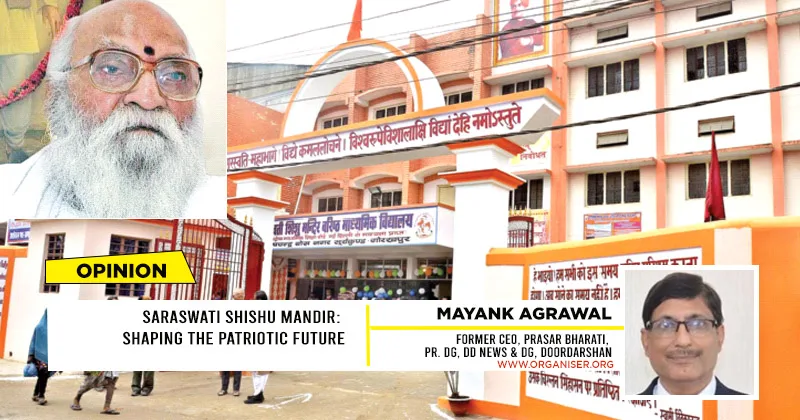
Saraswati Shishu Mandir: Shaping the patriotic future

The seed planted with the setting up of the first Saraswati Shishu Mandir in 1952 has today grown into a vast educational network that provides holistic education. Vidya Bharati now runs the largest private school network in Bharat that represents her cultural and spiritual unity

Mayank AgrawalMayank Agrawal
Oct 24, 2024, 08:30 pm IST
in Bharat, Opinion
Follow on Google News
FacebookTwitterWhatsAppTelegramEmail

Peering down the memory lane to a time about five decades ago, a strikingly vivid picture of my last day at Saraswati Shishu Mandir, in Rampur, Uttar Pradesh, springs to mind. Before we students left the school premises – the institution at that time taught till class five – each one of us would stand with bowed head before the picture of Ma Saraswati, make a nick on our thumb so a drop of blood flowed, and mark forehead of the Goddess of Knowledge with a tilak of that blood. This was no symbolic event; it was aimed at indelibly instilling Bharatiya sanskar in our tender minds.

First SSM in Gorakhpur

At that time, soon after Independence, there were barely a handful of institutions imparting modern education rooted in Indian ethos. It was eminent social reformer and educationist, Nanaji Deshmukh, who established the first Saraswati Shishu Mandir in Gorakhpur, in 1952, as an institution of holistic  learning, where education was integrated with Indian values and moral principles. Nanaji Deshmukh’s goal was to create an educational system which would be the direct answer to Lord Macaulay, who, in 1835, had brought Western education to India through his infamous minute on education. This introduction of the expensive British education, with English as the medium of instruction, effectively shut the doors for many bright young Indian minds.

Indigenous Industries Ruined  Macaulay’s words, “We must, at present, do our best to form a class who may be interpreters between us and the millions whom we govern – a class of persons Indian in blood and colour, but English in tastes, in opinions, in morals and in intellect,” reflected his narrow-minded colonial contempt for the Indian people. His educational policy was also influenced by decades of evangelical pressures to prove that Indian literature and science were inferior to Western thinking. He went on to say, “A single shelf of good European literature was worth the whole native literature of India and Arabia.”

With the deliberate relegation of Indian knowledge to the background by a shockingly prejudiced British Government, even the finest works of Indian scientists, mathematicians and philosophers of the ancient and medieval periods were peremptorily dismissed as utterly mediocre and, therefore, unworthy of inclusion in the curriculum. The new Indian elite that emerged as a result of this new, British- imposed educational system, looked down on their fellow Indians. This created a new class of citizens who considered themselves superior creatures, who served the British interests, and who remained completely alienated from the Indian masses.

Nipping British Education in the Bud

Founder of the Rashtriya Swayamsevak Sangh (RSS), Dr Keshav Baliram Hedgewar, completely rejected the British educational system. He believed that education should not only impart knowledge, but also aim at building a strong national character, with values rooted in India’s rich culture and history. Dr Hedgewar himself was the product of the Vidyagriha Rashtriya Shala, Yavatmal, a non-colonial school established as an outcome of the Swadeshi Movement and other boycott movements following the Partition of Bengal.

As the vision was spelt out, it was further shaped by Guruji MS Golwalkar, second Sarsanghchalak of the RSS. He stressed the key role that a country’s cultural heritage played in nation-building. He also advocated an educational system that aimed at the “all-round development of the child’s personality”. These views were repeatedly articulated in his many speeches and writings. And so, the seed planted with the setting up of the first Saraswati Shishu Mandir in 1952 has grown, today, in just over seven decades, into a magnificent tree, with over 33 lakh students studying in more than 20,000 schools. With many of these schools providing education up to the senior secondary level, now, under the umbrella of Vidya Bharati, the school education in the country has been revolutionised. Today, Vidya Bharati runs the largest private school network in India, a network that not only covers the entire country, but also represents her cultural and spiritual unity, as embodied in the Sangh’s
postulate of Ekatmata.

Sharing Shivir’s Experience

I remember that when I was studying in Class IV, as a child of nine years, students of our class were taken -under the loving care and supervision of the Acharyas – from Rampur, on a week-long excursion to Lucknow and Ayodhya. That was my first experience of staying in a tented camp (shivir). The thrilling memory of dressing up in impeccably white kurta and churidar pyjama and singing the famous stanzas of Nirala– “Var de Veena Vaadinee Var De…” in a packed-to-capacity auditorium in Lucknow are still vividly etched in my mind.

The Vidya Bharati schools are preparing a generation of Bharatiya citizens infused with the pure passion of patriotism. Following the Sangh’s ethos of acting with a collective spirit and of reaching out to more and more people, Vidya Bharati runs more than a thousand schools in the tribal areas of the North East, Jharkhand, Odisha, Madhya Pradesh, Chhattisgarh, Rajasthan and Gujarat. And it is imparting free education to about twenty thousand tribal students living in urban hostels run by Vanvasi Kalyan Kendra.

The contribution of the alumni of Vidya Bharati schools to India’s cultural renaissance has been emphatic, visible, and enormously positive. As a mantra from the Rig Veda, signifying togetherness, says, “संगच्छध्वं संवदध्वं सं वो मनांसि जानताम्। देवा भागं यथा पूर्वे सञ्जानाना उपासते।।,” meaning, “Let us come together, let us speak together, let our minds be of one accord as the gods of old sat together in harmony to worship”, the alumni of Vidya Bharati schools are today a powerful force at the forefront of the country’s journey to becoming Vishwa Guru.

Topics: Indigenous Industriesgood European literatureBritish- imposedNipping British EducationRashtriya Swayamsevak Sangh
Share1TweetSendShareSend
✮ Subscribe Organiser YouTube Channel. ✮
✮ Join Organiser's WhatsApp channel for Nationalist views beyond the news. ✮
Previous News

Promising Start: PM internship scheme offers cross 1.25 lakh mark in record two weeks

Next News

Cabinet approves Rs 6,798 crore projects to boost connectivity, cut logistics costs, & reduce CO2 emissions in 5 years

Related News

RSS Pracharak V Bhagayya Ji Addressing the ‘Yuva Samvad’ programme in Ranchi

Jharkhand: RSS aims to foster social unity, social harmony and national spirit: V Bhagayya Ji

(Left) Congress leader Mohammed Nalapad (Right) Karnataka Minister Priyank Kharge

RSS Defamation Case in Karnataka: Court orders personal appearance Of Priyank Kharge, Mohammed Nalapad

Guruji MS Golwalkar: The lessons for social harmony and united Hindu society

Vice President CP Radhakrishnan along with Union Defence Minister Rajnath Singh at the release of the book ‘RSS @ 100: A Century of Service, Unity & Sacrifice’

RSS has restored and rebuilt the lost glory of Bharat: Vice President CP Radhakrishnan

RSS Sanghik held at the Parvathi Kalyana Mandapam in Chandranagar

Keralam: Kanchi Shankaracharya calls for societal upliftment and cultural preservation at Sangh Sanghik

Tribute to Shri Nand Kishore Goenka

Shri Nand Kishore Goenka: A yugpurush of service, values, dedication and national spirit

Load More

Latest News

Glasgow CWG 2026: Mirabai Chanu secures India's first gold

Glasgow CWG 2026: Mirabai Chanu secures India’s first gold, wins her third medal at CWG games

Dr Mohan Bhagwat at the two-day Dakshin Bharat Prabodhan Baithak, organised by Vishwamangalya Sabha, in Bhagyanagar on 26 July, 2026.

‘Motherhood is the foundation of civilisation’; Dr Mohan Bhagwat urges society to correct distorted narratives

Tambdi Mahadeva Mandir

Tambdi Mahadeva Mandir: Exploring Goa’s nearly 900-year-old Shiva shrine hidden in the Western Ghats

Pandharpur Wari: Building Hindu unity amid false narratives from extremists & leftist groups

Suna Besha 2026: Mahaprabhu Jagannath and sibling deities dazzle in divine golden splendour as lakhs flock to Puri

India is intensifying its crackdown on food adulteration through stricter enforcement to protect consumer health

Food Adulteration in Bharat: How authorities are cracking down on hazardous chemicals and unsafe food networks

CJP Protest: Azadi from scamsters

Billawar Shiva Mandir

Billawar Shiva Mandir: Exploring J&K’s 1,000-year-old masterpiece of Nagara temple architecture

Prime Minister Narendra Modi

PM Modi interacts with Viksit Vibrant Village Programme participants; Hails developed villages as key to Viksit Bharat

Several Delhi Police vehicles were damaged following protests during the ‘Chalo Sansad’ march near Janpath in New Delhi on July 20

CJP Protest: Education reforms Vs ideological confrontation

Load More
  • Privacy
  • Terms
  • Cookie Policy
  • Refund and Cancellation
  • Delivery and Shipping

© Bharat Prakashan (Delhi) Limited.
Tech-enabled by Ananthapuri Technologies

  • Home
  • Search Organiser
  • Bharat
    • Assam
    • Bihar
    • Chhattisgarh
    • Jharkhand
    • Maharashtra
    • View All States
  • World
    • Asia
    • Africa
    • North America
    • South America
    • Europe
    • Australia
  • Editorial
  • Operation Sindoor
  • Opinion
  • Analysis
  • Defence
  • Culture
  • Sports
  • Business
  • RSS @ 100
  • Entertainment
  • More ..
    • Sci & Tech
    • Vocal4Local
    • Special Report
    • Education
    • Employment
    • Books
    • Interviews
    • Travel
    • Health
    • Politics
    • Law
    • Economy
    • Obituary
  • Subscribe Magazine
  • Read Ecopy
  • Advertise
  • Circulation
  • Careers
  • About Us
  • Contact Us
  • Policies & Terms
    • Privacy Policy
    • Cookie Policy
    • Refund and Cancellation
    • Terms of Use

© Bharat Prakashan (Delhi) Limited.
Tech-enabled by Ananthapuri Technologies