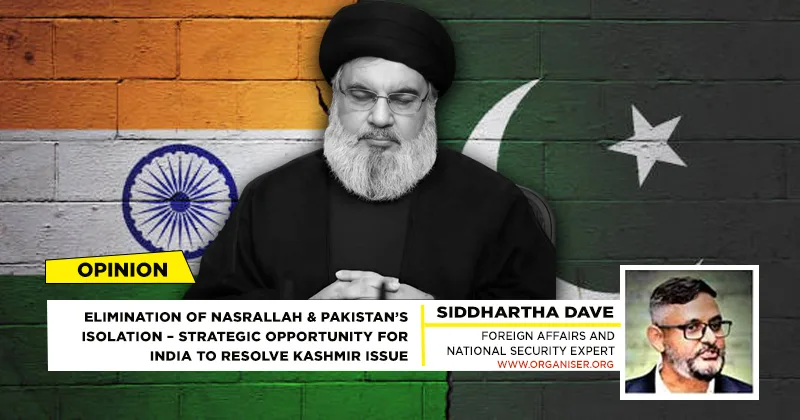
The assassination of Hassan Nasrallah, the leader of Hezbollah, marks a defining moment not only for Lebanon but for the entire Middle East and the world. For over three decades, Nasrallah has been the face of Hezbollah, a designated terrorist organization responsible for violence, extremism, and destabilization across the region. From orchestrating attacks on Israel to expanding Iran’s influence in the Middle East, Nasrallah’s role as a villain of world peace has been undeniable. His assassination shall usher in a new chapter for Hezbollah, Lebanon, and the broader geopolitical landscape of West Asia.
Hassan Nasrallah’s tenure as Secretary-General of Hezbollah began in 1992, and under his leadership, the group has transformed into a paramilitary force with a global reach. Hezbollah’s operations span far beyond Lebanon, involving covert military missions, terrorist activities, and drug trafficking that fund its violent campaigns. Nasrallah, as the mastermind, had directed Hezbollah’s military efforts against Israel and aligned the group with Iran’s anti-Western agenda.
The ramifications of Nasrallah’s assassination shall not be limited to Hezbollah. Lebanon, already grappling with political and economic crises, shall see increased instability. Hezbollah’s dominance in Lebanese politics has been a major factor in Lebanon’s struggles to maintain neutrality and peace, with the group repeatedly dragging the country into conflicts with Israel and neighboring states.
Nasrallah’s death shall deepen the power vacuum in Lebanon’s already fragile political landscape. As Hezbollah’s grip on Lebanon weakens, the country could face internal violence and sectarian unrest. Lebanon’s Sunni, Christian, and Druze factions, which have long opposed Hezbollah’s dominance, may attempt to seize the opportunity to assert control, leading to potential civil unrest.
More importantly, Israel’s security would benefit from Hezbollah’s leadership crisis. A weakened Hezbollah would reduce the threat of missile attacks and cross-border infiltrations that have plagued Israel for decades. The resulting instability in Hezbollah could diminish its ability to act as Iran’s frontline in the Levant, weakening Tehran’s foothold in Lebanon.
Hassan Nasrallah’s assassination has dealt a significant blow to Iran’s regional ambitions. Hezbollah serves as a key pillar of Iran’s “Resistance Axis,” which includes various militias in Iraq, Syria, and Yemen. Through Hezbollah, Iran has projected power and extended its influence to Israel’s northern border, posing a constant threat to the region’s stability.
Nasrallah’s leadership of Hezbollah has been central to Iran’s strategy of using proxy forces to engage Israel in indirect warfare. His death shall weaken Iran’s ability to coordinate Hezbollah’s military operations, potentially forcing Tehran to take more direct action in Lebanon or risk losing influence in the region. Would Iran engage with Israel, directly? Only time shall tell.
While Iran could attempt to replace Nasrallah with another loyalist, his assassination could lead to power struggles within Hezbollah, reducing its operational capacity. This would directly benefit Israel and the United States, both of which view Hezbollah as a significant terrorist threat. For Israel, a disorganized Hezbollah means a reduced risk of immediate conflict, allowing for greater regional stability.
The reverberations of Nasrallah’s assassination would extend far beyond Lebanon. Hezbollah’s military operations have long stretched into Syria and Iraq, where the group has fought to preserve the Assad regime and assist Iran in spreading its influence. Nasrallah’s absence could weaken Hezbollah’s ability to operate effectively in these conflict zones.
In Syria, Hezbollah’s involvement has been crucial to propping up Bashar al-Assad’s regime and maintaining Iranian control over strategic areas. A leadership crisis within Hezbollah could limit its ability to continue these operations, destabilizing Assad’s position and weakening Iran’s influence in Syria.
Meanwhile, Israel could capitalize on Nasrallah’s death to further isolate Hezbollah and counter Iranian influence. The resulting power vacuum could encourage anti-Iranian actors, including Gulf Arab states and regional militias, to assert their dominance, shifting the balance of power in favor of U.S.-allied forces.
For the United States and its allies, Nasrallah’s assassination shall be seen as a significant victory in the fight against terrorism. Hezbollah has long been designated as a terrorist organization by the U.S. government, and Nasrallah’s role in orchestrating attacks against American and Israeli targets has made him a top enemy in the global war on terror.
The U.S. has consistently worked to weaken Hezbollah’s financial and operational networks, and the removal of Nasrallah shall be a major milestone in these efforts. It could provide an opportunity for the U.S. to further isolate Hezbollah, impose additional sanctions on its members, and reduce its ability to raise funds through illicit activities such as drug trafficking and money laundering.
In a rapidly changing geopolitical landscape, the assassination of Hezbollah leader Hassan Nasrallah by the Israeli Defense Forces (IDF) signals a new phase of power dynamics in the Middle East and beyond. As the region grapples with the vacuum created by Nasrallah’s death, another significant shift is emerging on the global stage—Pakistan’s increasing isolation over its long-standing Kashmir narrative.
The recent United Nations General Assembly (UNGA) saw a notable departure from tradition, as Turkish President Recep Tayyip Erdoğan, a key supporter of Pakistan, refrained from mentioning Kashmir, marking a potential diplomatic shift. Malaysia, too, which has often backed Pakistan’s position, abstained from raising the Kashmir issue. This emerging global trend of sidelining Pakistan’s rhetoric on Kashmir presents a rare and significant opportunity for India to push for a permanent resolution to the Kashmir issue, one that has long been at the heart of Indo-Pakistani tensions.
The assassination of Hassan Nasrallah, a major figure in Iran’s proxy warfare and leader of the Hezbollah terrorist organization, has not only dealt a blow to Iran’s influence but also created a ripple effect that reaches Pakistan. With Iran’s regional influence under threat, and Hezbollah struggling with internal leadership challenges, Pakistan loses one of its indirect supporters in the global Islamist camp.
Hezbollah, backed by Iran, has long been a destabilizing force in the Middle East, engaging in proxy wars that indirectly benefited countries like Pakistan by shifting global attention away from South Asia. Nasrallah’s death alters this equation, putting Pakistan’s political maneuvering in jeopardy as global powers, particularly Israel and the United States, increase their focus on dismantling terror networks and addressing regional instabilities more aggressively.
As Hezbollah faces uncertainty, Pakistan finds itself increasingly isolated—both regionally and globally—on the issue of Kashmir. Without strong backing from the Middle East or key Islamic countries, Pakistan’s position is weakening.
At the 2024 UNGA, the absence of any mention of Kashmir by Turkish President Erdoğan marked a sharp departure from his previous stances, where he often spoke in favor of Pakistan. Turkey, under Erdoğan, has been one of Pakistan’s most vocal supporters on the Kashmir issue. This year, however, the silence was deafening, signaling a potential recalibration of Turkey’s foreign policy priorities, possibly influenced by its economic and strategic relations with India.
Malaysia’s decision to abstain from discussing Kashmir further illustrates the shifting sands in Pakistan’s traditional alliances. With these countries distancing themselves from the Kashmir issue, Pakistan finds itself diplomatically cornered. Even in the Islamic world, support for Pakistan’s Kashmir narrative is diminishing, isolating Islamabad on the global stage.
This growing isolation provides India with a strategic advantage. Pakistan’s diplomatic credibility on the Kashmir issue is eroding, as global powers recognize the region’s political realities. Meanwhile, Jammu and Kashmir, now fully integrated into India’s political framework following the abrogation of Article 370, is gradually returning to normalcy with recent elections held to form a state government. The democratic process in Jammu and Kashmir stands in stark contrast to the political instability in Pakistan-occupied Jammu Kashmir (PoJK), where the people have increasingly voiced their desire to join India.
Recent developments in Pakistan-occupied Jammu and Kashmir (PoJK) indicate a growing dissatisfaction with Pakistan’s administration and a rising sentiment among its people to reunite with India. PoJK, which has long suffered from political neglect, economic deprivation, and an unstable security environment, is witnessing a grassroots movement for change. The people of PoJK see the progress being made in Jammu and Kashmir under Indian governance, where investments, development, and political stability are becoming the norm. This growing desire for a better future, coupled with Pakistan’s failure to provide basic rights and services, has emboldened the pro-India movement in the region.
India must capitalize on this momentum. The isolation of Pakistan, both in global diplomatic circles and within its own borders, provides India with a historic opportunity to assert its claim over PoJK and pave the way for the reunification of Kashmir under its sovereignty. The time is ripe for India to engage with the people of PoJK, support their democratic aspirations, and further expose Pakistan’s failures in the region.
The growing support for India’s position on Kashmir is not just a result of Pakistan’s isolation; it is also a reflection of India’s rising stature on the world stage. Under the leadership of Prime Minister Narendra Modi, India has emerged as a global player whose influence extends beyond South Asia. India’s strategic partnerships with countries like the United States, Israel, and Gulf nations have strengthened its position, allowing it to push back against Pakistan’s outdated claims on Kashmir.
Modi’s leadership has transformed India into a diplomatic powerhouse, one that is actively shaping the global narrative on security, counterterrorism, and development. The world increasingly recognizes India’s role as a stabilizing force in a turbulent region. As the international community turns its attention to the issues of terrorism and extremism, India stands as a key ally in the fight against global terror networks, many of which have links to Pakistan.
Conclusion: The Time for a Permanent Solution is Now
The assassination of Hassan Nasrallah, the growing isolation of Pakistan, and the shifting global attitudes towards Kashmir have created a unique window of opportunity for India to resolve the Kashmir issue once and for all. With Pakistan’s traditional allies abandoning its cause, and the people of PoK openly expressing their desire to reunite with India, the stage is set for India to assert its territorial claims and push for the integration of the entire region.
India’s growing global influence, coupled with Pakistan’s diminishing credibility, makes this the perfect moment to settle the Kashmir issue permanently. As Pakistan continues to flounder both domestically and internationally, India must act decisively, seizing this opportunity to bring lasting peace and stability to the region.
In a world where terrorism is being dismantled, and rogue nations are increasingly isolated, India has the chance to lead the way, both in the region and on the global stage, by resolving one of the most contentious geopolitical issues of our time.