The United Nations came into existence in 1945, after the post-war era to foster global brotherhood and prevent the previous two world war-like situations in future. There are six principal organs of the United Nations (UN) namely UNGA, UNSC, ECOSOC, Trusteeship Council, ICJ and UN secretariat.
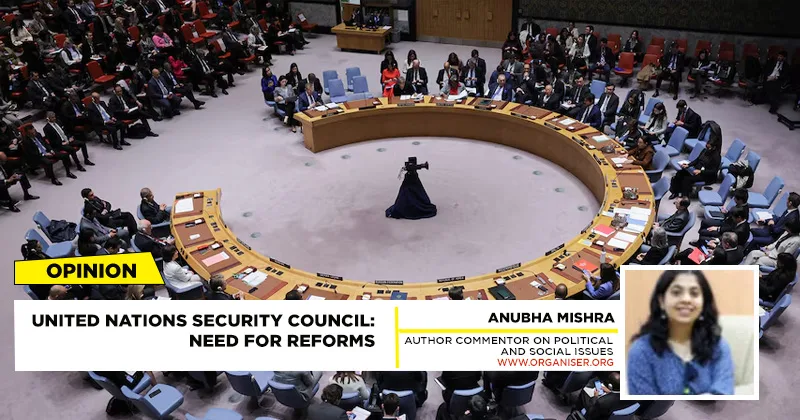
The United Nations Security Council has five permanent members—the United States, China, France, Russia, and the United Kingdom—collectively known as the P5; with the major responsibility to veto a resolution. The Security Council’s ten elected members, which serve two-year, nonconsecutive terms, are not afforded veto power. The P5’s privileged status has its roots in the United Nations’ founding in the aftermath of World War II. The United States and the Union of Soviet Socialist Republics (USSR) were the outright victors of the war, and, along with the United Kingdom, shaped the postwar political order. As their plans for what would become the United Nations took shape, U.S. President Franklin D. Roosevelt insisted on the inclusion of the Republic of China (Taiwan), envisioning international security presided over by “four policemen.” British Prime Minister Winston Churchill saw in France a European buffer against potential German or Soviet aggression and so sponsored its bid for restored great-power status.
Coming to the present day, nearly a quarter century has passed but the world is still stuck in the same loop of demanding reforms in our institutions. While addressing a special session in 2023, UN Secretary-General Antony Guterres stressed the need for reforming and modernizing the multilateral system and remarked “It is reform or rupture. The world has changed. Our institutions have not,”. Next year marks an important milestone in the history of the international arena as 2025 marks the 80th anniversary of United Nations. It becomes even more imperative to discuss these reforms as Indian Prime Minister, Sh. Narendra Modi is in the United States to address the ‘Summit of the Future’ at the United Nations General Assembly in New York and India joined by its other G4 colleagues namely Brazil, Japan, and Germany – have echoed call for a greater representation in the permanent and non-permanent category time and again, stressing the significance of reflecting the diversity and plurality of views from the 193 member states.
The over-representation of Western countries in the Council neither reflects the UN’s diverse composition, nor the current geopolitical realities, reform in our multilateral institutions are not only urgent but also a precondition to international peace, stability, security and an effective international order. The status quo to this must change and a more inclusive approach should be adopted in correcting some historical wrongs by granting rightful and just representation to voices from the global south. The Security Council should reflect today’s global realities. For instance, both Africa and Latin America lack a permanent seat on the Council, while Europe is overrepresented (with UK and France among the P-5) and Asia and Caribbean is underrepresented.
India has long been a vocal proponent of reforming the UNSC, arguing that the 5-member Council, established in 1945, is outdated and does not reflect modern geopolitical dynamics. With the Council often paralysed by internal divisions, particularly over major conflicts such as the war in Ukraine and the Israel-Hamas conflict, India and other reform advocates assert that expanding permanent membership would strengthen the Council’s capacity to respond to global crises. Current composition of the Security Council, with its “glaring under-representation and un-representation” of key regions in Security Council membership, is “detrimental” to its legitimacy and effectiveness. It is also to be noted that the Council’s inability to address critical conflicts and maintain international peace and security underscores the urgent need for reform. Without reforms in the UNSC, there is a risk of the UN being sidelined by other regional organisations. For example, SCO, NATO, BIMSTEC etc.
The UN membership has undergone a sea change since 1945 and the new realities need to be reflected in the permanent membership. Any proposal that does not address the issue of representation of the Global South, including Africa, Asia and Latin America, in the permanent category does a grave injustice to the aspirations of developing countries for equality. The use of veto power should not hinder the Council’s reform process for these countries, member countries should reflect flexibility on the issue for constructive negotiations.
India has been at the forefront of years-long efforts to reform the Security Council, saying it rightly deserves a place as a permanent member at the UN high table, which in its current form does not represent the geo-political realities of the 21st Century. Now, Let’s weigh in on the reasons why India deserves a chair at the UNSC. India has a sizeable demography and rising economy which makes it a strong voice. India is the largest democracy with a large demography, with more than half of its population under the age of 30. Secondly, India is the seventh largest economy in the world, with its GDP at $2.72 trillion.
Then, India is the second largest contributor of uniformed personnel to UN Peacekeeping. The peace-keeping missions deployed by the UN in various war-torn nations of the world are being supported majorly by Non-permanent members such as India, Rwanda, Bangladesh etc. It currently deploys more than 6,000 military and police personnel to UN operations in Abyei, the Central African Republic, Cyprus, the Democratic Republic of the Congo, Lebanon, the Middle East, Somalia, South Sudan, and Western Sahara. Nearly 180 Indian peacekeepers have made the supreme sacrifice in the line of duty, the highest number from any troop-contributing country.
Not just this, India’s unwavering support to adopt sustainable development goals as part of its state policy is also noteworthy. India’s progress on the SDGs is measured by the SDG India Index, which assigns a score to each state and union territory based on their performance on the 16 SDGs. It also fosters a competitive spirit amongst state members which compels them to achieve their targets in time time-bound manner and the recently inaugurated mission LiFe (lifestyle for environment) by the Indian Prime Minister is also a testimony to the same.
In the last decade, India has scripted a new developmental story on various fronts and ushered as the leading voice of the global south. India being the leader of NAM requires a permanent member status in UNSC to raise the concerns of these nations. As the geopolitical realities in Indo-Pacific region are changing rapidly and it needs diplomatic clout which it can use to defend its national interest. The region being under-represented is also a problem which should be dealt with soonest.
The ongoing debate on Security Council reform must prioritise maintaining the UN’s relevance in the 21st Century by ending policy paralysis and also by achieving equal representation that is inclusive of emerging powers and its aspirations along with existing P-5 country’s concerns, ensuring that the august body is fulfilling its mission of a global platform formed for peace and progress.