
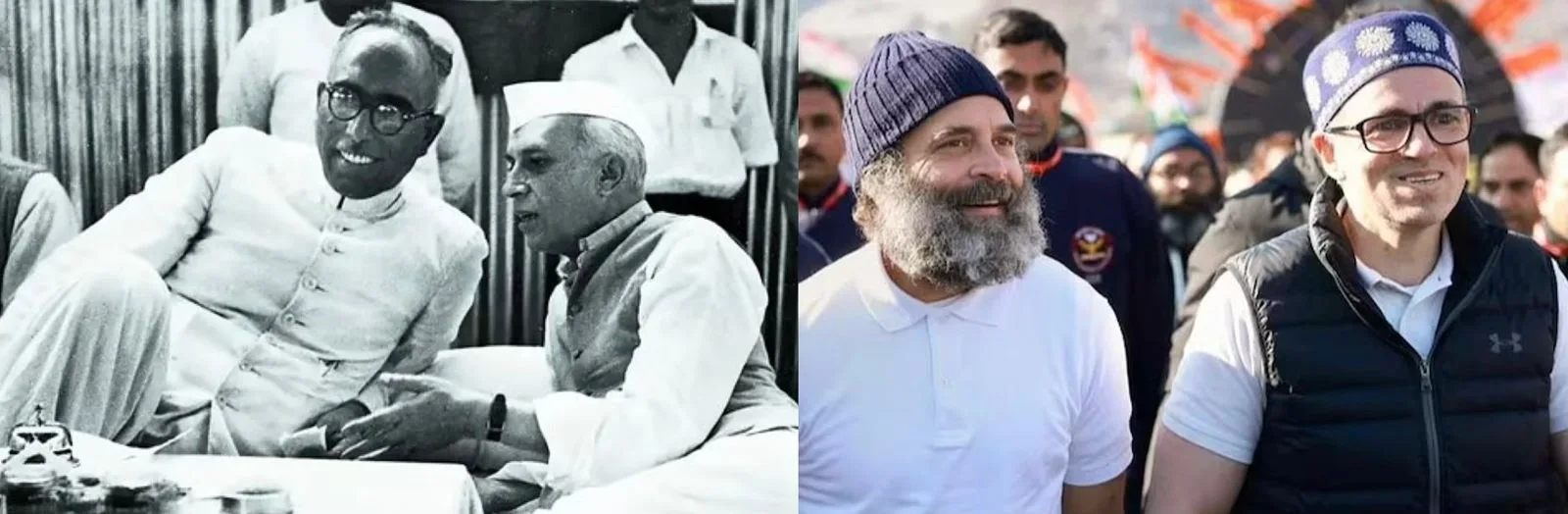
If one looks at the past, the history of Jammu & Kashmir deeply revolves around the friendship of Jawaharlal Nehru and Sheikh Abdullah. Their personal friendship and political alliance, which shaped the early years of the State are often cited as the reason why Kashmir fell into a spiral of terrorism, corruption, and dynastic politics. From the controversial decision to implement Article 370 and Article 35A to the enduring political influence of the Abdullah and Nehru families, the seeds sown by them continue to give bitter fruit in Kashmir. The brand new alliance between Rahul Gandhi’s Congress and Omar Abdullah’s National Conference (NC), is more problematic for the national integrity as NC has promised to restore Article 370 and 35A, if it returns to power. This will take back Kashmir to the troubled State it was in during the regime of Nehru and Sheikh Abdullah.
Friendship dangerous for Bharat
Nehru, who saw a spirit of secularism and socialism in Sheikh Abdullah, supported him to rose to power in Kashmir, side-lining the legitimate ruler Maharaja Hari Singh. The Instrument of Accession signed by Maharaja Hari Singh in 1947, was meant to integrate Kashmir into Bharat while allowing its autonomy in certain areas. However, Nehru’s insistence on Article 370, which granted special status to Jammu and Kashmir, created a legal barrier between Kashmir and the rest of the country. Sheikh Abdullah, who became the Prime Minister of Kashmir, used Article 370 and Article 35A as tools to maintain his political dominance, ensuring that Kashmir remained under his control rather than a fully integrated part of Bharat.
The autonomy granted under Article 370 allowed corruption and nepotism in Kashmir’s political system. Abdullah’s NC turned Governance into a family affair. This laid the foundation for dynastic politics that continue to plague Kashmir, where political power is passed like an inheritance property rather than in a democratic way.
The seeds of discontent with Nehru-Abdullah’s Kashmir policy were evident in the early 1950s with the rise of the Praja Parishad movement. The Praja Parishad, a political party in J&K opposed Article 370 and demanded the full integration of the State with India. The movement gained momentum as it became clear that Article 370 was being used not to protect the unique identity of Kashmir but to shield Sheikh Abdullah’s autocratic rule.
The Nehru-Abdullah friendship laid the foundation for the dynastic politics that continue to plague Kashmir, where political power is passed like an inheritance property
Kashmiris soon realised that Article 370 had nothing to do with the federal Constitution. Sheikh Abdullah initially brainwashed Nehru into believing that it was at his behest that the Muslims of the State had embraced India instead of the Islamic country of Pakistan. Nehru began to accept his baseless assumption and continued to maintain their friendship.
Rather than engaging with the legitimate concerns of the Praja Parishad, Nehru sided with Abdullah, even rejecting the nomination papers of 13 of its candidates in the 1951 elections. This decision further reinforced the perception that Nehru prioritised his friendship with Abdullah over the interests of the State.
Article 370 and 35A: Tools of Division and Corruption
Implementation of Article 370 and 35A not only created a constitutional barrier between Kashmir and the rest of India, but also resulted in corruption and unaccountability in the State’s administration. These articles allowed Jammu and Kashmir to have its own Constitution and flag, fostering a political environment dominated by the Abdullah and Nehru families. This set-up prioritised the interests of these two families over the development of the State. Instead of fostering progress, the special status facilitated nepotism, political favouritism and inequality, worsening the condition of the State. The meaning of the development was to preserve the power and privileges of separatists rather than addressing the needs of the general public.
The Article 35A, which gave the State the right to determine who is a permanent resident of the State, was not inserted into the Constitution by an amendment passed by the Parliament. It was inserted by the President following the advice of Jawaharlal Nehru in the Constitution on May 14, 1954, by issuing a similar order, using the powers granted to the President by Article 370 of the Constitution. This deprived the people of Jammu and Kashmir of the full benefits offered by the Constitution of Bharat, including representation and reservations for Scheduled Castes (SC) and Scheduled Tribes (ST). Notably, Congress these days is fighting elections across the country, alleging that BJP will finish the reservation. In contrast, it is in alliance with the National Conference, which had said in its manifesto to restore 35A, which will take away all the benefits from SCs and STs granted under the Constitution of Bharat.
Breeding ground for terrorists
The rise of terrorism in Kashmir was the result of the policies of Nehru and Abdullah. Political instability and a lack of economic opportunities in the State, with the inclusion of corruption and dynastic rule made Kashmir a breeding ground for Islamists. The insurgency that erupted in the 1990s was not only fueled by external factors like Pakistan but also by decades of misgovernance under the Nehru-Abdullah regime. The insurgency, which has claimed thousands of Hindu lives is a tragic reminder of the long-term consequences of this alliance. The failure to fully integrate Kashmir into Bharat coupled with the misuse of Articles 370 and 35A further nurtured separatist elements.
A New Dawn for Kashmir
The abrogation of Article 370 and 35A by the Narendra Modi Government on August 5, 2019, marked a significant turning point in Kashmir’s history. The decision, which brought Jammu and Kashmir fully under the purview of the Indian Constitution, was seen by many as the fulfillment of a long-standing demand. The abrogation of Article 370 and 35A has also opened up new opportunities for the region. With the removal of the special status, the Union Government has been able to push forward with much-needed reforms in the State, including the implementation of anti-corruption measures, reservation policy, infrastructure development, etc. The return of normalcy to the region, with a reduction in terror activities and an increase in tourism, is a testament to the positive impact of these changes.
Congress-NC Alliance: Threat of a Return to Old Order
The alliance between the Rahul Gandhi, great-grandson of Pt. Nehru, and Omar Abdullah, grandson of Sheikh Abdullah, has raised concerns among those who fear that these parties, if they come to power, will undo the progress made in recent years. The National Conference has made it clear in its manifesto that it intends to restore Article 370, a move that would effectively reverse the gains made since its abrogation. It has also promised the release of political prisoners (separatists). This alliance between the new generation dynasts of Congress and National Conference is viewed by many as an attempt only to regain power rather than to offer a vision for Kashmir’s future.
The new partnership between the Nehru-Abdullah families could lead to a resurgence of corruption and anarchy that have plagued Kashmir for decades, as well as a potential revival of separatist sentiments and terrorism. As Jammu and Kashmir stand at a crossroads with the potential for a new era of peace and development, it is crucial that the lessons of the past are not forgotten in the upcoming elections.