





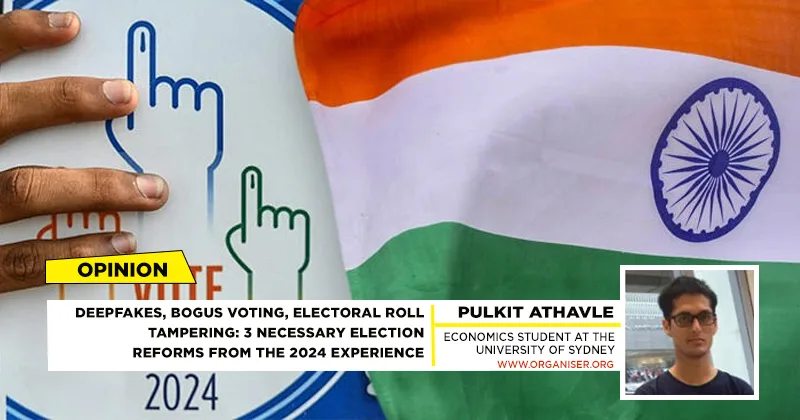
Although the 2024 Lok Sabha elections were marked by much handwringing and recriminations over the ostensible State of Indian democracy, the matter seems to have been laid largely to rest after the surprise election results. Indeed, India has run the world’s largest elections, freely and fairly, for decades – in stark contrast to the experience of many others with similar levels of diversity and development.
Yet, the highly-charged 2024 Lok Sabha election process threw up 3 crucial issues that need an urgent resolution to ensure that the electoral architecture remains effective: Deepfakes, Bogus Voting and Electoral Roll Tampering.
It is crucial for the ECI and Government to not only act on these issues but – more importantly – be seen to be responding, to avoid an insidious loss of faith in the electoral process. This is especially true for allegations of bogus voting and electoral roll tampering, which shake voter’s trust in the entire system – and cannot be dispelled by simply putting out bureaucratic press releases. As such, I propose active steps that the authorities must take to resolve these issues.
Deepfakes: An Intolerable Risk
Just as the 2014 Lok Sabha elections were the first ‘social media’ elections, the 2024 elections can be aptly described as the first deepfake election, where deepfakes moved from a curiosity to an active campaigning tool. Deepfakes use Artificial Intelligence (AI) to generate hyper-realistic fake videos that can increasingly imitate a target person’s voice, looks and mannerisms with a high degree of fidelity. These can be used to create a false impression amongst the public, especially those who are not as digitally literate, about what a politician has said or done.
In 2024, deepfakes involving personalities from M. Karunanidhi to Ranveer Singh were intermixed with fake videos involving sophisticated (non-deepfake) editing, such as the purported video of Amit Shah pledging to remove reservations. With the exponential improvements in Generative AI recently and the increased political conflict, this will only worsen by the time the 2029 Lok Sabha elections come around.
As such, my argument deals not only with deepfakes but also with sophisticatedly manipulated videos. While it is impossible to analyse precisely how effective these were in changing the 2024 election outcomes, the harms are serious enough for Indian democracy over the long term that they need a stringent and uncompromising response. This is for four reasons:
• Firstly, any regulation to ‘manage’ deepfakes faces the issue of enforceability. With hundreds of political events across India and even more campaign messages, the ECI is already stretched to the limit. Any regulation that aims to prevent ‘malicious’ use of deepfakes will likely only kick in by the time the video has already spread to millions of people. In most cases, it will also be extremely challenging to catch the technologically-savvy perpetrators.
• Secondly, even if the authorities focus on preventing political players from publicly sharing deepfakes about their opponents, eg on social media, there will always be the defence of plausible deniability where the perpetrators can claim that they (plausibly) believed that it was a genuine video. This will become an increasingly powerful defence as generative AI and video-editing become more capable and harder to distinguish from real videos – although it is a fundamentally flimsy defence since politicians (who as a rule are rather savvy) are extremely unlikely to actually believe their opponents have truly made an inflammatory remark that would be political hara-kiri.
• Thirdly, any regulation that tries to distinguish between ‘permissible’ and ‘non-permissible’ election deepfakes of opponents will be susceptible to the ‘gray area’ trap of determining just how much the opponent has implied in their public statements that might justify what is said in their deepfake.
• Some may take a benign view of many deepfakes, arguing that videos of Ranveer Singh or Karunanidhi are neither malicious towards political opponents nor misrepresent party stances. Yet, these are equally harmful because they focus politics on personalities rather than policies. If even a micro-minority of voters are swayed because they believe their favourite celebrity supports a particular party, Indian democracy will be worse off. Similarly, ‘benign’ deepfakes of historical figures not only promote personality politics but are likely to caricaturise their views – whilst also holding the potential to confuse non-digitally savvy voters.
Consequently, regulation of political deepfakes and edited videos is likely to be hard to enforce and susceptible to ‘plausible deniability’ and ‘gray area’ justifications. Yet, deepfakes and edited videos indisputably promote bad politics.
So, how can this be resolved?
While the deepfake genie is clearly out of the bottle, based on the precautionary principle, there are ways to ringfence its impact by raising the barriers extremely high for any sharing by politically associated persons. Any sharing of a deepfake or manipulated video by a politically associated person should be dealt with stringently through a law which would bar them from standing for any election or from holding any political position for the next 5 years without allowing for any justifications. This would make politicians and political parties extremely careful before they put out any video (deepfake or not) of their opponents because of the severe consequences for their political career – forcing them to focus on their own election platform.
Moreover, it creates an easy shorthand for wrongly victimised politicians to help voters understand that something is fake: if it isn’t on an official handle (due to the high costs imposed), it is likely fake.
Finally, perpetrators would be unable to game the situation as is currently possible – first, by sharing manipulated videos/deepfakes and reaping electoral benefits and then subsequently, benefiting from sympathy (while not losing their seat) when legal action is taken against them.
Bogus voting: Time for Biometric Verification of Voters
The second big issue is bogus voting – where other individuals vote in your name. Anecdotal claims that bogus voting had occurred emerged from both ruling alliance and opposition-controlled states. These allegations seed doubt in voter’s minds that cannot be fixed by simply stating that repolling was conducted in questionable booths.
The main problem is that the process of recording a voter’s presence at the booth remains extremely antiquated for an IT superpower like India, with individuals still having their names ticked off a paper that has to be flipped through by the booth official. Not only is this a laborious process (worsened by the heatwave conditions), but it is also overly dependent on the booth election officials, who must quickly decide if the voter ID card and the voter are genuine. This also leaves some room for misuse of their power. Religious and/or cultural factors such as veils add another layer of complexity in verifying identity – and were a cause of dispute in Hyderabad.
The solution is obvious: Biometrics-based voter verification. Presently, the ECI has facilitated the linking of a large number of Voter IDs with Aadhaar cards. This has reportedly helped them clear the voter list of many fraudulent and duplicate voters. It should be relatively simple to implement a system where the biometrics in the Aadhaar are used to verify voter identity at the voting booth. All the voter has to do is scan their fingerprint/iris, which will automatically register their presence at the voting centre in a non-tamperable system and prevent any double-voting. As this would be done within seconds, it should also speed up the voting process, which is likely to lead to shorter lines and higher voter turnout, especially as daily wagers will lose less time. This would eliminate the risk of bogus voting and substantially reduce the ability of booth election officials to abet fraudulent voting – making the election process more secure.
There is one catch: The Supreme Court of India has, in the past, not looked kindly at Aadhaar mandates and has emphasised the need for the right to privacy to be maintained. The ECI has also made submissions to the SC that linking Aadhaar to Voter IDs is not compulsory.
While this appears to be a challenge, it can be easily dealt with by introducing a provision for mandatory biometrics registration for all Voter IDs. Where voters are willing to link their Aadhaar with the Voter ID, the biometrics stored with the Aadhaar will be used. If not, they will have to undertake a separate effort to add their biometrics to their Voter IDs to keep them up-to-date and valid. This can be easily justified as part of ensuring a speedy and secure voting system – and matches existing precedents for compulsory biometrics when getting passports or Aadhaar cards made. In this way, there is no requirement to link Aadhaar with Voter ID (although there is a nudge), meaning it will likely not fall afoul of Supreme Court judgements/submissions, whilst still ensuring that biometrics-based voter verification can be used to prevent damaging incidents of bogus voting.
Electoral Roll Tampering: Implementing an Audit Trail
Finally, some states, such as Tamil Nadu and Rajasthan, saw prominent claims that voters had been arbitrarily struck off the electoral rolls. In some cases, a political vendetta was alleged, while in others, those who were struck off claimed to be mystified. It is certainly true that the ECI needs to remove fraudulent or deceased voters from the electoral rolls to keep them updated – and that there are bound to be some imperfections. However, there is a difference between the odd legitimate voter being accidentally removed from the rolls, and more frequent reports from certain constituencies/neighbourhoods about the same – with the latter causing voters to question the integrity of the entire ECI (whether justified or not).
To ensure that such ‘cleanup’ drives do not systematically remove legitimate voters, it is necessary to implement a clear audit-like system where electoral rolls have clear, permanent audit trails along the lines of existing audit software for financial accounts. As part of this, any edits of the electoral roll will be permanently stored by the non-tamperable software, along with the details of the electoral officer who has made these changes. Naturally, these details will not be made easily available to other ECI officers or to political parties/candidates to avoid pressure being exerted on the independent body. Instead, this data should only be accessible by extremely select senior officers in the national ECI (and not state election commissions) to prevent state politicians from exerting pressure. This will allow for the creation of a proper process where parties or voters can raise complaints about the deletion of bonafide voters from electoral rolls and this can be investigated with harsh consequences (such as discharge from government service) for electoral officers who are found to be negligently or wrongfully doing this.
The Way Forward
Where the integrity of the system is concerned, perception often matters more than reality. Thus, when implementing these reforms, it is important to have extensive publicity to explain how this solves the above issues. This should occur much before any election, and prominent celebrities and political figures should be roped in to ensure the message reaches the public and to limit the impact of any future misinformation. With effective communication about these 3 necessary election reforms, major areas of conflict that would be misused in political mudslinging will be largely neutered while ensuring that Indian elections become more issues-focussed, secure and accountable.












Comments