

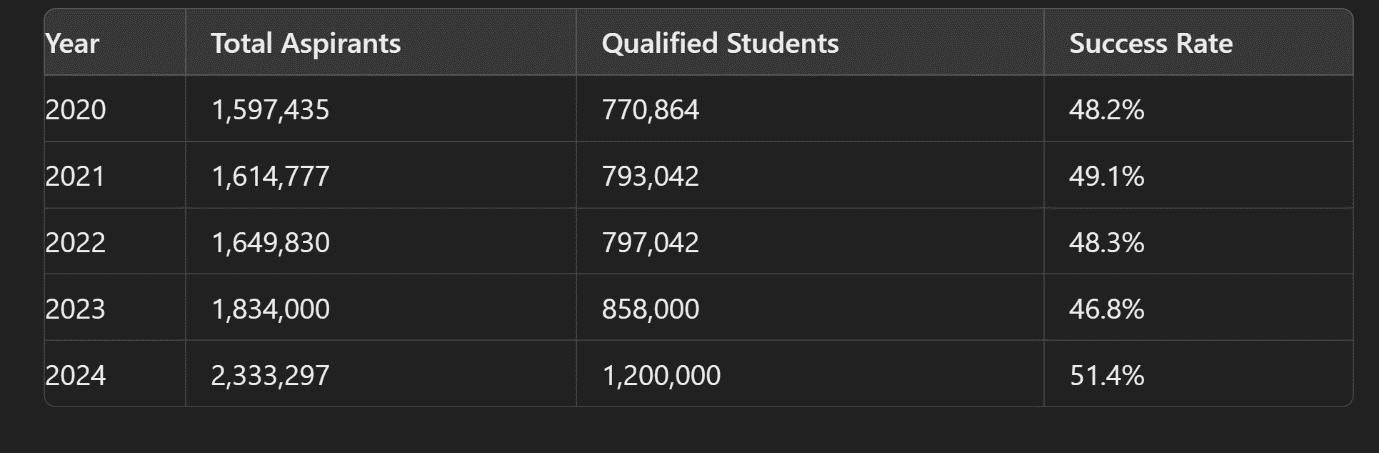
The National Eligibility cum Entrance Test (NEET) serves as the gateway for aspiring medical students across India. It is a highly prestigious examination among Indian citizens. Introduced in the 2013-14 academic year, NEET replaced the All India Pre Medical Test (AIPMT) to become the standardized test for admissions to undergraduate medical and dental programs. The National Testing Agency (NTA), which has been administering NEET since 2019, oversees this national exam encompassing courses such as MBBS, BDS, and AYUSH programs. NEET’s primary goal was to streamline the admission process, ensuring uniformity and high standards in medical education nationwide. The growing number of NEET candidates over recent years underscores its importance. In 2024, approximately 2.4 million students registered for the examination, reflecting the exam’s crucial role as a stepping stone to medical careers. The accompanying chart illustrates the number of students taking NEET over the past five years, revealing a clear upward trend. Despite the increasing number of applicants, competition remains intense, with only about 7.5 per cent of candidates successfully securing admission.
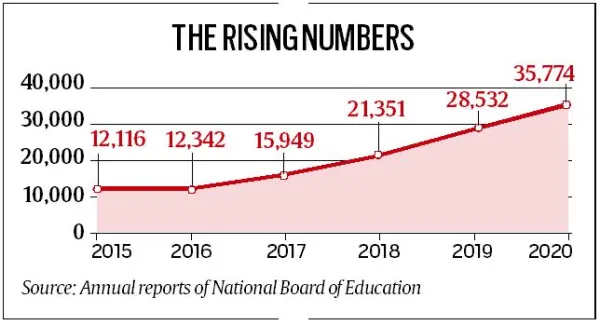
In recent years, there has been a significant increase in the number of Indian students opting to pursue medical degrees abroad. To ensure consistent educational standards, NEET has been made mandatory for these students. This requirement guarantees that Indian students studying overseas adhere to the same rigorous standards as their peers studying within the country, aiming to maintain uniformity in the quality of medical education and practice across all educational settings. According to reports from the National Board of Examinations (NBE), there has been a noticeable more than 3x rise in the number of students seeking medical education abroad.
As of now, India boasts 695 medical colleges collectively offering 1,06,333 seats for medical courses. Government colleges account for about 55,648 seats, with private MBBS colleges contributing 50,685 seats. In 2024, the government expanded this capacity by introducing an additional 5150 seats for MBBS courses. However, the limited availability of seats in Indian medical colleges contrasts starkly with the high number of students appearing for medical entrance exams each year. Pursuing medical education in private colleges within India remains considerably more expensive compared to attending private medical colleges abroad.
Initially conducted by the Central Board of Secondary Education (CBSE), the administration of NEET was transferred to the NTA in 2019. The NTA (National Testing Agency) was established by the Ministry of Education in 2017 to conduct efficient, transparent, and internationally standardised entrance tests. The necessity for a unified and transparent examination system became glaringly apparent following the 2010 corruption scandal involving the Medical Council of India (MCI). The scandal, which involved high-level bribery and corruption, led the Supreme Court to dismantle the MCI and propose the establishment of a new regulatory body. Consequently, the National Medical Commission (NMC) was created in 2019 to replace the MCI, aiming to introduce transparency, accountability, and improved standards in medical education and practice in India.
Despite encountering initial challenges, such as reports of irregularities and cheating, the NTA has diligently worked to uphold the integrity of the examination process. However, despite these efforts, NEET has not been immune to controversy. Incidents of paper leaks and cheating have occasionally tarnished the exam’s credibility, underscoring the ongoing necessity for stringent measures to safeguard its integrity. A unified entrance examination like NEET plays a pivotal role in ensuring a fair platform for all aspiring medical students in India. By standardizing the admission process, NEET eliminates disparities and ensures equal opportunities for all candidates. This consistency is essential for upholding rigorous educational standards and cultivating skilled medical professionals capable of addressing global healthcare challenges.
Essential Reforms needed
Transitioning to a digital examination infrastructure from traditional pen-and-paper tests can effectively minimize potential loopholes. Implementing computer-based examinations with multiple shifts featuring unique question sets divided into timed subsets can efficiently address the challenges associated with digital infrastructure.
Biometric Verification: Incorporating Aadhaar-linked biometric checks and facial recognition technology can effectively prevent impersonation during exams, ensuring that only legitimate candidates participate.
Increased Transparency in Question Paper Setting: Ensuring greater transparency in the question paper setting process can help prevent leaks. Involving a diverse panel of experts and implementing multiple layers of security can enhance the process’s integrity.
Advanced Proctoring Tools: The implementation of sophisticated proctoring tools, including facial recognition, eye movement tracking, and keystroke analysis, can help minimise instances of cheating. These tools can be pivotal in maintaining the examination’s integrity.
Examination centre Audits: Conducting random audits at examination centres can ensure compliance with anti-cheating protocols and identify any vulnerabilities. These audits can serve as a deterrent to potential malpractice.
Ethical Hacking: Employing ethical hacking techniques to test the examination infrastructure can pre-empt potential security breaches. Ethical hackers can identify and address vulnerabilities, enhancing the overall security of the exam.
Stringent Anti-Cheating Laws: Implementing and enforcing strict anti-cheating laws can act as a significant deterrent. Drawing from international examples, such as China’s rigorous measures for their equivalent of NEET, India can introduce similar laws to curb malpractice effectively.
Periodic Review of Examination Protocols: Regular reviews and updates of examination protocols can ensure they remain relevant and effective in addressing emerging challenges. This proactive approach can help maintain the examination’s credibility.
Enhanced Training for Invigilators: Providing comprehensive training for invigilators can equip them to better detect and handle instances of cheating. Well-trained invigilators are crucial in maintaining a fair examination environment.
Public Awareness Campaigns: Running public awareness campaigns to educate students and parents about the consequences of cheating and the importance of maintaining integrity can help foster a culture of honesty.
“NEET is more than just an examination; it is a stepping stone for aspiring medical professionals in India. Ensuring the highest standards of integrity, transparency, and efficiency in NEET is essential for maintaining the quality of medical education in the country. By addressing the current challenges and implementing the recommended reforms, NEET can continue to be a reliable and effective gateway for medical education in India. With continuous efforts and a commitment to excellence, NEET can help produce competent and ethical medical professionals who can contribute significantly to the healthcare sector, both in India and globally.”