From Prohibition to Permissiveness: Tamil Nadu's historical alcohol policy and its journey under DMK regime
June 6, 2026
  • Read Ecopy
  • Circulation
  • Advertise
  • Careers
  • About Us
  • Contact Us
Android AppiPhone AppArattai
Organiser
  • ‌
  • Bharat
    • Assam
    • Bihar
    • Chhattisgarh
    • Jharkhand
    • Maharashtra
    • View All States
  • World
    • Asia
    • Europe
    • North America
    • South America
    • Africa
    • Australia
  • Editorial
  • International
  • Opinion
  • RSS @ 100
  • More
    • Op Sindoor
    • Analysis
    • Sports
    • Defence
    • Politics
    • Business
    • Economy
    • Culture
    • Special Report
    • Sci & Tech
    • Entertainment
    • G20
    • Azadi Ka Amrit Mahotsav
    • Vocal4Local
    • Web Stories
    • Education
    • Employment
    • Books
    • Interviews
    • Travel
    • Law
    • Health
    • Obituary
  • Subscribe
    • Subscribe Print Edition
    • Subscribe Ecopy
    • Read Ecopy
  • ‌
  • Bharat
    • Assam
    • Bihar
    • Chhattisgarh
    • Jharkhand
    • Maharashtra
    • View All States
  • World
    • Asia
    • Europe
    • North America
    • South America
    • Africa
    • Australia
  • Editorial
  • International
  • Opinion
  • RSS @ 100
  • More
    • Op Sindoor
    • Analysis
    • Sports
    • Defence
    • Politics
    • Business
    • Economy
    • Culture
    • Special Report
    • Sci & Tech
    • Entertainment
    • G20
    • Azadi Ka Amrit Mahotsav
    • Vocal4Local
    • Web Stories
    • Education
    • Employment
    • Books
    • Interviews
    • Travel
    • Law
    • Health
    • Obituary
  • Subscribe
    • Subscribe Print Edition
    • Subscribe Ecopy
    • Read Ecopy
Organiser
  • Home
  • Bharat
  • World
  • Operation Sindoor
  • Editorial
  • Analysis
  • Opinion
  • Culture
  • Defence
  • International Edition
  • RSS @ 100
  • Magazine
  • Read Ecopy
Home Bharat

From Prohibition to Permissiveness: Tamil Nadu’s historical alcohol policy and its journey under DMK regime

In 1971, Tamil Nadu stood alongside Gujarat as one of the two states in India to enforce a total prohibition on alcohol. This remarkable stance was not just a legislative decision but a bold experiment in social reform and governance. To understand this journey, we delve into the historical landscape where political giants shaped the state's alcohol policies

WEBDESKWEBDESK
Jun 23, 2024, 08:00 pm IST
in Bharat, Tamil Nadu
Follow on Google News
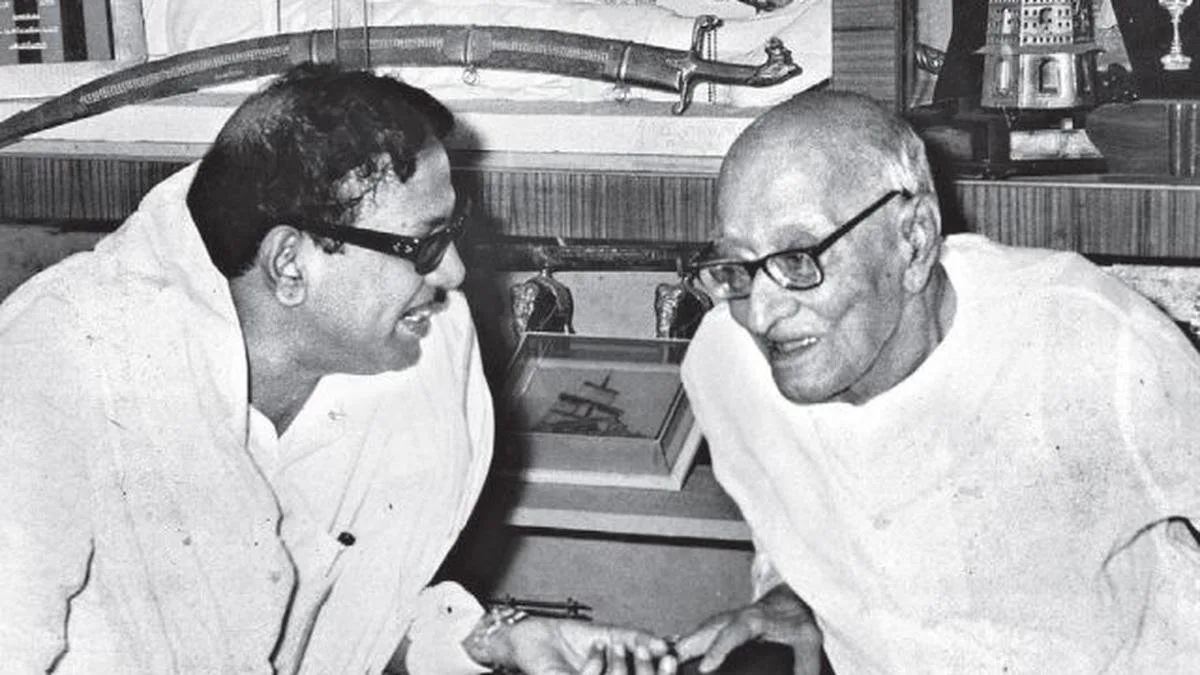
Rajaji with DMK's Muthuvel Karunanidhi (Image Source: X)

Rajaji with DMK's Muthuvel Karunanidhi (Image Source: X)

FacebookTwitterWhatsAppTelegramEmail

In the midst of alarming hooch tragedies claiming hundreds of lives in Tamil Nadu today, it’s intriguing to revisit a period when the state, alongside Gujarat, stood out as one of the only two in India to enforce a total prohibition of alcohol. The current trends are deeply concerning, yet they prompt a reflection on past solutions and strategies that could guide future reforms. Let’s embark on a journey through the fascinating history of Tamil Nadu’s approach to alcohol regulation and prohibition.

In 1971, Tamil Nadu stood alongside Gujarat as one of the two states in India to enforce a total prohibition on alcohol. This remarkable stance was not just a legislative decision but a bold experiment in social reform and governance. To understand this journey, we delve into the historical landscape where political giants shaped the state’s alcohol policies.

Rajaji’s Prohibition Era

The saga began in 1937, when Rajaji, a prominent leader of the Indian National Congress, assumed office as the Prime Minister of Madras Presidency. Armed with a vision to combat alcoholism, Rajaji initiated prohibition in stages, starting from his home district of Salem. Liquor shops shuttered, advertisements banned, and stringent measures imposed marked the early days of this ambitious social project. Despite concerns over revenue loss, Rajaji staunchly defended his actions, famously stating, “The rich must be taxed if the poor are to be saved.”

In a diplomatic move to avoid friction with the British colonial administration, Rajaji exempted European officers from prohibition, granting them permits to consume alcohol. Ironically, the British officials in Salem, including the district collector and police superintendent, chose to abstain voluntarily, underscoring the moral weight of Rajaji’s campaign.

Special concessions were granted to churches for sacramental wine and hospitals for medicinal purposes. Stringent policing against bootlegging became the norm, with alcohol addicts within the police force reassigned out of affected districts. Governor Lord Erskine praised the success of prohibition, drawing attention from even the British monarchy for its effective implementation.

Congress Continues Prohibition

Post-independence, Tamil Nadu continued its prohibition policy under Congress rule, setting it apart from neighbouring states like Andhra Pradesh and Mysore. However, the tide turned in 1971 when M. Karunanidhi assumed office as Chief Minister following C.N. Annadurai’s death. Despite opposition, Karunanidhi lifted the prohibition citing economic reasons, arguing that the state deserved compensation for lost revenue from the central government and coalition partners.

The End of an Era

Fast forward to 1971, when M. Karunanidhi assumed the Chief Minister’s office after the demise of C.N. Annadurai. Despite strong objections, especially from the legacy of Rajaji, Karunanidhi advocated for lifting the prohibition on economic grounds. He argued that the central government, under Indira Gandhi’s leadership, had failed to compensate states with existing prohibition policies for their revenue losses.

On a fateful evening in July 1971, Rajaji personally visited Karunanidhi to plead against the repeal of prohibition, warning of its detrimental effects on future generations. However, Karunanidhi remained resolute, and in the face of mounting opposition, the DMK government lifted the prohibition that had stood for over 25 years.

The Aftermath

With the stroke of a legislative pen, Tamil Nadu transformed from a bastion of sobriety to a state with flourishing alcohol and toddy markets. Chennai alone boasted 56 toddy shops and 52 liquor outlets, while districts like Thanjavur saw a proliferation of 1304 toddy shops. The state’s revenue surged, with annual earnings reaching 26 crores from alcohol sales alone. Yet, this economic gain came at a profound social and cultural cost, reflecting a stark departure from the ideals that once shaped the state’s moral landscape.

Reflections on Today

As we reflect on Tamil Nadu’s journey from prohibition to permissiveness, questions linger about the societal implications and the legacy of leaders like Rajaji and Karunanidhi. The shift underscores a broader narrative of evolving governance and economic priorities in post-independence India, where policies on alcohol continue to be debated in the context of public health, revenue generation, and social order.

Today, as Tamil Nadu grapples with the fallout of unrestricted alcohol consumption, the tale of its journey from prohibition to liberation serves as a poignant reminder of the delicate balance between public policy, economic imperatives, and social responsibility. The legacy of leaders like Rajaji, who upheld moral principles despite challenges, contrasts sharply with subsequent decisions that reshaped the state’s relationship with alcohol.

In the words of Thiruvalluvar, the revered Tamil poet and philosopher, the state’s current trajectory may evoke a sense of unease about the moral fabric and societal values that define Tamil Nadu today.

Topics: Tamil NaduDMK leader M KarunanidhiHooch tragedy death tollRajajiprohibition of alcohol
Share1TweetSendShareSend
✮ Subscribe Organiser YouTube Channel. ✮
✮ Join Organiser's WhatsApp channel for Nationalist views beyond the news. ✮
Previous News

Bangladeshi arrested in Surat with forged Hindu identity; 4 cases of illegal Bangladeshi immigration in last 72 hours

Next News

Grassroots and Glass-roofs: Modi 3.0 and Post-Binary Thinking

Related News

K Annamalai Resigns from BJP, Party accepts his resignation

Ex- Tamil Nadu party chief K Annamalai quits from BJP, Nitin Nabin accepts resignation

Tamil Nadu Governor Rajendra Vishwanath Arlekar

Tamil Nadu Governor calls Thiruvalluvar a ‘sanatani’; says his wisdom matters more than saffron or white robes

A huge crowd of Sanatanis, along with the Hindu Munnani Karyakartas, gathered to
protest near Coimbatore Power House in Sivananda Colony on May 15

Sanatan Dharma and Politics in Tamil Nadu: Eradicating the eternal

Tamil Nadu CM Joseph Vijay with PM Narendra Modi at Delhi on May 27

Tamil Nadu: CM Joseph meets PM Modi, thanks him for Aanaimangalam copper plates, raises Vande Mataram, fishermen issues

Tamil Nadu: Activist flags Rs 2,700 crore temple money in to TNPFC, seeks rollback of DMK-era HR&CE amendments

Padma Award recipients at the Civil Investiture Ceremony-I held at Rashtrapati Bhavan on May 25, 2026

Padma Awards 2026: Tamil Nadu’s cultural, literary and medical legends honoured by President

Load More

Latest News

Israel to Install Statue of Chhatrapati Shivaji Maharaj; Israel’s Consul General in Mumbai, Yaniv Revach, met Maharashtra Chief Minister Devendra Fadnavis and sough his support in this regard

Chhatrapati Shivaji Maharaj’s legacy to reach Israel; Statue to be installed as symbol of India-Israel friendship

IIGH Public Policy Seminar: Women’s dignity, safety & equal opportunity discussed

Representative Image

Decoding Hezbollah: How the terror group built a massive arsenal against Israel

Representative Image

Plastic, Traffic and Landslides: How rising tourist footfall is posing threat to the mountainous region

The Green Realignment: Why the US-India trade pact is a battle for climate and supply chain security

Sanatan Dharma teaches that spiritual growth is built through simple daily actions performed with sincerity, discipline, and devotion

Living Sanatan Dharma Every Day: 24 traditional habits that inspire a meaningful and virtuous life    

Indian Army to train 5 lakh personnel in drone operations; Scripting strategic edge in next gen battlefield tactics

CJP Under the Lens: From Delhi Riots defenders to foreign media endorsements

Cockroach Janata Party Under Scrutiny: From Naxal sympathizers to foreign media endorsements- Know real face of CJP

A representative image

The Middle Class Story: How governance reforms are powering India’s next growth engine

From Armenia and Greece to Cyprus, India's defence diplomacy is creating new pressure points for Turkey

How India’s Mediterranean Push and Indo-Pacific rise unsettle Turkey’s strategic calculus

Load More
  • Privacy
  • Terms
  • Cookie Policy
  • Refund and Cancellation
  • Delivery and Shipping

© Bharat Prakashan (Delhi) Limited.
Tech-enabled by Ananthapuri Technologies

  • Home
  • Search Organiser
  • Bharat
    • Assam
    • Bihar
    • Chhattisgarh
    • Jharkhand
    • Maharashtra
    • View All States
  • World
    • Asia
    • Africa
    • North America
    • South America
    • Europe
    • Australia
  • Editorial
  • Operation Sindoor
  • Opinion
  • Analysis
  • Defence
  • Culture
  • Sports
  • Business
  • RSS @ 100
  • Entertainment
  • More ..
    • Sci & Tech
    • Vocal4Local
    • Special Report
    • Education
    • Employment
    • Books
    • Interviews
    • Travel
    • Health
    • Politics
    • Law
    • Economy
    • Obituary
  • Subscribe Magazine
  • Read Ecopy
  • Advertise
  • Circulation
  • Careers
  • About Us
  • Contact Us
  • Policies & Terms
    • Privacy Policy
    • Cookie Policy
    • Refund and Cancellation
    • Terms of Use

© Bharat Prakashan (Delhi) Limited.
Tech-enabled by Ananthapuri Technologies