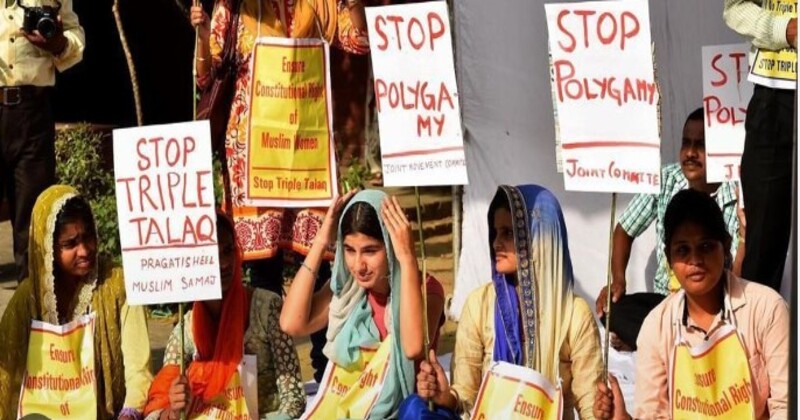
The recent news of the implementation of UCC in Uttrakhand, and the recommendation of a ban on polygamy in the state of Assam by a former High Court Judge-led panel has sparked a nationwide debate on the issue of polygamy. Many who support this contention, argue that it is necessary for gender justice whereas the opponents label it as an attack on minorities.
“Polygamy” comes from the Late Greek word polugamía, which means “state of marriage to many spouses” or the practice of a man marrying more than one woman. This practice has been outlawed by the Hindu Marriage Act, 1955 which applies to Hindus, including Sikhs, Buddhists, and Jains. Further, the Indian Penal Code, of 1860 penalizes the practice of bigamy under Sections 494 and 495. Moreover, the Christian law, Parsi law, as well as the Special Marriage Act, also forbids the practice of bigamy. However, the Shariat Protection Act exempts Muslims in India from being penalized under the aforementioned sections of the IPC. It hence acts as a shield for them in their practice of polygamy.
The shackling of women and the perpetuation of gender inequality are two of the main arguments levelled against the practice of polygamy as polygamy ascertains a proponent to the patriarchal power structures of these religions. On top of that, it keeps women at a disadvantage within the home and in marriage. In polygamy, men are allowed to have more than one wife, but women are not allowed to marry twice. Scholars also contend that polygamy serves to perpetuate the oppression of women by reinforcing the idea that they are inferior to males. In addition to reflecting a sexist culture, polygamy also undermines the entire idea of morality and gender justice norms set up by the revered Constitution of India.
To bring attention to the problematic elements of polygamy, the discussion surrounding individual liberty and equality was drawn out by philosophers like John Stuart Mill and Simone de Beauvoir. Mill, who was an outspoken advocate for personal freedom, said that “Freedom should only be curtailed when it starts to inflict harm on other people” and the idea of Polygamy squarely fits here since it harms the society by being a source of gender inequality and power inequalities. Further, Simone de Beauvoir’s theory pushed for women’s freedom from oppressive social institutions.
The right to life, as envisaged under Article 21 of the Indian Constitution, includes the right to live with dignity and polygamy is nothing but a clear and obvious violation of this sacrosanct principle. In Javed v. The State of Haryana, the court observed that “polygamy is a morally repugnant practice that the state has the authority to replace, much like Sati”. Further in Jafar Abbas Rasool Mohammad Merchant vs State of Gujarat, it was held that Articles 14 and 15 address non-discrimination by the state and equality before the law, respectively, and polygamy can be seen as a contravention to both these fundamental rights and if the state acts as a mute spectator it would be seen as if the practice has been aided and facilitated by the state machinery.
It is a well-established legal notion that Article 25 protects religious faith and not practices that may be harmful to public health, morality, or public order. The Supreme Court in Khursheed Ahmed Khan v. State of U.P reiterated that polygamy was not a fundamental religious practice and that the state had the authority to institute monogamy as a reform, being empowered by Article 25 which provides the state with the power to legislate with regard to social reform as observed in Javed v. State of Haryana.
Every individual is guaranteed the right to life and personal liberty under Article 21 and this has evolved into one of the foundational human rights protected by the Constitution of India which has been broadened by the interpretations and observations of the constitutional courts. Krishna Iyer, J., ruled in the Maneka Gandhi v. Union of India case that “personal liberty establishes the value of the human being”, further in Francis Coralie Mullin v. Administrator, Union Territory of Delhi, it was held that the right to life encompasses the right to be treated with human dignity. In a multitude of seminal decisions, the courts in India have always kept this particular fundamental right as sacrosanct to the liberty of an individual and when we talk about the right to life and personal liberty, gender justice and the dignity of women are something which should be non-negotiable principles. In today’s liberal culture, women must be given equal standing and any practice that undermines the dignity of women should be abolished.
Polygamy is an egregious behaviour that violates the dignity of the female spouse. Engaging in such conduct violates the conjugal rights, dignity, self-respect, and privacy of the wife, all of which are protected by Article 21. It is the responsibility of every individual to protect the privacy of their personal affairs, including those of their family, marriage, reproduction, motherhood, child-bearing, etc. The right to life encompasses the entitlement to maintain good health and mental status. The institution of polygamy engenders discord among women and detrimentally affects their psychological well-being. It is possible that the husband’s remarriage during their legitimate marriage could be considered emotional cruelty towards the first wife. Thus, polygamy is harmful to women and violates their guaranteed right to live peacefully in a stable mental condition. In contemporary society, marriage serves a purpose beyond being a convenient arrangement to satisfy biological, physical, and carnal desires without transgressing the moral standards of the era. Presently, spouses are deemed to serve a purpose beyond that of mere labourers on the assembly line that ensures the survival of the human race. The first wife views the second marriage as an ongoing wrong rather than a singular immorality. In a modern democratic society, gender equity is a fundamental requirement that safeguards the integrity of the nation. Practices that deny women opportunity and status equality have no place in contemporary liberal society. Any practice or custom, regardless of evidence to the contrary, that was prevalent before the Constitution cannot be regarded as a legal foundation for asserting rights if it is determined to be contrary to human rights, dignity, social equality, and the explicit mandate of the Constitution and parliamentary legislation. For quite some time, there has been a pressing need for a comprehensive prohibition on polygamy, given that it severely undermines the security and protection of spouses and also violates their fundamental rights.A recent research carried out by Emory University has also found that polygamous husbands are more likely to be violent towards their wives and children, and that abuse can occur from either the husband or wife.
No one is immune to the effects of gender inequality; it hinders women and men alike from escaping their present condition of deprivation and reclaiming their rightful place in society. The full range of constitutional safeguards needs to be extended to every community. There will be social backwardness and unequal development if some parts of society are left behind, and the whole community will also lag in the process of development. The progress and integrity of the nation are jeopardized by such uneven development. All communities must adhere to the three guiding values of secularism, equality, and fraternity. By guaranteeing women’s equality, the entire population would reap the benefits. Today when we celebrate “Aazadi ka Amrit Mahotsav” there are many who keep on facing the brunt of this archaic social practice.
Hence, a law to outlaw polygamy is necessary not only for achieving gender equality, and justice but also for honouring the ideals that our constitutional forefathers had dreamt for our nation. To foster social harmony and unity among its religiously and culturally varied population, India must support initiatives that promote equality and justice.