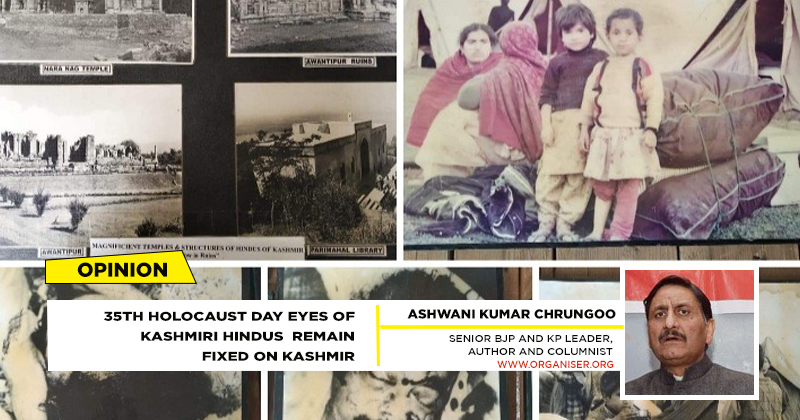
January 19, 2024 marks the 35th Holocaust Day of the Kashmiri Pandits. Their genocide and ethnic cleansing during the period 1989-90 and thereafter are an integral part of their history and civilization. The forced extermination from Kashmir led Kashmiri Pandits to an unwanted dispersal. They are facing hard questions relating to their survival, issues of identity and existential concerns. Despite losing much of their hope all these years regarding their resettlement in Kashmir, their eyes remain fixed on Kashmir all the time. Their soul and inner voice keep them alive to maintain dreaming about their cherished homeland in Kashmir.
We have been perpetually hearing the oft-repeated quotations like, “Kashmiri Pandits have been forced to live as refugees in their own country”, “Kashmiri Pandits need to be resettled in Kashmir with honour, dignity and security”, “Kashmir is incomplete without Kashmiri Pandits” etc over the last more than three decades of exile. Leaders of all hues, thinkers of various shades and key officials of the government have been observed using these phrases quite often whenever need be. For the last more than three decades, nothing tangible could be done beyond expression of these vague terms to suit the situation. In order to arrive at a plausible solution, it is important to analyse the key factors that affected the community of Kashmiri Pandits for the last four decades.
Extremism in Kashmir was not a sudden happening, it had its history, and the minority community of Kashmiri Pandits became a natural victim of this extremism in the valley. In absence of any responsible response to extremism and radicalism in Kashmir by the then government/s, these monsters overshadowed every sphere of activity in Kashmir. There is hardly any field of activity that hasn’t come under their influence, directly or indirectly. Terrorism was introduced in Kashmir valley in the late eighties only when the ground was already thriving with Muslim fundamentalism, extremism and radical ideology.
It needs to be made amply clear here that all the governments at the Centre right from 1947 up to 1990 failed to gauge the situation in Kashmir particularly in regard to the Kashmiri Pandits -the indigenous people of Kashmir. They ignored the alarming bells that sent regular messages about the indefinite future of the minority community in the valley. The governments both at the centre and in the state ignored the plight of the community in Kashmir and pursued a “policy of no-policy” about them, always and ever.
There was no major change of policy even after the forced mass exodus of the Pandits from Kashmir in 1989-90. Instead, their exodus was called “migration” and they were officially recognised as “migrants”. This author led a relentless struggle in the National Human Rights Commission (NHRC) for almost a decade during the 1990s pleading for recognition of genocide of the displaced community of Kashmir. The NHRC after a prolonged discussion, debate and hearing in its court (constituted for the purpose) said in its decision in June 1999, “the Commission is constrained to say that acts akin to genocide were committed against the Kashmiri Pandit community and……A genocide type design may exist against them in the minds and utterances of the terrorists and militants in Kashmir valley….they (Kashmiri Pandits) have not been given due understanding and relief that they deserved…..the excesses committed against them are starc and tragic”.
The Supreme Court of India, in its recent judgement on Article 370 also dwelt upon the issue of displacement of the Kashmiri Pandits. There are instances when a number of High courts made important observations about the banishment of Kashmiri Pandits. While J&K High Court said that “the migration of Kashmiri Pandits was unparalleled and cannot be compared with any other migration”, the Delhi High Court called the displacement as “ethnic cleansing”. The former Home Secretary of the government of India called the barbarism committed against the Pandits as “Genocide”. Amnesty International, Global Human Rights Defence and several other human rights bodies also expressed their genuine concerns about the mass exodus and human rights violations of Kashmiri Pandits.
All the above observations, pronouncements and decisions about the neglected community of Kashmiri Pandits were not taken to any logical conclusion by the powers that be. Ever since the displacement of the Kashmiri Pandit community in 1989-90, the displaced people of Kashmir have been demanding a statutory political representation in the Legislative bodies of the state and the country. Again, this author was instrumental in pursuing this cause with the Delimitation Commission and the government of India for the last five years persistently; and ultimately, the Parliament of India passed the Bill to provide two nominations to the displaced community in the J&K Legislative Assembly. With this opens the debate in regard to the final resettlement of the Kashmiri Pandits -the original inhabitants of Kashmir in the valley they belong to for the last thousands of years.
Earlier a few efforts were made in this direction that were called “rehabilitation of Kashmiri Pandits in the Kashmir valley” but all such attempts failed on the ground. One such attempt was the monetary incentive for rebuilding the damaged houses and the second was the linkage of PM’s employment package for the displaced youth with the issue of “rehabilitation”. It needs to be noted here that the resettlement of the Kashmiri Pandits in the valley is fundamentally a political issue that needs a political solution. Their resettlement in Kashmir, keeping in view their past and recent history, have to be realistic in essence and implementable in approach. It has to cater to the following four factors essentially: Land, constitutional guarantees for future, security, and economic viable opportunities. It is only on the basis of these factors together that the obligatory ‘sense of security’ will follow.
The demand of the Kashmiri Pandits for a homeland in Kashmir as enunciated in the Margdarshan-1991 resolution deliberated extensively on this subject. This government led by the PM Narendra Modi showed great guts to implement the Resolution ‘partially’ when it took historic steps on 5-6 August 2019 in the Parliament of India. The J&K state stands reorganised, Article 370 has been made dysfunctional, both Ladakh and J&K have been brought under central administration with the declaration of Union Territories and separatism based constitutional mechanism (separate constitution-flag-symbol, Article 35A and permanent resident concept) has also been done away with for ever. Public order has been restored by and large and law and order situation has also improved. The next step at the highest level should be to think in terms of the resettlement of the displaced Pandit community in Kashmir.
In order to arrive at the right situation in this regard, the government of India should initiate an appropriate dialogue and discussion on the subject directly with the credible representation of the Kashmiri Pandit community. The focus should be directly on the four factors ie land, constitutional guarantees, security and economic opportunities. The Margdarshan Resolution of 1991 can be the guiding policy document to achieve the desired results. This government led by the PM Modi is having both the intent and the capability to get it done. We have parliamentary elections on our head now and will wish that the government led by PM Narendra Modi comes back to power with a renewed and superior strength to take this intended process to the next level. In all circumstances, the eyes of the Kashmiri Pandits will surely remain fixed on Kashmir, their historical habitat for the last ten thousand years.