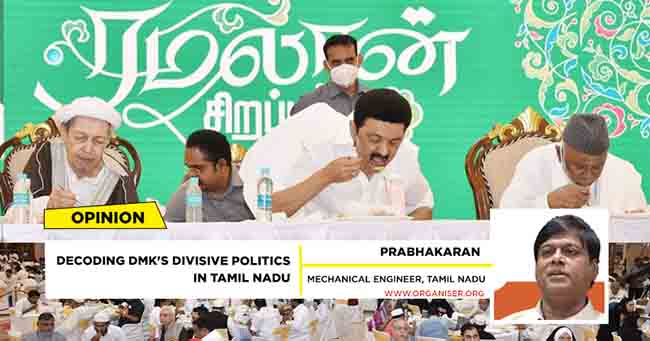
Political events in Tamil Nadu are always confusing, causing enthusiasts to either reject or ignore them, or to leave them to Tamilians to engage in. The statements made by DMK leaders such as Stalin about eradicating Sanatan Dharma, Maran’s statement about North Indians coming to Tamil Nadu for menial jobs, mocking Hindu festivals and sentiments, and fabricating narratives such as separate Dravidians/Dravidistan are not isolated or knee-jerk reactions. The goal of these arguments and their handlers is clear: to trap society in a cycle of aggressor and victim. So identifying the victim and aggressor is a real task here and determining who pushed society into this cycle is even more difficult and time-consuming.
“Our language and heritage define us – we won’t be enslaved by Hindi… Igniting the embers of the ‘1965 Anti-Hindi Imposition Agitations’ would be an unwise move”
— MK Stalin, CM Tamil Nadu
Despite the fact that the country entered Amrit Kaal with a new Parliament and Bharatiya-centric laws, the colonial political hangover persists, particularly in Tamil Nadu, where the former Justice Party, which was rooted in British-style divide and rule politics, is still playing the old game of victims and aggressors, similar to Communists’ “haves” and “have-nots.”
Isolating Madras Presidency
As we all know, the British established Indian National Congress in 1885 in order to avoid a repeat of the 1857 military-style Independence war against them. Until 1930, Congress members gladly served as a platform for movements demanding dominion status for India. Furthermore, the British devised a strategy to isolate each province, particularly the Madras Presidency, from the others. To decolonise ourselves in this Amrit Kaal, we must first identify how we were colonised by European forces. Once the plunder is secured, a thief is unconcerned about the target’s or victim’s safety. When targeting a wealthier victim, however, the thief must possess exceptional skills and employ strategic methods to keep the target unaware of the ongoing theft for an extended period of time. A meticulous strategy, advanced skills and a mechanism to withstand minor revolts or obstacles are all required if the loot is to last for centuries.
During Islamic rule, landlords and slaves, elites, and common people were divided to consolidate power. In essence, these binaries are often crafted and exploited by the British for generations
This can be applied to European colonial forces who arrived on the shores of Bharat in the late 15th century, and over the next 200 years, the French, Dutch, Spanish and British discovered that Bharat is economically wealthy and they were tasked with an unending destroying project. The British rose to prominence at a time when foreign Islamic rulers were weakening and Hindu kings were not powerful enough to dethrone the Muslims. During this time period, the British faced no or little opposition from Hindu kings or Muslims, making life easy for the colonial thieves.
During this time, British forces overpowered their rivals and established a strong foothold in most parts of the country, and they also survived an Indian-led military campaign in 1857. Following this unexpected setback, the East India Company safely handed over their occupied territories to the British Crown, beginning British Parliament rule in India for 89 years.
Social Change at Madras Presidency
After 1858, the entire political and social structure of the country, particularly in the Madras Presidency, changed almost in every section of society at every political, social and economic layer. The Presidency, which lasted from the late 17th century until Indian Independence in 1947, covered a wide range of regions. Madras (Chennai), Coimbatore, Madurai and Tiruchirappalli are cities in Tamil Nadu that form the heart of the Madras Presidency. Moving North, the province encompassed the Northern parts of modern-day Andhra Pradesh, including areas such as coastal Andhra and Rayalaseema. At various times, portions of modern-day Kerala’s Malabar region were also part of the Madras Presidency. Furthermore, some Northern districts of modern-day Karnataka, such as Bellary and South Canara, were included in the administrative unit, which was subject to the Madras Presidency’s extensive and diverse geographical coverage.
Playing Politics With Languages
To control how people perceive society, the British created distinctions. They began emphasising differences in languages such as Tamil, Telugu, Kannada, and Malayalam, making one language appear more important than another and denying dialects respect. To maintain a hierarchy, societal groups such as Brahmins, non-Brahmins and Dalits were highlighted, mirroring European social orders such as rulers, knights, and serps. Gender divisions and the rights of men and women have become contentious issues.
Power dynamics were strategically framed, with some castes described as aggressors and others as victims. Societal hierarchies, such as the perceived superiority of certain castes over others, are maintained to maintain control. Even distinctions based on skin colour, such as black and white, were manipulated to serve the interests of those in power.
The British grouped and reinterpreted physical and intellectual working castes as working and non-working classes. Language became a weapon, causing divisions between dialects, languages and literature. Spiritual beliefs were manipulated, labelling some as local deities and others as Vedic deities, Gods with and without weapons, creating groups of peaceful and aggressive Gods and causing generations of confusion. During Islamic rule, landlords and slaves, elites, and common people were divided to consolidate power. In essence, these binaries are often crafted and exploited by the British for generations.
While society was fighting for survival, the British looted the people under the cover of taxation with little resistance.
Laws Framed by the British
To name a few, the Indian Arms Act of 1871, in theory about firearms, in practice allowed confiscation of any agricultural tool with a long, sharp edge. In some absurd cases, even sickles were registered by the police. This was aimed at crushing the martial spirit of the rural masses.
Another shameful enactment was the “Criminal Tribes Act of 1878,” considering criminality hereditary. Many sections of society were brought under this act, forcing the unfortunate to report to the police station at dusk daily and remain confined until dawn. Mobility was brutally restricted. Travel required a “Radhari Chit,” a pass handed over to the police at the destination. Entangled communities either dwindled or fled to their native villages.
Conspiracy at Intellectual Level
At the intellectual level, the British, under the theory of ‘Whiteman’s Burden,’ propagated Bharatiya’s diversity as differences, and in order to subvert and demoralise Hindus, they established theological organisations, Christian Missionary schools to generate a large quantity of British and Eurocentric literature and narrative aimed at elites, bureaucracy, and school and college education systems.
William Jones established the Indo-Aryan language family, and Max Muller, Bopp, and others assigned it a “Central Asian homeland.” A rear assault from the south was led by Robert Caldwell, GU Pope, and Constantine Beschi, among others. In Bishop Caldwell’s book, The Comparative Study of Dravidian Languages, the argument was that Dravidians were the indigenous people of the South, while Brahmins were labelled as Aryan migrants who created the caste system, shunned manual labour, invented rituals for a living, and monopolised sinecures and Government jobs.
Through these organisations and literature, the British successfully created a layer of people who were British in thought but born in Bharat, a vicious seed that is still challenging the country’s nationalists.
Factors Behind Dravidian Movement
In Madras Presidency, there were several factors that contributed to the rise of the Dravidian movement. Some of the key points include:
Limited Awareness of Benefits: Early on, there was little understanding among people particularly who were not educated or connected to British administrations other than landlords and Brahmin sections. They perceived that English education will bring wealth and power. A pass in the 8th grade could secure a clerical position, while a degree could open doors to prestigious careers. When these early graduates entered revenue services, police, and legal professions, wielding significant power and influence, the non-Brahmin communities who had missed out on these opportunities became increasingly frustrated by the perceived Brahmin and landlords dominance.
Nepotism in Bureaucracy: Until the early 20th century, there was no proper recruitment system for lower levels of administration. Mostly Brahmins and landlords, who had access to English education, created an ecosystem of their families and friends. Thus all the junior or clerical positions were filled with perpetuating their hold on them and positions. A perception of British will stay in India or run with dominion status; they build their family network to secure their families and upcoming generations. On the one hand, Brahmins perceive this as security, while on the other, it is perceived as nepotism, a dual thought that is true for both sides.
“Who learn English get good jobs in IT, but those who learn only Hindi — people from UP and Bihar — end up cleaning roads and toilets. This is what happens when one learns only Hindi” — Dayanidhi Maran, DMK MP
This brief overview of post-Independence Tamil Nadu politics highlights the importance of regional dynamics, evolving alliances and the emergence of charismatic leaders. While questions about national parties’ struggles in the State may arise, the answer lies not solely in the Dravidian ideology but also in the complex interplay of internal rivalries, political strategies, and the rise of strong regional alternatives.
The interdependent communities of Dakshinapatha were divided by the British and nurtured by their laws for nearly 150 years, brought deep rooted divisions and created a complex social framework. Unfortunelty, post Independence these same were carried out under the name of Dravidian politics, whose leaders are emboldened enough to threaten to eradicate Sanatan Dharma. Now it is the time to uproot and eliminate their presence or influence with Swa based themes of Swadharma, Swabhiman and Swarajya.