Chandrayaan-3 has come a long way since its successful launch from the Satish Dhawan Space Centre in Sriharikota Range (SDSC SHAR) on 14 July at 14:35 IST. With its sights set on the Moon, India’s lunar mission features a lunar lander and a rover that will spend 14 days carrying out scientific activities on the surface. Andis India isolated in this exercise? no!
Here’s where the Vasudhaiva Kutumbakam (the world is but one family) philosophy that Prime Minister Narendra Modi talks of so often comes into play.
In addition to ISRO’s own deep space communication antenna, the Chandrayaan-3 mission will rely on support from ground stations around the world, coordinated by the National Aeronautics and Space Administration (NASA) and the European Space Agency (ESA). Chandrayaan-3 consists of a propulsion module, a lander module and a rover and the master controls of all three will be operated from ISRO’s Spacecraft Control Center in Bengaluru, India.
Another ESA station has tuned in to the #Chandrayaan_3 mission!
ESA’s 35-metre deep space antenna in New Norcia, Australia, will provide tracking support during the Lander Module’s descent to the lunar surface.
First contact with the module was established yesterday. pic.twitter.com/BtFJdwH2bI
— ESA Operations (@esaoperations) August 21, 2023
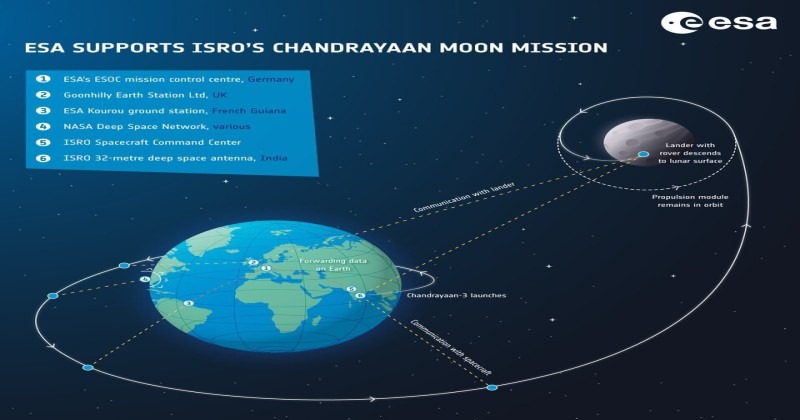
ESA supports ISRO’s Chandrayaan-3 mission:
1. ESA’s ESOC Mission Control Centre, Germany
2. Goonhilly Earth Station Ltd., UK
3. ESA Kourou Ground Station, French Guiana
4. NASA Deep Space Network, at various locations
5. ISRO spacecraft Command Centre. ISRO 32-metre Deep Space Antenna, India
New Norcia will serve as a back-up for @isro's ground station during the landing, currently planned for Wednesday 23 August.
Our station will receive vital signs from the lander – information about its health, location and trajectory – in parallel with the ISRO station. pic.twitter.com/PIThWlyUvg
— ESA Operations (@esaoperations) August 21, 2023
Why can’t ISRO do it alone?
Whatever forays into outer space are taken up by any agency or country, communication is an essential part of every deep space mission. Key to any space journey – manned or unmanned – is ground support from the stations on Earth that keep operators safely connected to spacecraft as they venture into the unknowns and risks of space.
This kind of back-up tracking is normal for critical mission operations such as a landing.
The New Norcia support on landing day comes on top of the routine support throughout the mission from @esa's Kourou station and @goonhillyorg. pic.twitter.com/s8KicuteBk
— ESA Operations (@esaoperations) August 21, 2023
How otherwise would scientists and mission teams on the ground get any data from a spacecraft, or know how the operation is going, how the instruments are doing, whether the spacecraft is safe or even know where it is?
ISRO is proud of its state-of-the-art 32-metre deep space tracking station that it operates in its home country India, thus enabling scientists to locate, track, command and receive telemetry as well as acquire scientific data from its distant spacecraft. But the Earth is rotating and also in a trajectory around the Sun, therefore, positions change and so do vantage positions.
Sometimes, ISRO’s operators need to track or command a spacecraft when it is outside the field of view of this antenna.
ESA explains the reason behind the collaboration for this mission between ISRO, ESA, and NASA thus, “Building new giant antennas and control stations around the world is very expensive. So, like many space agencies and commercial companies across the globe, ISRO will receive support from the stations of partner organisations instead. Not only does this significantly reduces costs, but it also fosters international spaceflight collaboration.”
Like all our deep space stations, New Norcia is controlled remotely from our ESOC #MissionControl centre in Germany.
It is managed locally by our Australian partners, @CSIRO.
We’re all set for landing day! #Chandrayaan_3 #Moon #ISRO #ESA pic.twitter.com/wKDj55f6VY
— ESA Operations (@esaoperations) August 21, 2023
“Since the launch of Chandrayaan-3, ESA has been supporting the mission by utilising two of the ground stations in the ESTRACK network to track the satellite in its orbit, receive telemetry from the spacecraft and forward it to the Mission Operations Centre in Bengaluru, and forward commands sent from Bengaluru to the flying satellite,” Ramesh Chellathurai, ground operations engineer at ESOC Darmstadt, Germany told an Indian national daily.
The European Space Agency has established a global ‘Estrack’ network of deep space tracking stations.
This network is a global system of ground stations providing links between satellites in orbit and ESOC, the European Space Operations Centre, Darmstadt, Germany. The core Estrack network comprises seven stations in seven countries.
ESA can help its partners track, command and receive data from spacecraft almost anywhere in the Solar System via its ESOC mission control centre in Darmstadt, Germany.
ESA’s 15 m antenna in Kourou, French Guiana helped ISRO confirm that the spacecraft had survived the rigours of lift-off and was in good health as it proceeded on its journey to the Moon.
As the spacecraft receded from Earth, ESA’s 32-metre antenna operated by Goonhilly Earth Station Ltd in the UK supported Chandrayaan-3’s propulsion and lander modules.
Crucially, it will support the lander during the entire phase of lunar surface operations, helping to ensure that science data acquired by the rover arrives safely with ISRO.
The two European stations will complement support from NASA’s Deep Space Network and ISRO’s own stations to ensure the operators and scientists at ISRO never lose sight of their pioneering Moon craft that will demonstrate to mankind the new technologies required for interplanetary spaceflight.
What will Chandrayaan-3 do after a successful landing?
Chandrayaan-3 has been programmed to carry out surface operations that will last for approximately 14 days.
At the moment Chandrayaan’s lunar is in lunar orbit after it has piggy-backed its way on the propulsion module till there. On 23rd August 2023, the lander will separate and begin its descent to the surface of the moon, while the propulsion module will remain in lunar orbit and use its scientific payload to study Earth.
The lander module has its job etched out. After its soft landing, it will deploy its instruments to measure the surface temperature and seismic activity around the landing site, using a laser retroreflector provided by NASA. Meanwhile, the rover’s instruments will be used to investigate the composition of nearby lunar surface material.