Nuh Violence: Understanding Theology of Vandalism
June 5, 2026
  • Read Ecopy
  • Circulation
  • Advertise
  • Careers
  • About Us
  • Contact Us
Android AppiPhone AppArattai
Organiser
  • ‌
  • Bharat
    • Assam
    • Bihar
    • Chhattisgarh
    • Jharkhand
    • Maharashtra
    • View All States
  • World
    • Asia
    • Europe
    • North America
    • South America
    • Africa
    • Australia
  • Editorial
  • International
  • Opinion
  • RSS @ 100
  • More
    • Op Sindoor
    • Analysis
    • Sports
    • Defence
    • Politics
    • Business
    • Economy
    • Culture
    • Special Report
    • Sci & Tech
    • Entertainment
    • G20
    • Azadi Ka Amrit Mahotsav
    • Vocal4Local
    • Web Stories
    • Education
    • Employment
    • Books
    • Interviews
    • Travel
    • Law
    • Health
    • Obituary
  • Subscribe
    • Subscribe Print Edition
    • Subscribe Ecopy
    • Read Ecopy
  • ‌
  • Bharat
    • Assam
    • Bihar
    • Chhattisgarh
    • Jharkhand
    • Maharashtra
    • View All States
  • World
    • Asia
    • Europe
    • North America
    • South America
    • Africa
    • Australia
  • Editorial
  • International
  • Opinion
  • RSS @ 100
  • More
    • Op Sindoor
    • Analysis
    • Sports
    • Defence
    • Politics
    • Business
    • Economy
    • Culture
    • Special Report
    • Sci & Tech
    • Entertainment
    • G20
    • Azadi Ka Amrit Mahotsav
    • Vocal4Local
    • Web Stories
    • Education
    • Employment
    • Books
    • Interviews
    • Travel
    • Law
    • Health
    • Obituary
  • Subscribe
    • Subscribe Print Edition
    • Subscribe Ecopy
    • Read Ecopy
Organiser
  • Home
  • Bharat
  • World
  • Operation Sindoor
  • Editorial
  • Analysis
  • Opinion
  • Culture
  • Defence
  • International Edition
  • RSS @ 100
  • Magazine
  • Read Ecopy
Home Bharat

Nuh Violence: Understanding Theology of Vandalism

After unleashing violence, Islamists have developed a habit of justifying it in the name of Islam. Undoubtedly, Islamic vandalism has led to radicalisation in India

Dr Prashant BarthwalDr Prashant Barthwal
Aug 8, 2023, 07:00 pm IST
in Bharat, Analysis
Follow on Google News
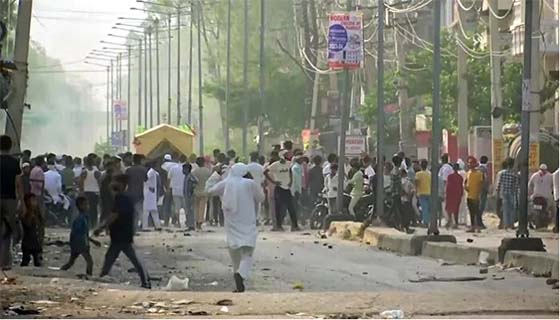
Severe violence erupted in Nuh after Islamists attacked on Hindu procession

Severe violence erupted in Nuh after Islamists attacked on Hindu procession

FacebookTwitterWhatsAppTelegramEmail

India, a diverse nation renowned for its rich cultural heritage and religious pluralism, has faced an alarming rise in political violence tied to Islamic extremism in recent years. The acts of Islamic vandalism, perpetrated by radicalised individuals and groups, have contributed to an atmosphere of fear, hatred, and discord within the country. In recent times, the world has witnessed a rising trend of secularists attempting to rationalise and support acts of vandalism carried out in the name of religion. One such instance that has sparked significant controversy is the Islamic vandalism in Nuh, Haryana.

Examining Islamic Vandalism

This critical essay aims to shed light on the detrimental consequences of justifying or supporting such actions, highlighting how it constitutes an anti-national act. Further, it also aims to critically examine the spread of Islamic vandalism and its connection to political violence in India, shedding light on the root causes, implications, and possible solutions to this pressing issue.

Islamic vandalism refers to the deliberate desecration, destruction, or defacement of religious sites, symbols, and artefacts by individuals or groups who claim to act in the name of Islam. This form of aggression against religious diversity and cultural heritage not only reflects a blatant disregard for India’s pluralistic values but also serves as a means to intimidate and assert dominance over other religious communities. Political violence, on the other hand, encompasses acts of terrorism, communal riots, and targeted violence with a political agenda. While these acts may be perpetrated by individuals or groups from various ideological backgrounds, the association of political violence with Islamic vandalism becomes pertinent when radical Islamic ideologies inspire or justify such actions.

Reasons for Intolerance

The rise of religious intolerance and polarisation in India has created an environment conducive to extremism. The polarising rhetoric from some political leaders, communal incidents, and social media echo chambers have further exacerbated these tensions. Further, the socio-economic disparities and marginalisation of certain communities can lead to feelings of alienation and frustration, making them vulnerable to radicalisation and extremist ideologies. India has not been immune to the influence of global jihadist organisations. These groups seek to exploit local grievances and create a fertile ground for their ideology to take root. Weaknesses in law enforcement and intelligence agencies can hamper effective counter-terrorism efforts, allowing radical elements to operate with relative ease.

Vitiating Communal Atmosphere

Islamic vandalism undermines the trust and harmony between religious communities, leading to the fragmentation of society along religious lines. Acts of political violence based on radical Islamic ideologies can stoke political tensions, creating instability and hindering the democratic process. The destruction of historical and religious sites not only robs India of its cultural treasures but also erodes its collective memory and identity. Political violence and instability can deter foreign investments and disrupt economic growth, affecting the livelihoods of ordinary citizens.

The Nuh region has seen its share of communal tensions, with instances of vandalism perpetrated in the name of Islam. While some secularists may argue that this stems from perceived injustices and marginalisation faced by the Muslim community, it is crucial to acknowledge that any act of violence or vandalism is inherently unlawful and counterproductive. Secularists who advocate for justifying Islamic vandalism in Nuh often argue from a position of empathy and concern for religious minorities. They may claim that historical injustices have led to a sense of alienation, pushing some individuals towards extreme measures. While it is essential to address social disparities, legitimising vandalism as a means of expressing dissent sets a dangerous precedent that undermines the fabric of a pluralistic society. One of the most significant threats posed by the justification of Islamic vandalism is the erosion of national unity. India is a diverse country with multiple religious and ethnic groups coexisting. The concept of secularism, enshrined in the Indian Constitution, ensures the equal treatment of all citizens regardless of their religious affiliation. However, justifying religiously motivated acts of violence only serves to deepen the divides and weaken the country’s social fabric. The rule of law is a fundamental pillar of any democratic nation. When secularists support or justify Islamic vandalism, they send a clear message that the rule of law can be overlooked in certain situations, depending on the identity of the perpetrator. This selective application of justice threatens the very essence of a fair and equitable society. The acceptance or support of religious vandalism by secularists sets a dangerous precedent for other extremist groups, regardless of their religious affiliations. If vandalism is condoned in one case, it opens the floodgates for others to justify their actions based on their own grievances. This escalating cycle of violence and disorder could tear apart the social fabric of the nation. By endorsing or defending Islamic vandalism, secularists inadvertently alienate moderate voices within the Muslim community who seek peaceful and constructive means of addressing their grievances. This alienation hampers the efforts of moderate voices to promote a harmonious coexistence, further polarising society.

The rising tide of Islamic vandalism and its connection to political violence is a concerning trend that demands urgent attention from all stakeholders in Indian society. Addressing the root causes and adopting a multi-faceted approach that encompasses interfaith dialogue, education, socio-economic reforms, and responsible political leadership can help India confront this menace effectively. Justifying or supporting Islamic vandalism in Nuh as an act of dissent or protest is undeniably an anti-national act. Instead of perpetuating divisions, secularists/intellectuals or other political leaders should promote dialogue, tolerance, and respect for the rule of law to strengthen the fabric of the nation and foster harmonious coexistence among its diverse communities. It is only by fostering unity, tolerance, and understanding that India can preserve its democratic values and cultural heritage while countering the menace of political violence stemming from Islamic vandalism.

(Views expressed are personal)
Topics: counter-terrorism effortsIslamist ViolenceHarayana Nuh ViolenceIslamic vandalismNuh regionreligious minoritiesCommunal Atmosphere in Nuh
Share8TweetSendShareSend
✮ Subscribe Organiser YouTube Channel. ✮
✮ Join Organiser's WhatsApp channel for Nationalist views beyond the news. ✮
Previous News

Kainchi Dham in Uttarakhand becomes another temple to ban entry of devotees in ‘revealing’ clothes

Next News

Uttar Pradesh Honor Killing: Afreen Bano killed by father and brother over alleged relationship with a Hindu boy 

Related News

The Global Terrorism Index 2026 puts the claim, “Terrorism has no religion?”, to the test and reveals stark global terror patterns

Terror Has No Religion? 2026 global indices challenge the claim, exposing patterns in Islamist violence worldwide

A representative image

Bihar to get 5 new regional units of Anti-Terrorism Squad

External Affairs Minister Dr. S. Jaishankar addresses the G-20 Foreign Ministers' Meet at New York

Wars derailing the growth of Global South, world must show “zero-tolerance” to terrorism: Dr. Jaishankar at G-20 meet

Bangladesh govt officially targets Organiser and OpIndia for exposing systematic anti-Hindu Pogrom

Representative image

India’s UN Representative raises voice at UNHRC over persecution of Hindus and Christians in Pakistan

Planned attack: CM Fadnavis vows action as fake social media Quran-burning rumour trigger violence by Islamists

Load More

Latest News

RSS Sarsanghchalak Dr Mohan Bhagwat

The time of Bharat has arrived; we need to expedite our preparation: Dr Bhagwat at RSS Karyakarta Vikas Varg 2

Padma Bhushan awardee and noted industrialist Kumar Mangalam Birla Kumar Mangalam Birla addressing the Samapana Samaroh (Valedictory Function) of the Rashtriya Swayamsevak Sangh Karyakarta Vikas Varg – Dwitiya at Nagpur, on June 4, 2026

“RSS always stood by the society and nation”, Kumar Mangalam Birla at RSS Karyakarta Vikas Varg 2 in Nagpur

Arunachal Pradesh seals all 15 illegal Mosques; Bandh called off by APIYO

MK Stalin with Sonai Gandhi; MK Stalin with Rahul Gandhi (File Photos) (Left to Right)

Tamil Nadu: DMK says no to INDIA Alliance meet in Delhi, blames Congress for political backstabbing

Union Finance Minister Nirmala Sitharaman

Karnataka: All-Women team powers Yadgir’s groundnut revolution; Nirmala Sitharaman inaugurates NABARD Unit

Keralam: Jamaat-e-Islami event features Hamas and Muslim Brotherhood ideologues, raises concerns over Political Islam

Representative Image (This is an AI Generated image)

Uttar Pradesh CM Abhyudaya Scheme: Apply for free civil services, JEE and NEET coaching from June 5

House worth Rs 2 crore of drug peddler bulldozed in J&K

Anti-narcotics campaign in J&K: Police demolish Rs 2 crore residential property linked to drug peddler Sheikh Tasaduq

As fuel shortages rippled across Asia, New Delhi expanded supplies to its neighbours while Beijing sought to turn energy security into strategic influence.

The Hormuz Test: How India’s energy assistance outshines China’s conditional approach

Demographic changes in Bharat’s border districts have raised concerns about migration, security, and social cohesion

Demographic Shift in Border Areas of Bharat: The dangerous design

Load More
  • Privacy
  • Terms
  • Cookie Policy
  • Refund and Cancellation
  • Delivery and Shipping

© Bharat Prakashan (Delhi) Limited.
Tech-enabled by Ananthapuri Technologies

  • Home
  • Search Organiser
  • Bharat
    • Assam
    • Bihar
    • Chhattisgarh
    • Jharkhand
    • Maharashtra
    • View All States
  • World
    • Asia
    • Africa
    • North America
    • South America
    • Europe
    • Australia
  • Editorial
  • Operation Sindoor
  • Opinion
  • Analysis
  • Defence
  • Culture
  • Sports
  • Business
  • RSS @ 100
  • Entertainment
  • More ..
    • Sci & Tech
    • Vocal4Local
    • Special Report
    • Education
    • Employment
    • Books
    • Interviews
    • Travel
    • Health
    • Politics
    • Law
    • Economy
    • Obituary
  • Subscribe Magazine
  • Read Ecopy
  • Advertise
  • Circulation
  • Careers
  • About Us
  • Contact Us
  • Policies & Terms
    • Privacy Policy
    • Cookie Policy
    • Refund and Cancellation
    • Terms of Use

© Bharat Prakashan (Delhi) Limited.
Tech-enabled by Ananthapuri Technologies