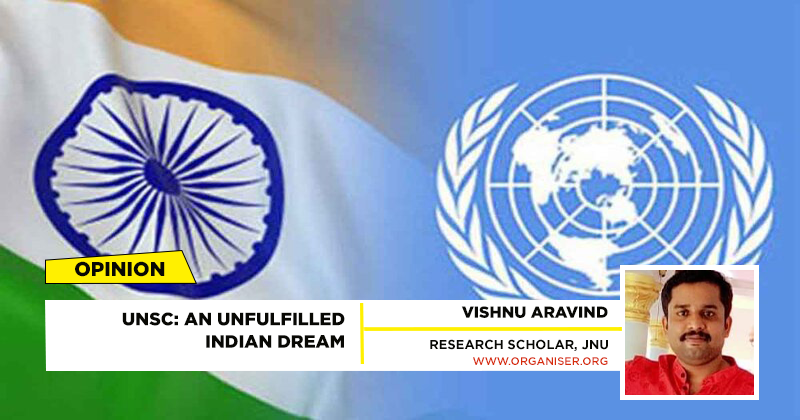
UNSC: An unfulfilled Indian dream
September 14, 2026
  • Read Ecopy
  • Circulation
  • Advertise
  • Careers
  • About Us
  • Contact Us
Android AppiPhone AppArattai
Organiser
  • ‌
  • Bharat
    • Assam
    • Bihar
    • Chhattisgarh
    • Jharkhand
    • Maharashtra
    • View All States
  • World
    • Asia
    • Europe
    • North America
    • South America
    • Africa
    • Australia
  • Editorial
  • International
  • Opinion
  • RSS @ 100
  • More
    • World Hindu Congress 2026
    • Op Sindoor
    • Analysis
    • Sports
    • Defence
    • Politics
    • Business
    • Economy
    • Culture
    • Special Report
    • Sci & Tech
    • Entertainment
    • G20
    • Azadi Ka Amrit Mahotsav
    • Vocal4Local
    • Web Stories
    • Education
    • Employment
    • Books
    • Interviews
    • Travel
    • Law
    • Health
    • Obituary
  • Subscribe
    • Subscribe Print Edition
    • Subscribe Ecopy
    • Read Ecopy
  • ‌
  • Bharat
    • Assam
    • Bihar
    • Chhattisgarh
    • Jharkhand
    • Maharashtra
    • View All States
  • World
    • Asia
    • Europe
    • North America
    • South America
    • Africa
    • Australia
  • Editorial
  • International
  • Opinion
  • RSS @ 100
  • More
    • World Hindu Congress 2026
    • Op Sindoor
    • Analysis
    • Sports
    • Defence
    • Politics
    • Business
    • Economy
    • Culture
    • Special Report
    • Sci & Tech
    • Entertainment
    • G20
    • Azadi Ka Amrit Mahotsav
    • Vocal4Local
    • Web Stories
    • Education
    • Employment
    • Books
    • Interviews
    • Travel
    • Law
    • Health
    • Obituary
  • Subscribe
    • Subscribe Print Edition
    • Subscribe Ecopy
    • Read Ecopy
Organiser
  • Home
  • Bharat
  • World
  • Operation Sindoor
  • Editorial
  • Analysis
  • Opinion
  • Culture
  • Defence
  • International Edition
  • RSS @ 100
  • Magazine
  • Read Ecopy
Home Bharat

UNSC: An unfulfilled Indian dream

Dr Vishnu AravindDr Vishnu Aravind
Jul 7, 2023, 09:00 pm IST
inBharat, Andaman and Nicobar Islands, Opinion
Follow on Google News
Facebook
Twitter
WhatsAppTelegramEmail

Prime Minister Narendra Modi reaffirmed India’s long-standing demand for permanent membership in the Security Council during his trip to the United States in June. Subsequently, S Jaishankar, India’s foreign minister, declared India’s candidacy for temporary membership in the council for the years 2028–2029. Later, India received support from many states, including the foreign minister of Great Britain. However, the Security Council reform agenda was again put on hold for the 25th time at the UN General Council meeting that was held on June 29. India vehemently opposed this action. Currently, China, France, Russia, Britain, and the United States are the five permanent members of the 15-member Security Council. Ten non-permanent members were chosen for two-year terms, and one permanent member has the power to veto any resolution. Whether the council is relevant or not is up for debate, but belonging to the world’s highest body of power is an honour and, more than that, something to be proud of for any nation.

India’s Eligibility

The country most suitable for permanent membership is India. The country is the world’s oldest and most populous democracy and is regarded as the mother of democracy. The nation promotes itself as a tranquil society that upholds the idea that “Vasudhaiva Kudumbaka” (the World is one family) is true. The nation continues to serve as the voice of the developing nations of the south. With 18 per cent of the world’s population, India is also the most populous nation, has the world’s fastest-growing economy, is a reliable nuclear power, and contributes military personnel to the UN’s peacekeeping mission. Additionally, the nation offers financial aid for humanitarian causes during all significant international crises. India has additionally met more than all requirements set forth by the UN for membership and has been a member since the

organisation’s founding. In addition, aside from a select few nations, other nations want to give India permanent membership. This is evidenced by the 184 votes India received in the election for temporary membership in the Council in 2021, out of a total of 193.

Missed Opportunities

Despite years of efforts to obtain permanent membership, India has a history of wasting opportunities. Offers from the United States and the Soviet Union were turned down during the Nehru administration. If one considers the state of the world at the time, it is questionable to what extent the Soviet promise was sincere.

India, a democratic state in Asia, was nonetheless invited to the Security Council by the US considering worries about Chinese expansion. In this regard, Nehru’s sister Vijayalakshmi Pandit, who was also India’s ambassador to the US, wrote to him in August 1950: “I have learnt of the discussions in the US State Department about the possibility of replacing China from the Council with India. Also, I was also asked by American journalists to accept the proposal and influence public opinion in India.” I said, ‘This will not be accepted in India.’’ A week later, Nehru wrote back, stating that “we must press for China’s accession to the Council” because “America’s wishes would not be heeded, India’s accession would be tantamount to insulting China and would lead to a deterioration of Indo-Chinese relations, the Soviet Union would leave the UN in protest, and the world would go to war.” The Soviet Union made a similar attempt in 1955, according to Sarvepalli Gopal, a historian, and the son of former vice president Dr S. Radhakrishnan, who wrote a biography of Nehru in 1979.

India was to be the sixth member, according to the Soviet plan. Volume 29 of ‘Jawaharlal Nehru Selected Works’ contains the correspondence between Nehru and Nikolai Bulganin, the Soviet Prime Minister at the time, which contains the same details. Bulganin penned: “We are interested in nominating India as the sixth member”. Nehru’s response, however, was odd. He replied “This would exacerbate tensions between India and China, involve India in controversies, and prompt changes to the UN Charter, therefore, we strongly oppose the proposal because the issue of China’s membership is the first to be resolved.

Another aspect of the story is that the Soviet Union had conquered dozens of nations and imprisoned billions of people by the year 1955, including those living on its own territory. As a result, it is unlikely that the Soviet Union would consent to India’s admission to the Security Council as a democratic nation. The pledge can also be viewed as a plan to comprehend India’s interest in the matter. In any case, it is evident from both contexts that Nehru did not place any value on India’s interests while serving as prime minister. This is the context in which Ambedkar criticized Nehru’s foreign policy for being centred on “what China will think.”

Possibilities and Barriers

The United States, Britain, France, and Russia are four of the Council’s five permanent members who support India’s membership. China, the only nation with a veto, opposes it because conflicts between China and India frequently involve the United Nations. When it comes to issues like Kashmir and terrorists, China has sided with Pakistan in the UN. China cannot, therefore, be expected to support India. Hope was raised by the unofficial meetings between Modi and Xi in Wuhan and Mahabalipuram, but this was dashed by the fighting in Galwan and Tawang. The expansion of the council is also hampered by internal issues and the self-interests of the current permanent members.

However, India came out on top with 26 per cent of the vote, followed by Japan (11 per cent) and Brazil (9 per cent), in a recent poll by the Atlantic Council, a think tank, to identify the state most likely to become permanent members of the Security Council in 2033. However, according to 64 per cent of respondents, by 2033, the UN’s most powerful body won’t have any new permanent seats. Geopolitical realities in the present day are not reflected in the council’s current makeup. Furthermore, the credibility of the organisation will be damaged if major countries like India are denied a permanent seat. India should therefore be soon chosen for the Security Council.

Topics: UN Security CouncilPM ModiSoviet UnionUN General Council meetingUNSCIndiaIndia-USPrime Minister Narendra ModiUN
Dr Vishnu Aravind
Dr Vishnu Aravind
Dr Vishnu Aravind is a researcher, political commentator and writer based in New Delhi, with a PhD from Jawaharlal Nehru University (JNU). His areas of interest include international politics, Indian foreign policy, electoral politics, election analysis, political developments, and cultural affairs. [Read more]
Share
Tweet
SendShareSend
✮ Subscribe Organiser YouTube Channel. ✮
✮ Join Organiser's WhatsApp channel for Nationalist views beyond the news. ✮
Previous News

West Bengal Panchayat Election – the beginning of the end of TMC

Next News

Squadron Leader Sindhu Reddy to lead Indian Air Force contingent at Bastille Day Parade

Related News

AI Generated Representative Image

BRICS Summit: Not de-dollarisation, but derisking from dollar; India scripts pragmatic shield against external shocks

The Bottle, the Broom & the Cockroach: How intoxication makes history and suffering disappear!

BRICS Summit 2026: Iran-UAE talks amid West Asia conflict; Reflects India’s diplomatic clout for regional peace

Chinese President Xi Jinping and Prime Minister Modi at BRICS Summit, 2026

BRICS Summit: China inks declaration on Pahalgam attack & counter-terrorism; India’s win amid Beijing-Islamabad ties

Members of the Tibetan community take part in a protest march against Chinese President Xi Jinping’s visit to India in New Delhi on September 11

Tibetans protest Xi Jinping’s India Visit; Demand action on China’s ‘ethnic unity’ law and repression

Prime Minister Narendra Modi arrives at Bharat Mandapam on Day 2 of the BRICS Summit 2026

BRICS Summit: PM Modi warns against weaponisation of critical minerals; Pushes early warning system amid global risks

Load More

Latest News

A representative image

Bankers Books Evidence Act 2026 to replace 1891 law from October 1: Here’s what will change?

SSC CGL exam Schedule (This is an AI generated image)

SSC CGL Tier 1 exams from September 30 to October 30; Check schedule and admit card details, vacancies

New Delhi, Sep 12 (ANI): Prime Minister Narendra Modi holds a bilateral meeting with Chinese President Xi Jinping on the sidelines of the BRICS Summit 2026, in New Delhi on Saturday. External Affairs Minister S. Jaishankar, NSA Ajit Doval and Principal Secretaries to the PM, Pramod Kumar Mishra and Shaktikanta Das also present. (@MEAIndia X/ANI Photo)

BRICS 2026: Why Putin, Xi and Pezeshkian meetings stand out in PM Modi’s diplomacy

Odisha Chief Minister Mohan Charan Majhi addresses the media at Bhubaneswar airport after returning from his UAE visit on September 13, 2026.

Odisha secures Rs 2.43 lakh crore investment proposals during CM Majhi’s five-day UAE outreach programme

Bhagwan Ganesh

Ganesh Chaturthi: Rationale behind worshipping Bhagwan Ganesh

RSS Akhil Bharatiya Sah-Bauddhik Shikshan Pramukh Deepak Vispute addressing the gathering

‘Nation First’ should be the guiding principle for every individual, regardless of their Field: Deepak Vispute

‘India was not poor; it was made poor’: The truth re-emerges through Jema Ferrer’s perspective

Six years after talent manager Disha Salian was found dead, her father Satish Salian on September 11 recorded a detailed statement with the Central Bureau of Investigation (CBI), naming Shiv Sena (UBT) leader Aaditya Thackeray, actors Dino Morea and Sooraj Pancholi, and others.

Disha Salian Murder Case: Father names Aaditya Thackeray in CBI statement; Lawyer claims gang rape, murder cover-up

Release of a book at Vishwa Bandhutva Diwas programme that was organised in Ujjain

Bharat’s youth rooted in sacrifice, service & discipline can give new direction to World: Parag Abhyankar

AI Generated Representative Image

“Let Go” — But only when it suits you? Exposing the double standards of Kashmir’s political leadership

Load More
  • Privacy
  • Terms
  • Cookie Policy
  • Refund and Cancellation
  • Delivery and Shipping

© Bharat Prakashan (Delhi) Limited.
Tech-enabled by Ananthapuri Technologies

  • Home
  • Search Organiser
  • Bharat
    • Assam
    • Bihar
    • Chhattisgarh
    • Jharkhand
    • Maharashtra
    • View All States
  • World
    • Asia
    • Africa
    • North America
    • South America
    • Europe
    • Australia
  • Editorial
  • Operation Sindoor
  • Opinion
  • Analysis
  • Defence
  • Culture
  • Sports
  • Business
  • RSS @ 100
  • Entertainment
  • More ..
    • Sci & Tech
    • Vocal4Local
    • Special Report
    • Education
    • Employment
    • Books
    • Interviews
    • Travel
    • Health
    • Politics
    • Law
    • Economy
    • Obituary
  • Subscribe Magazine
  • Read Ecopy
  • Advertise
  • Circulation
  • Careers
  • About Us
  • Contact Us
  • Policies & Terms
    • Privacy Policy
    • Cookie Policy
    • Refund and Cancellation
    • Terms of Use

© Bharat Prakashan (Delhi) Limited.
Tech-enabled by Ananthapuri Technologies