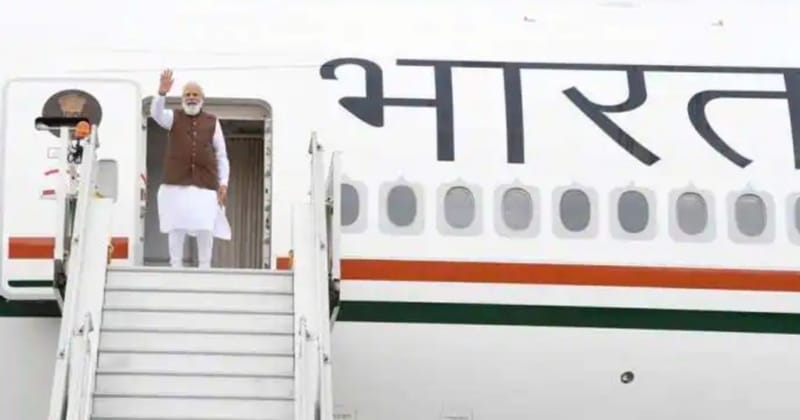
Ever since assuming office in 2014, Prime Minister Narendra Modi has displayed “increasing ambition to strengthen India’s global diplomacy and governance,” writes Jinali Yang for Newsweek.
PM Modi, in various global conferences led by India, has steadily focussed on India’s yearning to engage in dialogue with major powers such as the United States and Europe, as well as its intention to lead developing countries. In its G20 presidency in September 2023, India will not only strengthen its position as the leader of the “Global South” but also will magnify the voice of southern countries in the global order. India will also function as a bridge between democratic developing countries.
Since gaining its independence in 1948, India has primarily followed a non-alignment foreign policy, which was initially proposed by Jawaharlal Nehru, the country’s first prime minister, in 1954. It highlights India’s dedication to an independent foreign policy and highlights its desire to avoid entanglements with any power bloc. India initiated the Non-Aligned Movement during the Cold War and saw itself as the representative of developing nations. The movement included a large number of southern nations, as per Newsweek.
Newsweek is a New York-based news magazine and website which presents the latest news, in-depth analysis and ideas about international issues, technology, business, culture and politics.
The concept of “Global South” is not new and is not well defined. The vast majority of nations that are largely located in Southeast Asia, South Asia, Africa, and Latin America–the geographical South–are often referred to by this term. The phrase is frequently used to describe “north-south” differences in politics, economy, and society.
There are some exceptions even though the concept is geographically relevant. For instance, despite geographically being in the South, Australia is typically regarded as a northern nation. China is typically regarded as a southern country despite having a northern rather than a southern latitude. Notably, both China and India consider themselves the leaders of the Global South, and they have long fought each other for influence over southern countries.
From the US-Japan perspective, which spearheads the democratic world’s Indo-Pacific strategy, the US should support India’s position as the real leader of the “Global South” in order to curtail China’s influence, according to Jinali Yang’s report in Newsweek.
In recent years, India’s diplomacy has placed an increasing emphasis on enhancing ties with Western nations like the US and Japan, a trend that has intensified under the Modi government. India, the greatest democracy in the world, is regarded by European and American nations as a significant ally who shares their values, in contrast to China.
The “Indo-Pacific strategies” of important Western nations, including the US, Europe, and Japan, which intend to incorporate India, reflect this. For instance, the idea of the Quadrilateral Security Dialogue (Quad), which links Japan with the United States, Australia, and India, was put forth in 2012 by the then-prime minister of Japan, Shinzo Abe. He expanded on the idea of a Free and Open Indo-Pacific (FOIP) in 2016. Later, the US broadened this idea as part of its own Indo-Pacific Strategy to promote India’s expanding involvement and influence in international affairs. Both the Indo-Pacific Economic Framework for Prosperity and the Quad Mechanism, which was steered by the United States and India, were established.
India’s stance is closer to that of the West when it comes to relations with China. This alignment is brought about in part by the continuing border disputes between China and India, but it is also a result of the severe competition that the two ideological rivals will have for regional dominance in the decades to come.
India has yet to join China’s Belt and Road Initiative (BRI) but has used Sri Lanka’s current financial crisis as a lesson in the perils of falling into a debt trap to warn southern nations. In 2019, India withdrew from negotiations to join the Regional Comprehensive Economic Partnership, which is seen to as led by China. Cooperation between India and Japan has drawn more attention and relevance due to its effects on the Asian regional order amid the US-China rivalry.
India has improved relations with the industrialised members of the Group of Seven (G7). This year, India participated in the G7 Summit in Japan and has been actively acting as a link between the Global South and the camp of developed democratic countries, Yang writes for Newsweek.
However, in the context of US-China, and the EU-Russia confrontations, India has improved its ties with Western nations while retaining some degree of autonomy. Particularly in regard to the Russia-Ukrainian conflict, it has not entirely embraced the viewpoints of Western nations. India did not join the West in placing sanctions on Russia and has not denounced Russia’s hostile activities. India didn’t participate in the voting on a number of UN resolutions that denounced Russia.
In fact, India and Russia continue to have friendly relations. India has acquired a significant amount of oil from Russia despite the energy sanctions the West has placed on Russia in order to secure its energy supply and preserve a balance between Russia and China, especially in light of their military cooperation. The United States and other Western countries have displayed relative tolerance for India’s actions in the Russia-Ukrainian conflict given India’s strategic position and economic strength.
Due to India’s morally neutral stance in the Russia-Ukraine conflict, concerns have been voiced about the quality of Indian democracy as well as the potential detrimental effects of India’s leadership in the Global South on uniting the world’s democracies. However, the real issue would arise if other nations like China came to dominate the Global South.
The United States and the G7 nations should adopt clear policies to assist India in becoming a true ally in its role as the leader of the Global South given its indispensable role in Indo-Pacific affairs as the biggest democracy in the world, Newsweek reported.
(with inputs from ANI)