
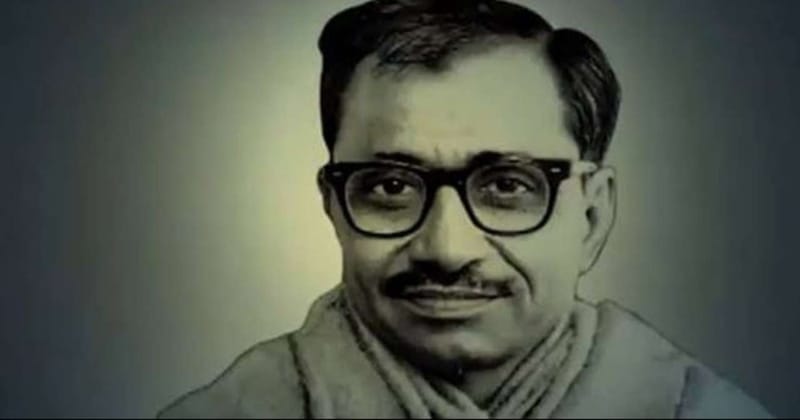
Pandit Deendayal Upadhyay is one of those thinkers in Bharat who exercised on ‘Swaraj of ideas’ – which means Decolonisation of ideas, i.e. Decolonisation of Indian minds. India was free politically, but ideologically, the colonial hangover is still there.
Elephants have many times the power and strength of humans. When an elephant is chained as a child, he develops the belief that he cannot break the chain and liberate himself, making him a prisoner of his thoughts and actions. The same thing happened to Bharatiya, particularly Hindus. Foreign invaders influenced Hindus’ minds such that they began to despise their own culture, Dharma, and history, forgetting that their forefathers’ socioeconomic success using ethical means was completely due to adhering to Dharma.
We can learn from Israel and Japan because, despite many natural constraints and a difficult neighbourhood, they are moving forward on all fronts. The simple reason is that they are united as a nation, ignoring political and social differences when it comes to overcoming any challenge faced by the nation. In our case, the brainwashed mindset never unites for a national cause, which is why dynastic political parties, corrupt leaders, vote bank politics, many foreign-funded activists and NGOs divide, particularly Hindus on caste lines, and make difficult inroads for the great Bharat. If Hindus unite, our nation will be excellent in every way, without damaging any religion and instead helping to better socioeconomic situations. Prepare for disaster if Hindus do not band together, as we have seen in Afghanistan, Pakistan, and Bangladesh. Let Hindus band together for a better world; it is what “Hinduness” stands for. And for this, “Ekatma Manavdarshan” should serve as the foundation for decolonising the thoughts of all Indians, particularly Hindus.
Pandit Deendayal Upadhyay outlines why and how Decolonisation of the Indian mindset is necessary. He introduced the basic concept of Indian philosophy in political, social and cultural discourses. Everything from the West need not be harmful, and every attribute of modernity need not be in the best interest for us. As stated by Pandit Deendayal Upadhyay in his ‘Principle of Confluence’, “While accepting and implementing any change, we must ensure that it is as per the ethos of our Nation and has Viability in contemporary times.” The Principle pronounced by Pandit Deendayal Upadhyay has provided us with the necessary direction in which this nation has to traverse. While maintaining plurality in our opinions, this Principle essentially gives us the foundation to traverse on a unidirectional way. Apart from finding a unidirectional approach to our shared objectives, Bharatiya values must become a ‘quid pro quo’ for all Policy decisions.
Pandit Deendayal Upadhyay envisioned an India based on a unique economic model in which a human being or humanity was at the centre of all things. He did not want Bharat to simply mimic Western economic principles in order to become a developed nation.
Pandit Deendayal Upadhyay wished to establish national liberation on the foundation of Bharatiya culture. As a result, Pandit Deendayal Upadhyay was unwilling to accept those Western conceptions that many deem axiomatic. He remarked from a Bharatiya perspective on topics such as Western ideas of state, secularism, democracy, and numerous ‘-isms’ of the West.
Subsequently, some Macro sectors where Decolonisation needs immediate attention are;
1. The medium of Knowledge.
2. Education System.
3. Judiciary.
4. Administration.
5. Research Methodology and;
6. Governance.
In the post-colonial era, the continuity of Macaulay’s model of education systematically debased the significance of Bharatiya languages and established the hegemony of English education over prevalent Education practices. English came preloaded with impressions to render our thought process monotheistically, and inclusivity was replaced by the exclusivity of monotheistic elitism. This elitism quickly infected the subsidiaries of governance, judiciary and most of the bureaucracy and created a massive fault line between commoners and these policymakers. While subsidiaries of governance and judiciary were supposed to be complementary to the body polity of this nation, on the contrary, it became an external entity and disengaged from society at large. The lack of will to reinject and rejuvenate the Bharatiya thought process further aggravated the problem.
The present education system does not empower the Indians, which becomes so visible in economic achievements. The statistics on imports and exports make this abundantly clear. India’s share of the world economy was 23 per cent, as great as all of Europe put together when Britain landed on its borders, but by the time the British withdrew from India, it had shrunk to little over 3 per cent. As a result, the New Education Policy 2020 is critical to creating an education system that brings the most out of every child in order to make our nation great again. The book will have a detailed explanation.
How has the colonial concept harmed the planet, and why is mental Decolonisation necessary?
Some intellectuals perceive the consequences of the current Western paradigm and underline the necessity for an alternative approach to Capitalism and consumerism that is not only materialistic but also encourages vulgar consumerism. Westerners believe that heavy industries and the capitalist’s attitude will address all problems, which have been proven to be useless and have instead resulted in major environmental degradation such as acute pollution, food poisoning, bio-diversity loss, and serious health risks. Every man is fundamentally a soul endowed with a body-mind combination that is plagued by a toxic condition. However, the so-called materialistic man acts in such a way that he endangers society by causing the extinction and endangerment of numerous species and endangering our future generation. In this day and age of globalisation, neither reason nor sociopolitical thought seems to be guiding humanity in the correct way. Financial wealth reigns supreme, facilitating most materialism devoid of humanity. As a result, man, whose next higher stage of growth is divinity, descends to the level of beastliness.
The Western paradigm of massive industrialisation causes climate change, ecological degradation, the wealth gap, massive unemployment, terrorism, and many other problems. Rapid deforestation is undermining the entire existence of mandatory forest cover and wreaking havoc on our natural resources. Rivers and water supplies are rapidly depleting and polluting. Global warming has reached a tipping point, and carbon emissions from developed countries are out of control. Some countries’ economic development should not be allowed to jeopardise the healthy progress of less developed countries. Similarly, depriving future generations of their legitimate cultural and natural riches by greedy and exploitative segments of the current generation will be considered a crime against humanity.
Why is “Ekatma Manavdarshan” so important at this time?
Because it lacks spirituality, the fragmented version of Western Humanism is a barrier to human unification and world peace. Spirituality is incorporated with humanism by Swami Vivekananda, Shree Aurobindo, Rabindranath Tagore, and Pandit Deendayal Upadhyay.
It is the spiritual ethos that integrates the various phenomena of mundane existence through the Divine Principle, i.e., the Supreme Soul (Paramatman) that exists in all natural phenomena in the form of Atman (Soul). Pandit Deendayal Upadhyay believes that the unique blend of Karma Yoga, Bhakti Yoga, and Gyana Yoga will serve the aim of spiritual and material elevation. This is how Indian humanism spirally merges the person, family, society, nation, globe, and creation. However, the Western approach to these phenomena is merely mechanical, with each phenomenon isolated from the others.