Nuclear Test: When history was created on May 11, 1998 by the Vajpayee Government
July 13, 2026
  • Read Ecopy
  • Circulation
  • Advertise
  • Careers
  • About Us
  • Contact Us
Android AppiPhone AppArattai
Organiser
  • ‌
  • Bharat
    • Assam
    • Bihar
    • Chhattisgarh
    • Jharkhand
    • Maharashtra
    • View All States
  • World
    • Asia
    • Europe
    • North America
    • South America
    • Africa
    • Australia
  • Editorial
  • International
  • Opinion
  • RSS @ 100
  • More
    • Op Sindoor
    • Analysis
    • Sports
    • Defence
    • Politics
    • Business
    • Economy
    • Culture
    • Special Report
    • Sci & Tech
    • Entertainment
    • G20
    • Azadi Ka Amrit Mahotsav
    • Vocal4Local
    • Web Stories
    • Education
    • Employment
    • Books
    • Interviews
    • Travel
    • Law
    • Health
    • Obituary
  • Subscribe
    • Subscribe Print Edition
    • Subscribe Ecopy
    • Read Ecopy
  • ‌
  • Bharat
    • Assam
    • Bihar
    • Chhattisgarh
    • Jharkhand
    • Maharashtra
    • View All States
  • World
    • Asia
    • Europe
    • North America
    • South America
    • Africa
    • Australia
  • Editorial
  • International
  • Opinion
  • RSS @ 100
  • More
    • Op Sindoor
    • Analysis
    • Sports
    • Defence
    • Politics
    • Business
    • Economy
    • Culture
    • Special Report
    • Sci & Tech
    • Entertainment
    • G20
    • Azadi Ka Amrit Mahotsav
    • Vocal4Local
    • Web Stories
    • Education
    • Employment
    • Books
    • Interviews
    • Travel
    • Law
    • Health
    • Obituary
  • Subscribe
    • Subscribe Print Edition
    • Subscribe Ecopy
    • Read Ecopy
Organiser
  • Home
  • Bharat
  • World
  • Operation Sindoor
  • Editorial
  • Analysis
  • Opinion
  • Culture
  • Defence
  • International Edition
  • RSS @ 100
  • Magazine
  • Read Ecopy
Home Bharat

Nuclear Test: When history was created on May 11, 1998 by the Vajpayee Government

At 3:45 pm on May 11, 1998, India achieved a milestone under the code name Operation Shakti and successfully conducted the Pokhran-2 test which came as a shock to the United States

Nirendra DevNirendra Dev
May 11, 2023, 05:00 pm IST
in Bharat, Technology
Follow on Google News
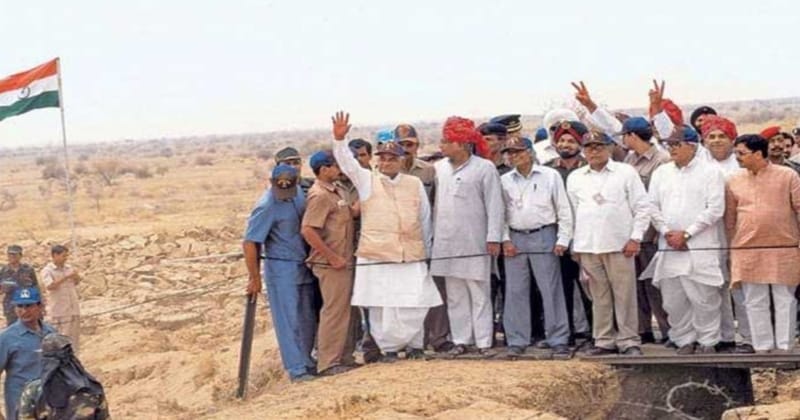
APJ Abdul Kalam, Atal Bihari Vajpayee, and George Fernandez at the nuclear site in Pokhran

APJ Abdul Kalam, Atal Bihari Vajpayee, and George Fernandez at the nuclear site in Pokhran

FacebookTwitterWhatsAppTelegramEmail

Of course, India made history on May 11-13 in the year 1998, when the Atal Bihari Vajpayee Government conducted the nuclear tests, popularly known as Pokhran-2.

Creditably for Atal Bihari Vajpayee and people like Dr APJ Abdul Kalam and R Chidambaram – the top scientists involved in the highly important assignment – the Pokhran-2 was achieved in “less than two months of the Vajpayee Government taking office” for the second time. The exercise could ensure that the American spy system “did not even smell it” before the country actually conducted the tests and Atal Bihari Vajpayee had announced the same.

I still remember the afternoon. Suddenly a press conference was convened. Those were the days of unstable polity and coalition regimes; BJP’s ally AIADMK led by Jayalalitha, was persisting with unreasonable demands and pressures. So when the media conference was convened, we in a leading news agency office were actually speculating on whether Atal Bihari Vajpayee would finally resign.

Thus the development was anti-climax, and it left the world shell-shocked.

Credit must be given to the then Defence Minister George Fernandes, who otherwise for long was against any nuclearisation programme.

In the mid-1990s, P V Narasimha Rao had ordered conducting the tests, but the programme was abandoned at the pressure of the Americans. Atal Bihari Vajpayee’s trusted aide and ministerial colleague Jaswant Singh later said, “It is reasonable to conclude that Narasimha Rao had ordered nuclear tests in 1995. Satellite imagery, and some even suggest human intelligence from India, revealed the plans to the US Government, which then was made public and the premier Rao backed off”.

Jaswant Singh and others in the know of things like K Subrahmanyam (father of present External Affairs Minister Dr S Jaishankar) had argued emphatically that India was “left with no option” but to go for
covert nuclear weaponisation.

Jaswant Singh even said, “The Sino-Pakistan nuclear collaboration continued in violation of the NPT and it was obvious that the NPT regime in India’s neighbourhood had collapsed”. Moreover, Pakistan was getting Chinese assistance in setting up a plutonium production reactor at Khushab.

The nuclear journey of India is also punctuated with stories of failure of political leadership, especially between 1987 and 1998. In fact, Gen K Sundarji, former army chief, had penned a novel, ‘The Blind Men of
Hindustan’ virtually poured out, ventilating the frustration of the military chiefs for keeping the country and the forces unprepared.

In fact, on the other hand, Pakistani leaders, including Nawaz Sharif and Benazir Bhutto, kept on using the Nuke card and tried to blackmail India. Nawaz Sharif said in 1994 that Pakistan could even use nuclear weapons against any Indian attempt to seize Pakistan-occupied Kashmir. Prior to that, Benazir Bhutto 1992, in an interview with NBC, said that ‘bombs were assembled’ behind her back by the Pakistan army when she was the Prime Minister.

K Subrahmanyam later said – “The same Benazir Bhutton vehemently denied Rajiv Gandhi’s suggestion during his visit to Pakistan in 1988 that she was not in charge of the nuclear weapon programme and the army”.

Now look into other areas. In May 1998, when the Vajpayee Government conducted the tests, China possessed 450 nuked warheads, the US had 12,070, Russia – 22,500, France – 500 and the UK- 300.

Now, we need to have a closer look at certain facts of history.

Though India attained the potential to develop nuclear weapons after the first nuclear explosion at Pokhran in 1974, India steadfastly refrained from exercising its nuclear option. Instead, the policy of New Delhi was to choose to work for nuclear disarmament, notwithstanding deteriorating security situations.

In the 1970s, Prime Minister Morarji Desai had said in an interview with Barbara Walters of American Broadcasting Company (ABC) that he would never go in for nuclear weapons.

India later opted to develop only a credible “minimum” nuclear deterrent due to the widespread recognition that nuclear weapons globally had soon turned into ‘political weapons’ and not weapons of
warfighting.

In the end, of course, we may conclude that India’s nuclear policies and the preparations for tests had not developed in a vacuum. Experts later had reasons to say that the Nuke-journey was essentially a “graduated and measured” response to international happenings.

There were a few interesting episodes, and they are worth mentioning. Ukraine, which is in the news for war with Russia, had come under enormous pressure, and even reportedly, financial incentives were offered to force it to give up its nuclear weapons capacities.

On the other hand, even South Africa had planned nuke tests, but as Nelson Mandela assumed office in 1994 as a black-majority Government, the pressure to give up its programmes intensified.

Finally, what ends well is ‘well’ for everyone.

The then PM Atal Bihari Vajpayee said that there was no need to cover the nuclear explosions “with a veil of secrecy… India now is a nuclear weapons state.”

Also Read : National Technology Day: PM Modi launches multiple projects worth Rs 5800 crore

On May 27, 1998, Atal Bihari Vajpayee told Parliament in a suo motu Statement: “We do not intend to use these (nuclear) weapons for aggression or for mounting threats against any country; these are weapons of self-defence, to ensure that India is not subjected to nuclear threats or coercion. We do not intend to engage in an arms race.”

We may add, in the end, that on May 29, 1998, Pakistan also conducted nuclear tests at Chagai.

Atal Bihari Vajpayee then offered to discuss a no-first-use agreement with Pakistan and other countries, bilaterally or in a multilateral forum.
 

Topics: Operation ShaktiPokhran-2Dr APJ Abdul KalamR ChidambaramNuclear weaponsNuclear testsIndiaAtal Bihari Vajpayee
Share1TweetSendShareSend
✮ Subscribe Organiser YouTube Channel. ✮
✮ Join Organiser's WhatsApp channel for Nationalist views beyond the news. ✮
Previous News

Maharashtra Dy CM Devendra Fadnavis hails SC’s judgment over Shiv Sena-centric crisis; calls it ‘Victory for Democracy’

Next News

Tamil Nadu: ISRO successfully tests semi-cryogenic engine at new facility in Mahendragiri

Related News

PM Modi's Gifts to Albanese Blend India's Ancient Craft, Modern Music and Premium Coffee

From Dhokra Sculpture to Colonial Cousins Vinyl: PM Modi’s gifts to Australian PM Albanese showcases cultural heritage

Prime Minister Narendra Modi and New Zealand Prime Minister Christopher Luxon

India-New Zealand Strategic Partnership: A new horizon for New Delhi’s economic diplomacy

Economic resilience of India amid West Asia crisis

Bharat’s Data Centre Moment: From digital consumer to trusted technology power

Different shades of diplomacy and foreign policy

Prime Minister Narendra Modi and Indonesia President Prabowo Subianto

Beneath BrahMos: PM Modi’s Indonesia visit and the strategic deal underlining nickel

Load More

Latest News

PM POSHAN

PM POSHAN Scheme: Yogi government launches massive drive to recruit 3.53 lakh cooks in Uttar Pradesh

Uttar Pradesh: US national claiming special forces past held near Indo-Nepal border without passport

Rajaprasad Bije Ritual: Servitors Convey Mahaprabhu's Recovery Message to Gajapati Maharaja Divya Singh Dev

Odisha: Rajaprasad Bije ritual held at Puri Jagannath Temple; Gajapati Maharaja informed of Mahaprabhu’s recovery

Mukhyamantri Majhi Ladki Bahin Yojana

Maharashtra: Kirit Somaiya exposes 92 lakh ‘Bogus’ Ladki Bahin beneficiaries after verification

KPSC Chief Shivashankarappa Sahukar suspended as Governor orders inquiry

Karnataka Governor suspends KPSC Chief Shivashankarappa Sahukar over recruitment scam allegations, seeks SC probe

Rs 100 Crore Palani Temple land registered in private names, probe demanded

Tamil Nadu: Palani temple land worth Rs 100 crore illegally registered in names of two individuals, sparks outrage

UP CM Yogi Adityanath inaugurates 'Vriksharopan Mahayagya-2026' in Gorakhpur

‘Ek Ped Maa Ke Naam’: Uttar Pradesh creates green history by planting 40 crore saplings, CM Yogi hails achievement

Uttarakhand govt ends grants for 456 madrasas after abolishing Madrasa board

Uttarakhand govt ends grants to 456 Madrasas after abolishing Madrasa board; U-DISE benefits stay

Supreme Court (Left), Ayodhya Ram Mandir (Right)

Ayodhya Ram Mandir Donation Row: Union, UP, Temple trust get notice as SC seeks SIT status report

PoJK Freedom Struggle: Uprising against illegal occupation

Load More
  • Privacy
  • Terms
  • Cookie Policy
  • Refund and Cancellation
  • Delivery and Shipping

© Bharat Prakashan (Delhi) Limited.
Tech-enabled by Ananthapuri Technologies

  • Home
  • Search Organiser
  • Bharat
    • Assam
    • Bihar
    • Chhattisgarh
    • Jharkhand
    • Maharashtra
    • View All States
  • World
    • Asia
    • Africa
    • North America
    • South America
    • Europe
    • Australia
  • Editorial
  • Operation Sindoor
  • Opinion
  • Analysis
  • Defence
  • Culture
  • Sports
  • Business
  • RSS @ 100
  • Entertainment
  • More ..
    • Sci & Tech
    • Vocal4Local
    • Special Report
    • Education
    • Employment
    • Books
    • Interviews
    • Travel
    • Health
    • Politics
    • Law
    • Economy
    • Obituary
  • Subscribe Magazine
  • Read Ecopy
  • Advertise
  • Circulation
  • Careers
  • About Us
  • Contact Us
  • Policies & Terms
    • Privacy Policy
    • Cookie Policy
    • Refund and Cancellation
    • Terms of Use

© Bharat Prakashan (Delhi) Limited.
Tech-enabled by Ananthapuri Technologies