Nation first or religion first
September 13, 2026
  • Read Ecopy
  • Circulation
  • Advertise
  • Careers
  • About Us
  • Contact Us
Android AppiPhone AppArattai
Organiser
  • ‌
  • Bharat
    • Assam
    • Bihar
    • Chhattisgarh
    • Jharkhand
    • Maharashtra
    • View All States
  • World
    • Asia
    • Europe
    • North America
    • South America
    • Africa
    • Australia
  • Editorial
  • International
  • Opinion
  • RSS @ 100
  • More
    • World Hindu Congress 2026
    • Op Sindoor
    • Analysis
    • Sports
    • Defence
    • Politics
    • Business
    • Economy
    • Culture
    • Special Report
    • Sci & Tech
    • Entertainment
    • G20
    • Azadi Ka Amrit Mahotsav
    • Vocal4Local
    • Web Stories
    • Education
    • Employment
    • Books
    • Interviews
    • Travel
    • Law
    • Health
    • Obituary
  • Subscribe
    • Subscribe Print Edition
    • Subscribe Ecopy
    • Read Ecopy
  • ‌
  • Bharat
    • Assam
    • Bihar
    • Chhattisgarh
    • Jharkhand
    • Maharashtra
    • View All States
  • World
    • Asia
    • Europe
    • North America
    • South America
    • Africa
    • Australia
  • Editorial
  • International
  • Opinion
  • RSS @ 100
  • More
    • World Hindu Congress 2026
    • Op Sindoor
    • Analysis
    • Sports
    • Defence
    • Politics
    • Business
    • Economy
    • Culture
    • Special Report
    • Sci & Tech
    • Entertainment
    • G20
    • Azadi Ka Amrit Mahotsav
    • Vocal4Local
    • Web Stories
    • Education
    • Employment
    • Books
    • Interviews
    • Travel
    • Law
    • Health
    • Obituary
  • Subscribe
    • Subscribe Print Edition
    • Subscribe Ecopy
    • Read Ecopy
Organiser
  • Home
  • Bharat
  • World
  • Operation Sindoor
  • Editorial
  • Analysis
  • Opinion
  • Culture
  • Defence
  • International Edition
  • RSS @ 100
  • Magazine
  • Read Ecopy
Home Bharat

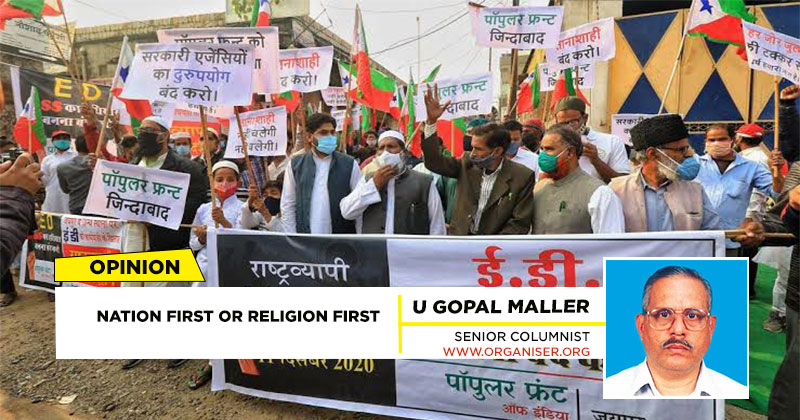
Nation first or religion first

The religious beliefs of certain people prohibit their cohabitation with people following other beliefs, which primarily led to India’s partition in 1947. Suppose the religious tenets of a citizen are not in conformity with the secular spirit and values of our Constitution

U Gopal MallerU Gopal Maller
May 7, 2023, 08:30 pm IST
inBharat, Opinion
Follow on Google News
Facebook
Twitter
WhatsAppTelegramEmail

It was recently, a three-judge Bench of the Supreme Court reversed its earlier verdict, given in 2011, which said “Mere membership of a banned organisation will not incriminate a person” under the Unlawful Activities (Prevention) Act, 1967, and Terrorist and Disruptive Activities (Prevention) Act, 1987, “unless he resorts to violence or incites people to violence and does an act intended to create disorder or disturbance of public peace by resort to violence. “Now that our nation is faced with the twin dangers of religious fundamentalism and terrorism getting support even at the international level, another matter that demands urgent judicial review, in my opinion, is the interpretation of religious freedom enshrined in our Constitution, given by the Supreme Court on August 11, 1986.

“If (minorities) they really have come honestly to the conclusion that in the changed conditions of this country, it is in the interest of all to lay down real and genuine foundations of a secular State, then nothing is better for the minorities than to trust the good- sense and sense of fairness of the majority, and to place confidence in them. So also it is for us who happen to be in a majority to think about what the minorities feel, and how we in their position would feel if we were treated in the manner in which they are treated. But in the long run, it would be in the interest of all to forget that there is anything like majority or minority in this country and that in India there is only one community.” This was Sardar Vallabh Bhai Patel speaking in the Constituent Assembly on May 25 1949. (Constituent Assembly Debates [Proceedings] Volume VIII, http://loksabhaph.nic.in).

Have we been able to lay down the real and genuine foundation of a secular State, as proposed by Sardar Patel?

It was the diabolical use to which Jinnah had put religion that ended in India’s partition in 1947. According to American philosopher George Santayana, “Those who do not learn from history are doomed to repeat it.” Now the billion-dollar question is, have we learnt anything from the lessons partition has taught us?

In his famous ‘Tryst with Destiny’ address, made in the Constituent Assembly on the midnight of August 14/ August 15, Pandit Nehru said: “Before the birth of freedom, we have endured all the pains of labour, and our hearts are heavy with the memory of this sorrow. Some of these pains continue even now. Nevertheless, the past is over, and the future beckons to us now” (Great Speeches of Modern India, page 185).

Is it true? Have we at all left the past behind? Or are we in the process of resurrecting our dreaded past? Unfortunately, the current situation in the country compels one to think that, knowingly or unknowingly, we are busily engaged in resurrecting for petty political gains what, according to Pandit Nehru, we have left behind! Today, have we decided conclusively which is first: NATION or RELIGION? Dr B. R. Ambedkar, whom we with highest regard call the Father of the Indian Constitution, has made it unequivocally clear: “The sovereignty of scriptures of all religions must come to an end if we want a united, integrated modern India.” What is the ground reality? Have we paid any heed to his sane advice? Let me give an instance:

In 1985, three siblings studying at the Kidangoor NSS High School in Kerala were suspended from the school for not singing the national anthem because, being Jehovah’s Witnesses, they were prohibited by their faith to pray to any entity other than Jehovah.

An MLA of the Kerala Assembly, who learned about the incident through a newspaper, raised the issue in the Assembly and the government with K. Karunakaran as the Chief Minister, constituted by a one-person Commission to probe the matter. Although the Commission absolved the siblings of the charges of showing disrespect to the national anthem by refusing to recite it, the District Education Officer insisted that the students should give in writing that they would recite the national anthem if they had to continue to study in the school.

The Father of the siblings, a college professor, moved a plea in the Kerala High Court against the government order, which was rejected. Then he moved the Supreme Court, and on August 11, 1986, the Supreme Court gave a verdict in his favour, which read: “We may at once say that there is no provisions of law which obliges anyone to sing the National Anthem nor do we think that it is disrespectful to the National Anthem if a person who stands up respectfully when the National anthem is sung does not join the singing… Proper respect is shown to the National Anthem by standing up when the National Anthem is sung. It will not be right to say that disrespect is shown by not joining in the singing…” Here, the question is whether the siblings could fully subscribe to and honour the tenets of their religion by standing up while the National Anthem was being sung and, at the same time, not singing it. Were they, in effect, not participating in the singing of the National Anthem?

Upon receiving the verdict in favour of the siblings, they attended the classes only for one day and then decided to leave the school. It is noteworthy here that the sole intention of the Father was to uphold the religious freedom of his progeny.

Can it be interpreted as the right of a citizen to refuse to do anything their religion prohibits? Can it be interpreted as the right of a citizen to follow everything her/his religion sanctions meticulously? Is our National Anthem a prayer? Or is it a patriotic song that expresses our national identity and the unity of our people? Does it not represent our independence and sovereignty as a nation?

Should our people’s religious precepts and beliefs take precedence over the secular character of our Constitution? The religious beliefs of certain people prohibit their cohabitation with people following other beliefs, which primarily led to India’s partition in 1947. Suppose the religious tenets of a citizen are not in conformity with the secular spirit and values of our Constitution. Should they prevail, as happened in the case of the siblings who refused to sing our National Anthem on religious grounds? Or should we take a relook at the verdict pronounced in the matter in 1986? It is for the judiciary and the legal and Constitution experts to find plausible answers to all these important questions.


Topics: Unlawful ActivitiesnationkeralaSupreme CourtReligionkerala assemblyConstituent Assembly
Share
Tweet
SendShareSend
✮ Subscribe Organiser YouTube Channel. ✮
✮ Join Organiser's WhatsApp channel for Nationalist views beyond the news. ✮
Previous News

“The AAP Story”: BJP alleges “sex for job” scandal, demands sacking of Punjab Minister

Next News

Why Myanmar’s Rakhine and Bangladesh getting closer day by day?

Related News

Registrar of Copyrights in India has rejected an application of computer scientist to make AI as an Author

DABUS loses copyright battle in India: Human author must be named; The tradition of Apūrvatā to Maulikatā

1993 Blasts Case: SC Rejects Abu Salem’s Release Plea

From 1993 Mumbai blasts to Portugal extradition: SC rejects Abu Salem’s bid for early release

Keralam madrasa teacher Imbichikoya surrenders before Kollam court in POCSO case

Keralam madrasa teacher Imbichikoya surrenders before court after two POCSO cases registered over students’ complaints

Two Supreme Court cases have put India’s constitutional safeguards for tribal land, representation and self-governance under renewed scrutiny

Demography as a Weapon: The Supreme Court’s twin test on tribal protections

SC Backs Eviction from Tamil Nadu Temple Land

SC backs eviction from Tamil Nadu Temple land: Muslim occupants cannot claim rights through illegal sale

Jaipur Terror Case: Supreme Court Refuses to Release Sarwar Azmi

Jaipur Terror Case: Supreme Court refuses to release Sarwar Azmi, cites national security

Load More

Latest News

(Left) Naga leader Dr. S. C. Jamir: (Right) RSS Sarsanghchalak Dr Mohan Bhagwat

Bridging Perspectives: Dr SC Jamir meets RSS’ Dr Bhagwat, highlights mutual respect, secularism, and Naga aspirations

Tiger Bright coffee from Koraput’s tribal farmers featured in BRICS Summit media kits in New Delhi

From Eastern Ghats to BRICS: Koraput Coffee puts Odisha’s tribal enterprise on global map

The RSS has spent a century building influence through organisation, social networks and ideological formation beyond the electoral arena

RSS at 100: How the Sangh built a century-long network of influence beyond Indian politics

India on a Platter: BRICS Dinner Menu Celebrates Regional Culinary Heritage

BRICS Dinner Menu: From Khandvi, mushroom kebabs to pulao global leaders get a taste of Bharat’s culinary heritage

Exterior of the Lokayukta Building

Karnataka Lokayukta records 1,248 cases in four years, 887 linked to bribery

RSS Akhil Bharatiya Karyakarini Sadasya Dr Manmohan Vaidya at a Pramukh Jan Samvad Sangosthi organised by Kashi Mahanagar on the occasion of the RSS Centenary Year,

Entire society must unite with a sense of oneness; This Is the spirit of Sangh Work: Dr Manmohan Vaidya

‘Samuel Could Never Do This’: Mother Rejects Blasphemy Allegations Against Son in Lahore

Pakistan Blasphemy Case: Mother of Christian man Samuel Arif claims false implication, seeks justice

Prime Minister Narendra Modi, along with Chinese President Xi Jinping, Russian President Vladimir Putin and other world leaders, poses for a picture at a joint tree plantation initiative during the BRICS Summit

BRICS Summit 2026: India as the voice of Global South, shared responsibilities & scripting inclusive world order

Chinese President Xi Jinping and Prime Minister Narendra Modi

BRICS Summit 2026: PM Modi hold talks with President Xi; Stresses border peace & tranquility as key to India-China ties

Tamil Nadu: Hindu Munnani flags TVK govt’s restrictions on Vinayaka pandals, barring women, children from processions

Load More
  • Privacy
  • Terms
  • Cookie Policy
  • Refund and Cancellation
  • Delivery and Shipping

© Bharat Prakashan (Delhi) Limited.
Tech-enabled by Ananthapuri Technologies

  • Home
  • Search Organiser
  • Bharat
    • Assam
    • Bihar
    • Chhattisgarh
    • Jharkhand
    • Maharashtra
    • View All States
  • World
    • Asia
    • Africa
    • North America
    • South America
    • Europe
    • Australia
  • Editorial
  • Operation Sindoor
  • Opinion
  • Analysis
  • Defence
  • Culture
  • Sports
  • Business
  • RSS @ 100
  • Entertainment
  • More ..
    • Sci & Tech
    • Vocal4Local
    • Special Report
    • Education
    • Employment
    • Books
    • Interviews
    • Travel
    • Health
    • Politics
    • Law
    • Economy
    • Obituary
  • Subscribe Magazine
  • Read Ecopy
  • Advertise
  • Circulation
  • Careers
  • About Us
  • Contact Us
  • Policies & Terms
    • Privacy Policy
    • Cookie Policy
    • Refund and Cancellation
    • Terms of Use

© Bharat Prakashan (Delhi) Limited.
Tech-enabled by Ananthapuri Technologies