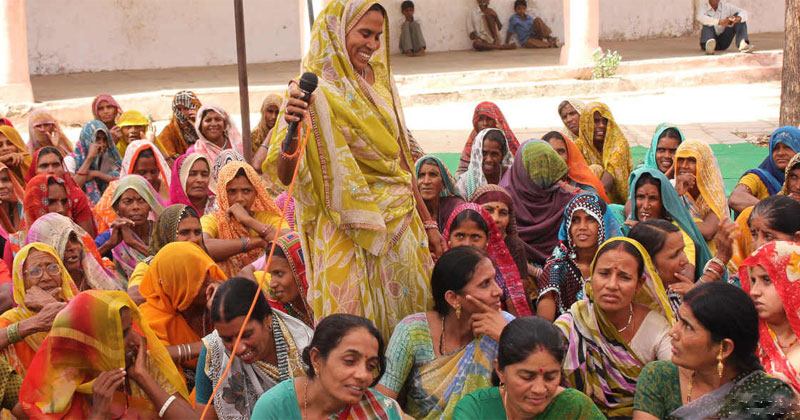
The National Panchayati Raj Day (NPRD) is being celebrated on April 24, since 2010. The theme of National Panchayati Raj Day 2023 is Panchayaton ke Sankalpon ki Siddhi ka Utsav. The PRI’s are celebrating this monumental occasion in the right spirit and in line with the Azadi Ka Amrit Mahotsava 2.0 directives of adopting “whole-of-society” and “whole-of-government” approach as well as enhancing the outreach of AKAM 2.0 to touch the lives of every Indian.
The 1992 amendment proved to be catalytic, bringing more than 14.5 lakh women into leadership positions in India’s local governance. Today, as many as 20 states – Andhra Pradesh, Assam, Bihar, Chhattisgarh, Gujarat, Himachal Pradesh, Jharkhand, Karnataka, Kerala, Madhya Pradesh, Maharashtra, Odisha, Punjab, Rajasthan, Sikkim, Tamil Nadu, Telangana, Tripura, Uttarakhand and West Bengal – have increased reservations for women in their PRIs to 50 per cent. Many states such as Karnataka have more than 50 per cent women representatives in PRIs, which indicates that women are now winning in wards that were not reserved for them.
Politics and governance, for ages considered the prerogative of men, are now changing at the grassroots. India has been a frontrunner in some dimensions of women’s political participation with several success stories of women’s leadership — as prime minister, cabinet ministers, and chief ministers. Today, women leaders in PRIs have come to their role as independent achievers, making their way in a domain in which they have historically been excluded.
Women Panchayat Elected representatives are focussing their governance on Development based economy. Looking to the increased participation of women representatives across the Madhya Pradesh, a study was undertaken by the research scholars of School of Social Sciences and Management Studies, Dr. B. R. Ambedkar University of Social Sciences, Dr. Ambedkar Nagar (MHOW). The study was conducted on 100 women panchayat elected representatives (WPER) in four districts of Nimar region of Madhya Pradesh namely – Barwani, Khargone, Khandwa, and Burhanpur. Purposive Sampling method was used to select these one hundred women panchayats elected representatives. Very positive results have come out after analysing the facts obtained from the study by scientific method.
As far as the profile of respondent women is concerned, majority (77 per cent) of the EWRs were first-time representatives, 34 per cent married before the age of 20; 13 per cent WPER s did not go to school, while 17 per cent completed only primary schooling; 25 per cent completed Class XII, and 12 per cent finished undergraduate studies.
The study reveals that the evidence of women’s effectiveness as leaders and their positive association with development is now well established. Women elected under reservation invest more in public goods that are reflective of community priorities, such as drinking water. The experience reported seems to be that women leaders have preferences and development priorities similar to those of the people in their communities.
Research study reveals that women representatives with her fellow female ward members, are prioritising improvement of nutrition outcomes and services in her panchayat, through promotion of kitchen gardening and mobilising communities at annaprashan and baby shower celebrations under POSHAN Abhiyaan.
Research study also reveals that constituencies reserved for women leaders have a higher delivery of civic facilities (drinking water, schools, health centres, fair price shops), and the measured quality of these facilities is at least as high as in the non-reserved constituencies, highlighting the value of such affirmative constitutional measures.
However, women’s political participation continues to be gendered. While health and education are considered appropriate domains for women rural infrastructure and budgetary management remain the preserve of men. Research study reveal that more than three fourth of the women ward members, are successfully improving the quality of mid-day meals by lodging a complaint. In many panchayats women ward members have successfully ensured removal of encroachment at the Primary Health Centre.
Women elected panchayat representatives stated an improved understanding of their roles and responsibilities as PRI members, following their participation in development activities. Most of the WPERs reported a marked increase in awareness of panchayat committees and participation at meetings. Most of the WPER are aware of standing committees and their role at panchayat level. 88 per cent were aware of Village Health Sanitation Nutrition Committees (VHSNC), 72 per cent of Education committee and 54 per cent of Public Works committee.
However, WPERs knowledge of financial committees remains low – just 15 per cent were aware of the Financial Audit committee and 23 per cent of the Financial Planning and Coordination committee.
Elected women are excluded by their gender, domestic responsibilities, and poor financial and digital literacy. Lack of adequate information and managerial experience among newly elected women representatives is challenging, as they struggle to understand what is expected of them as elected members, leading to a situation where male representatives often seize power.
Even so, WPER’s often mention their confidence and eagerness to contest elections. However, few feel that they have any actual power to effect change easily — 57 per cent of them believe that they cannot change things easily in their constituencies, while 43 per cent felt that they could. This represents an interesting dichotomy, where women leaders are feeling more valued by their constituents, and more self-confident, but at the same time finding it difficult to navigate existing local governance systems.
WPERs are expected to supervise, monitor, and ensure effective implementation of various development initiatives through smartphones. But only 63 per cent WPER participants owned a phone and among them, only 24 per cent had a smartphone.
This reflects the larger gender digital divide in India, where awareness of mobile internet is growing rapidly, but usage remains low among women, particularly those in rural areas. A 2020 report by the GSM Association, a trade body that represents the interests of mobile network operators globally, says women in India are 28 per cent less likely than men to own a mobile phone and 56 per cent less likely than men to use mobile Internet. Thus, the digital divide emerges as a challenge for WPERs, and also an avenue to get support from family, especially sons and husbands.
In recent years, we have seen how increasingly responsibilities and powers are being delegated to Panchayat level — important initiatives like POSHAN Abhiyaan mandate their leadership. How can then, half the PRI representatives who are women, be left behind if these critical responsibilities vest in them? It is easy to put down women without being sensitive to their disadvantages.
A key takeaway of this research study has been that once women start, there is no looking back. Their achievements give them a huge sense of self-worth, an ambition to do more. While we wait for indicators to further improve in low resource settings, more concerted efforts need to be made to empower WPER’s.
For women elected to Panchayats to successfully challenge the prevailing status quo in rural self-government and take on traditionally male-dominated domains through visible participation and agenda setting, stakeholders and government need to make special efforts to facilitate them on-boarding, ensure regular flow of information and facilitation. Till then, instead of highlighting stories of proxy leaders, focusing on achievements and progress would build a progressive narrative and support for women’s political participation.
(The writer is an Eminent Social Scientist, Columnist, and presently posted as Dean and Chairman – Board of Studies at Dr. B. R. Ambedkar University of Social Sciences, Dr. Ambedkar Nagar (MHOW), Madhya Pradesh)