





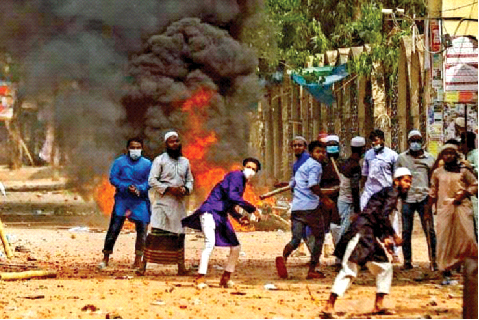
Sri Ram Navami Shobha Yatras across Bharat were no different this year. No, we are not emphasising the immortality of Sanatani values and the eternal spirit of Sri Ram and Ramayan. We are concerned about an undying political innuendo that “Muslim areas” must be avoided as ‘Ramazan’, is going on. The same month of ‘Ramazan’ which supposedly stands for peace and forgiveness, witnessed several attacks on Shobha Yatras. These attacks and subsequent rioting were reported from West Bengal, Maharashtra, Bihar, Delhi, Gujarat, and Telangana, among several other States.
While the political apostles of Muslim fundamentalism have always blamed Hindus for ‘provocation’, it couldn’t be far from the truth. From the days of the Salem riots of 1882, Muslims have always objected to Hindu religious processions. A series of flaming riots occurred in Shahabad (1917), and Delhi, Nagpur, Lahore, Lucknow, Moradabad, Bhagalpur, Gulbarga, Shahjahanpur, Kankinarah, Kohat, and Allahabad during 1924-25. Then again in 1925-26 in Calcutta, the riots were carried out in the United Provinces, the Central Provinces, Bombay, Berar, and Sholapur. More riots occurred in Nagpur (1927), Bombay (1928), Benaras and Cawnpore (1933-34), Amritsar and Panipat (1937) and the list goes on. Most of these major riots share three common causes: cow slaughter, music before the mosque, and Hindu yatras. If this column sets out to document all the major communal riots in our freedom struggle years, it would seem like a history of flaming riots and not of ‘Swaraj’.
Muslim Gangsterism After 1947
The point of stating so many facts to make a connection to the attacks on Shobha Yatras today is simple. The question at hand is, why are many Muslims hypersensitive and on edge when they witness Hindu religious processions in public spaces? And, why do they set out to attack, pelt stones, and involve themselves in what BR Ambedkar called “gangsterism”?
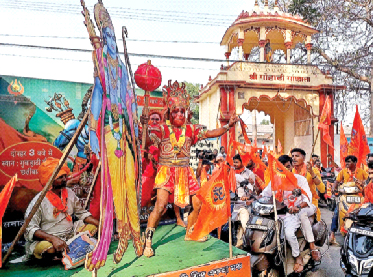
The scars of Partition never healed in independent India since major cultural faultlines between Hindus and Muslims were never repaired, rather stropped. These cultural faultlines were a continuity from the past: cow slaughter, music before the mosque, and Muslim responses to Hindu yatras. With the Jabalpur riots (1961), the myth of Nehruvian pluralism took a blow. Jawaharlal Nehru, who was a prime witness to the mad-dance of Muslim fundamentalism during the freedom movement acted all surprised. But all he could do was to write letters. On June 4, 1961, he wrote letters to Sadiq Ali, Khwaja Ahmed Abbas, and YB Chavan, asking them to address and resolve the issue. As if they could do it.
During Nehru’s tenure as Prime Minister (1950-1964), 243 communal riots were documented in 16 States. Indira Gandhi (1966-77 & 1980-84) sat over 337 communal riots in 15 States, including the Nielli Massacre of 1983. Rajiv Gandhi witnessed 291 communal riots in 16 States, including the barbaric Sikh Pogrom of 1984 (Source: Varshney-Wilkinson Dataset on Hindu-Muslim Violence in India, 1950-1995, Version 2). There were 1,194 communal riots documented in India from 1950-1995. Out of these 871 or 72.95 per cent were during Nehru, Indira & Rajiv’s PM-ship!
Attacks on Shobha Yatras
Attacks on Sri Ram Navami are not a recent phenomenon. West Bengal of 2018 or 2023 is not new! In Jamshedpur (1979), a Ram Navami procession passed through an area which had a significant population of Muslims. A major riot broke out that led to the killing of 120 people according to the Govt data. In Hyderabad (1978), Muslims started throwing stones on a Sri Ganesh procession consisting of 2000 people. Baroda (1982) saw intense communal clashes when the Dussera and Muharram coincided. Hazaribagh (1983) also recorded rioting when a procession led by Hindus was stopped by Muslims near the Jama Masjid. A Shivaji Jayanti procession in Bhiwandi (1984) led to large-scale communal violence.

In fact, Shivaji Jayanti procession was banned after the 1970 riots in Bhiwandi, a move which was resented by the Balasaheb Thackeray-led Shiv Sena. In Ahmedabad (1986), violence broke out during the historic Rath Yatra procession through the walled city areas. Disturbances started after the annual Rath Yatra of Bhagwan Jagannath was subjected to a heavy stone-throwing barrage in the “sensitive” Dariapur and Kalupur localities. Read “sensitive” as “Muslim areas”. Indore (1989) witnessed the same story when major riots broke out after a ‘Ramshila’ procession was stopped. A wave of communal violence took place in Kota, Badaun, Bhagalpur, Ratlam, Mhow, Khargone, Khambat, Palanpur and several other places for the same reason. Riots broke out in Kota (1989) on the occasion of Anant Chaturdashi when Hindus took out a procession. In Bhadrak (1989), riots occurred during the Ram Navami procession. In fact, at occasions it was not only about Hindus.
More than Ten per cent Formula
Data on major communal riots during 1978-1993 show that cities which have a sizeable Muslim population (Ten per cent) have witnessed the horrors of rioting, law and order crisis, and turbulent environ more than the others. (See Table 1.1) Let us consider Hyderabad and Lucknow, which have much in common. They are called historical centres of “Indo-Muslim” culture by secularists. They were ruled by Muslim princes, called the Nizams in Hyderabad and Nawabs in Lucknow, for a long time. From the vantage point of parliamentary politics, post-1947, the proportion of Hindus and Muslims in the population of these cities has roughly been in the same range. In Hyderabad, Muslims have constituted 35-37 per cent of the population since 1961, and in Lucknow 28-30 per cent.
Attacks on Shobha Yatras, not a new phenomenon
- Jamshedpur (1979), a Ram Navami procession passed through an area which had a significant population of Muslims. A major riot broke out that led to the killing of 120 people, according to the Govt data.
- Hyderabad (1978), Muslims started throwing stones on a Sri Ganesh procession consisting of 2,000 people
- Baroda (1982) saw intense communal clashes when the Dussera and Muharram coincided.
- Hazaribagh (1983) also recorded rioting when a procession led by Hindus was stopped by Muslims near the Jama Masjid
- A Shivaji Jayanti procession in Bhiwandi (1984) led to large-scale communal violence
- In Ahmedabad (1986), violence broke out during the historic Rath Yatra procession through the walled city areas
- Indore (1989) saw major riots broke out after a ‘Ramshila’ procession was stopped.
- Riots broke out in Kota (1989) on the occasion of Anant Chaturdashi when Hindus took out a procession
- In Bhadrak (1989), riots occurred during the Ram Navami procession
Communal violence, in these two cities, however, is a study in contrast. Lucknow’s only major Hindu-Muslim riot of this century took place in 1924. There were no riots during India’s Partition in 1947 or after the demolition of a disputed structure in Ayodhya in 1992. Hyderabad’s communal peace was first broken in 1938. Turbulence continued from 1938 to 1948, followed by an uneasy communal peace in the 1950s. In the 1960s Hyderabad experienced communal disturbances in eight out of ten years. The period since 1978 has been especially violent. With the exception of 1986-89, riots have taken place every year, some with horrendous brutality. Hyderabad is still represented by All India Majlis-E-Ittehadul Muslimeen (AIMIM) which originates from MIM, a party responsible for many riots. The case of Lucknow only seems different because we are focusing on Hindu-Muslim riots. If you make it Muslim Vs Muslim, it looks radically different. Lucknow has witnessed sectarian strife between Shias and Sunnis for many decades. Sectarian tensions appeared in 1949, 1951, 1952, and 1953-54; Shia-Sunni riots took place in 1968, 1969, 1970, 1973, 1974, 1977, and 1979. After 1979, Muharram processions, the ritual bone of sectarian contention, were banned.
Competitive Communalism? NO!
Since the data on Muslim fundamentalism and their tendency to bargain with power by rioting in public spaces is so stark and pervasive, none could lie about it. So, political apostles of Muslim appeasement coined a new term called ‘Competitive Communalism’. The implication is simple: Muslims are communal and rioters, only because Hindus are. The absurdity of this claim becomes visible quite easily.
Malegaon (1983) saw flaming communal riots after some crackers were bursted before the Jama Masjid to celebrate the victory of the Indian Cricket team in the World Cup. Let that sink! Before that Congress CM Abdul Rahman Antulay (1980-82) had left no stone unturned to radicalise the Muslims in Malegaon. Antulay floated the idea of constructing a martyr’s memorial to honour those who had lost their lives in the freedom struggle. The Malegaon authorities came up with names, all of which were Muslims. Malegaon in Nashik district is an interesting case since Muslims are in a majority, being 78.95 per cent of the total population. Unsurprisingly, all the MLAs from Malegaon constituency since 1952 have been Muslims.
AMBEDKAR ON MUSLIM GANGSTERISM
“Music may be played before a mosque in all Muslim countries without any objection. Even in Afghanistan, which is not a secularised country, no objection is taken to music before a mosque. But in India, the Musalmans must insist upon its stoppage for no other reason except that the Hindus claim a right to it… The third thing that is noticeable is the adoption by the Muslims of the gangster’s method in politics. The riots are a sufficient indication that gangsterism has become a settled part of their strategy in politics.”
Bhimrao Ramji Ambedkar, ‘Pakistan or the Partition of India’ in Vasant Moon (Ed.) BAWS, Vol. 8, 1990, p. 269
Moradabad (1980) is as bizarre case as it gets. It has a Muslim population of 46.79 per cent. Eid prayers were disrupted and scores of people, including many young children, died in a stampede at the Idgah. The riot occurred on this particular occasion because a police constable on duty refused to chase a pig when asked by Muslims in the Idgah. There was a long-standing rivalry between the Muslims in this area and the Valmikis. Constant clashes occured between them over land, and the straying of pigs into the Muslim locality. The riots in Moradabad was followed by Biharsharif, Meerut, Baroda, Bhiwandi, Pune and Sholapur. Where is the point of Hindus being the provocators, when Muslims in the areas dominated by them have gone rioting over most futile issues?
Academics, “pseudo-secularists”, political apostles, and apologists of Muslim fundamentalism made Rath Yatra and Kar Seva in the context of Sri Ramjanmanbhoomi movement responsible for flaming communal fire in the late 1980s-early 1990s. Riots which were over almost all the states from Assam to West Bengal, Bihar, Orissa, Uttar Pradesh, Madhya Pradesh, Rajasthan, Andhra Pradesh, Karnataka, Gujarat, Maharashtra and Delhi didn’t occur in a political vaccum.
GANDHI ON MUSLIM HATE FOR RAMANAMA
“I have heard of a peremptory demand for total cessation of music, soft or loud, at any time whatsoever in front of mosques. There is too a demand for the stopping of arati during prayer hours in temples in the neighbourhood of mosques. I heard in Calcutta that even boys passing by a mosque early in the morning and reciting Ramanama were stopped.”
Mahatma Gandhi, ‘That Eternal Question’, Young India (October 22, 1925), in CWMG, Vol. 33, p. 136
As soon as Rath Yatra entered in Chandni Chowk area in October 1990, massive riots started. The flames of riots spread from Fatehpuri Masjid to Lal Kuan and Jama Masjid Chowk in no time. Similar incidents happened in Agra, Lucknow, Kanpur, Ahmedabad, Jodhpur, Beawar, Indore, Hyderabad, and where not. Bhagalpur (1989-90) is a case in point. Rajiv Gandhi as PM was playing with communal fire. Local administration was made a scapegoat in the Bhagalpur Communal Riots Inquiry Commission. It suggested that the intelligence sources and the people were well aware of the likelihood of riots breaking out, but did not stop the Rath Yatra procession and allowed it to pass through a Muslim-dominated area.
The question remains why are Muslims hyper-sensitive, barbed and violent to Hindu yatras? And why has the Indian state not done anything to transform the “sensitive areas” to make them “normal”? Why should BJP-RSS-VHP be made guilty for carrying out a Yatra, which Hindus have done forever? And why not Muslims be asked to exercise restrain, grow tolerance and acceptance, and respect the secularism and pluralism of the nation? There are a hundred ways to answer these questions. A fact-sheet on the nature of attacks by Muslims on Sri Ramnavami Shobha Yatra is just one among many.













Comments