Since 1998, after Russia went bankrupt, US/NATO assumed her to be militarily/ financially weak. US/NATO was very confident of their military/economic superiority. This gave them a feeling that they are above laws that govern human behaviours such as universality, credibility and reciprocity. Since then, Russia has performed an economic miracle. To offset it, US/NATO began by blocking ‘Nord Two Pipelines’. On realising Russian superiority in missile/nuclear space warfare, US tried to find a war that would deplete Russian weaponry to such an extent that Russia would, once again, be the Russia of 1998. She readily found a proxy in Ukraine, keen on joining NATO/European Union. US compelled NATO to agree to her proposal. And the result is the Russia-Ukraine conflict.
Russian military offensive in Ukraine has set in motion a chain of events. It resulted in a global upheaval which, in political and economic terms, is comparable to World War I and II. This is the initial phase of this conflict, with more players getting involved as time passes. Yet few conclusions can be drawn after the completion of one year of this conflict. This conflict is a result of illusions the participants had about themselves. Almost all of the direct and indirect actors in the Ukrainian crisis built their domestic and foreign policies on theoretical, highly ideological constructions. In February 2022, postmodernism collided with the real world. This is an attempt to analyse the main players in this conflict.
Confronting Russia
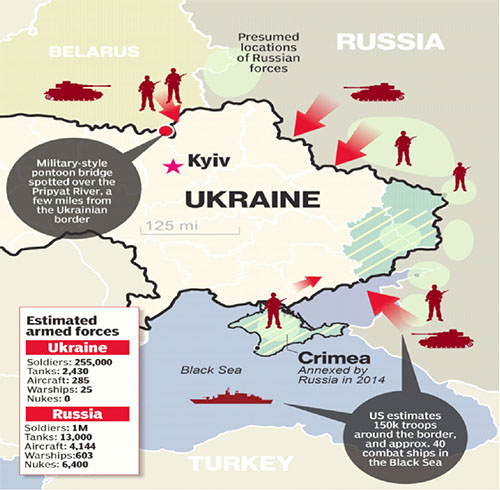
The US/NATO and the countries bordering Russia wanted a security situation, clear rules of the game, and a high degree of influence over Ukraine. When Russia entered Ukraine on February 24, 2022, she wanted to solve this issue quickly, spilling little blood. But she failed to achieve this objective, and this anti-Russian outpost turned out to be very strong and ready to fight, even at the cost of her own destruction.
Right now, offensives are being carried out only in the Donbas region, not along the entire front but in localised areas, mainly by the forces of Wagner Private Mercenary Contractor Group and former local militias. The Russian Army was not prepared for a large-scale land conflict on a front line of a couple of thousand kilometres, with a need to conduct combined armed operations on the level of World War II, backed up by the mobilisation of hundreds of thousands of men. This prevented Russia from conducting a full-scale offensive with the decisive goal of defeating the Ukrainian Army. It seems that the Russian Army may be preparing to do that in 2023.
Prolonging the conflict
The US wanted complete control over what goes on in the world, which entails that her counterparts’ interests are determined in Washington. This inflexibility has led to the current crisis, wherein the US could not reach an agreement with Russia. The fact is that the US has nothing to lose and everything to gain from prolonging the Ukraine conflict. The US principle of “might before right” has already led to a sharp weakening of the American position in West Asia; the prospect of conflict with China has become almost irreversible; and she has laid time bombs under her relations with allies in Europe and Asia that are likely to go off in future.
US wanted complete control over what goes on in the world, which entails that her counterparts’ interests are determined in Washington. This inflexibility has led to the current crisis, wherein US could not reach an agreement with Russia
After World War II, the US built a global system where it took control of political and economic processes around the world without much resistance. The US was confident that a military conflict like Ukraine could not be won without her direct involvement. That the Ukrainian army is holding up quite well as of date supports this assumption. But the US and Ukraine must realise that Russia has engaged only a small part of its military resources in this operation, and an escalation would only be determined by political decisions, not the military and mobilisation capabilities of both sides. But if the conflict escalates, it will be extremely difficult for the US/NATO to respond without directly engaging their air defences and Air Forces in this conflict.
Western Europe/NATO countries
As of date, the prosperity of Europe/NATO countries has rested on two pillars: American military/political/economic roof and cheap Russian resources. This has led to their acceptance of the most vicious anti-Russia sanctions without any regard for any anticipated economic/existential damage to them. This conflict has deprived them of a major market and, most important, a resource base. Also, it has driven them into total dependence on the US, which has real military power and control over global political and economic processes.
As the US/NATO’s attempts to shock and awe Russia economically failed, they now either need a military victory or a start to diplomatic dialogue in Ukraine. The reasons are simple. a) Anticipated prospect of high energy prices in years ahead; b) Resultant de-industrialisation and falling living standards, c) certain global recession, d) the possibility of subsidising ruined Ukraine indefinitely and e) Spectre of hundreds of billions of dollars in losses from lost accumulated investments in Russia. This is frightening without any solution in sight in the near future.
One year ago, Russia gave the West a last chance to prevent a full-blown Russo-Ukraine conflict. The West did not cash in on it. Resultantly, long-standing problems of the European Union, mainly the migration crisis and the constant concern about the economic stability of southern-Europe, were brushed under the carpet.
Weapon of West
With active American/NATO instigation and support, successive governments in Ukraine wanted to build a mono ethnic state hostile to Russia within its post-Soviet borders with a significant Russian population. This attempt to tilt decisively to the American/NATO Block led to a civil conflict, each side supported by the West and Russia, respectively. As the civil conflict escalated in 2014, Ukraine started to turn into a weapon of the West against Russia. This move of the US/NATO was partially successful as both the Ukrainian Armed Forces and the State withstood the February 24, 2022, blow, recovered, and have, with Western support, inflicted a series of painful blows on Russia in the last four months.
Military successes are not strategic. Therefore, the price of this Ukrainian success is the death of the Ukrainian economy. As per estimates, a) More than 35 per cent of the pre-February 2022 population has left/fled Ukraine; b) Production was reduced to half before Russian strikes on energy facilities in October 2022. This is down by 78 per cent in mid-January 2023, and c) Resultant huge unemployment, empty coffers, further impoverishment of the population and mass closure of businesses.
Though US/NATO provides powerful backing to Ukraine, they have avoided direct involvement in ground/air fighting, shifting all the burden and hardship onto Ukraine. When the conflict ends; a devastated Ukraine will have to deal with consequences on its own. Therefore, any further delay in ending the conflict will be disastrous for her.
Existential War
The Ukraine War is existential for Russia as she cannot allow the utilisation of Ukraine as an American/NATO military base with pointed missiles capable of reaching Russian territory in one or two minutes. Russia wanted to accept the 2014 and 2015 Minsk agreements. But France, Germany and Ukraine refrained from joining it. Instead, all of them used this intervening period to arm and train Ukraine’s military for war against Russia.
The fact that Russia-Ukraine conflict is escalating is a reality. Ukraine fires two to seven thousand missiles/bombs/artillery, shells a day at Russia, and Russia fires 20 to 50 thousand missiles/bombs/artillery shells a day at Ukraine. To eliminate this disparity, military/financial aid to Ukraine needs to be increased by at least 50 per cent; at the Munich Security Conference held on February 18, 2023, all European leaders agreed. The US/NATO makes two to three lakh missiles/bombs/artillery shells a year. If the war drags on, they will have to make seven to ten lakh missiles/bombs/shells a year. It will cost approximately 4.7 billion dollars per year. This will be in addition to present assistance. It is difficult to predict how long the US/NATO/European Union will be able to bear this cost.
On February 21, 2023, Russian President Vladimir Putin announced that Russia is suspending its participation in the New Start treaty, the only remaining major nuclear agreement between Russia and the US. This takes the world into uncharted territory. President Putin has directed his defence ministry to prepare, not necessarily carry out, possible nuclear tests.
Putin is now infusing additional equipment and 300,000 mobilised troops into the war, for a new offensive that Russia has not announced as yet but is already underway in eastern-Ukraine. Although the conflict is limited to Ukraine today, there is no guarantee that Russia’s hunger will be satisfied only there.
On February 21 2023, during his secretive 23-hour visit to Ukraine, American President Joe Biden said, “One year ago, the world was bracing for the fall of Kyiv. Well, I just visited Kyiv and can confirm that Kyiv stands strong, proud, tall and most important, it stands free.” One has to take this statement with a pinch of salt for obvious reasons. While in Kyiv, American President announced a new weapons package for Ukraine worth about $500 million. This 32nd military aid package brings American military aid commitment to over $30 billion since Russia invaded Ukraine in 2022.
Thus, the vision of the first anniversary of the Russian invasion on February 24, 2023 is both grim and vexing. It marks a full year of killing, destruction, loss, and pain felt even beyond the borders of Russia and Ukraine. War-related price shocks are just one example. It also raises a question: How much longer until this stops? It is difficult to sum up the misery of 365 days of bloodshed and the full scale of global repercussions.
February 24, 2022, has not led to World War III, not as yet; but who knows what will happen next. Only time will tell.