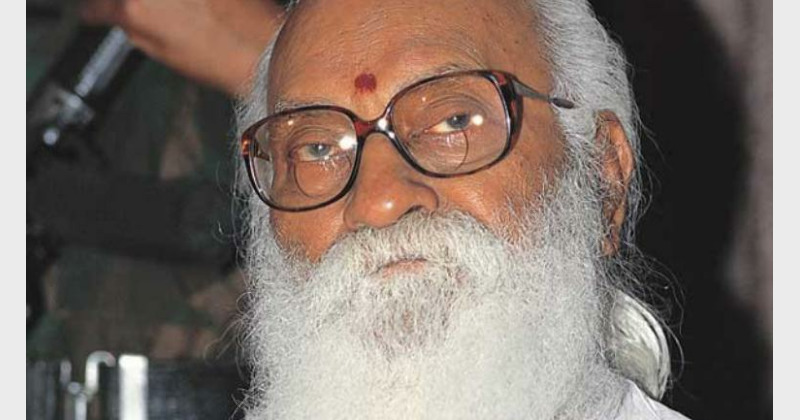
Chandikadas Amritrao Deshmukh, or shortly Nanaji Deshmukh, is a person who needs no introduction. A social activist who patiently worked and reformed hundreds of villages in the economically backward regions of Central India and rescued lakhs of people from utter poverty. He was an economist who gave the world an autonomous economic alternative when the world was polarized between exploitative capitalism and dogmatic communism. As an intellectual, Nanaji started the first Rural University in India. He pioneered the conflict-free society through “Litigation free villages” and made the villagers partners in their development. A political activist who crafted one of the largest pro-democracy movements in Independent India that led to the restoration of democracy in India after a two-year dictatorship. His sharp intellect and extraordinary organizing skill have put an indelible mark on Indian politics.
Born on October 11, 1916, in a humble Maharashtrian family at Kadoli, a small town in Parbhani district, Nanaji had little money to pay for his tuition fees and books. But he had such a burning passion for knowledge that he did not shy away from working as a vegetable vendor and raised money for achieving his objective. Lokamanya Tilak was the role model of Nanaji. He showed a keen interest in social service and activities. His family was in close contact with Dr. Hedgewar, a regular visitor to the family of Nanaji. Dr. Hedgewar saw great hidden potential in Nanaji and encouraged him to attend RSS shakhas.
Nanaji joined the RSS, devoting his whole life to the service of the Nation. He was sent to Uttar Pradesh as a Pracharak, and he went to Gorakhpur, where he endured great pain to introduce the Sangh ideology in the eastern UP. It was not an easy task as the Sangh had no funds to meet, even day-to-day expenses. He had to stay in a Dharmashala but had to keep on changing Dharmashalas as no one was allowed to stay there for more than three days consecutively. Ultimately, he was given shelter by Baba Raghavdas because he would also cook meals for him. In a short span of three years, his hard work bore fruits, and almost 250 Sangh Shakhas appeared up in and around Gorakhpur.
In 1947 the RSS decided to launch two journals, Rashtradharma and Panchjanya, and a newspaper called Swadesh. For this purpose, Shri Atal Bihari Vajpayee was assigned the editor’s responsibility, and Shri Deendayalji was made the Margdharshak with Nanaji as the Managing Director. It was a challenging task as the organization was hard up for money to bring out the publications. Yet, it never dampened their spirits, and these publications gained popularity and recognition.
Mahatma Gandhi’s assassination led to the imposition of a ban on the RSS. The publication of the journals and newspaper came to a grinding halt. A different strategy was adopted, keeping the ban in mind, and Nanaji was the brain behind underground publication work by the RSS those days. When the ban was lifted and decided to have a political organization, Jana Sangh came into being. Shri Guruji asked Nanaji to take charge of Bharatiya Jana Sangh in Uttar Pradesh as party Secretary. Nanaji had worked as an RSS pracharak in Uttar Pradesh, and his groundwork proved of great help in organizing BJS at the grassroots. By 1957 BJS had established its units at each and every district in Uttar Pradesh and credit for this goes to the Nanaji, who had extensively travelled all over the State.
Nanaji actively participated in Bhoodan Movement started by Vinoba Bhave. By spending two months with Vinoba, he was inspired by the success and appeal of the movement. When Jai Prakash Narayan called “Total Revolution”, he responded by giving total support to this movement. When the Janata Party was formed, Nanaji was one of its main architects. Janata Party stormed into power by sweeping off the Congress, and Nanaji was elected from Balrampur parliamentary constituency in Uttar Pradesh. He politely refused when he was offered a ministerial berth by then Prime Minister, Shri Morarjee Desai. For him, politics was never a career but a mission. He was not the person who would stick to politics or office, come what may. Of his own volition, he announced his retirement from politics in the presence of Jai Prakash Narayan and, since then, never looked back.
In 1977, he moved to Chitrakoot, a remote village in Madhya Pradesh, with a mission to create a prototype of a self-sustaining model of development based on the concept of “Gram Swaraj”. For the first time, there was a model, which depended on civil society than on the Government for development. “Do not wait for the Government to solve your problems.” Nanaji used to tell people, “we have to find solutions to our problems”. Hundreds of villages that have come under what is now popularly known as the “Chitrakoot project” generate their electricity through Bio-energy and solar energy plants.
The villages, which always faced water shortage, today have a variety of rain harvesting and water conservation methods. Organic farming has become a way of life, and chemical fertilizers are no more used. Women run many small-scale industries which produce quality goods. Nanaji established Chitrakoot Gramodya Vishwavidyalaya in Chitrakoot, India’s first rural university and was its first Chancellor. All of this with very little support from the Government. For all those who thought Gandhian and Indian economic models were too idealistic and unrealistic, he was an answer. He was an example of holistic development, of the fruits of development, reaching the last man.
Nanaji’s vision was to form a conflict-free society. He had found to his dismay that a lot of energy of the rural people was wasted in litigations, which left them both impoverished and exploited. He said, “If people fight amongst themselves, they will have no time for development”. He pioneered a method of sorting conflicts and differences between the villagers called the Litigation Free Model, which was based on the ancient Indian principles of consensus making and alternate conflict resolution. When the President of India, Dr A P J Abdul Kalam, visited Chitrakoot, he was amazed by this. He congratulated Nanaji for giving to the nation the litigation-free model of resolving disputes he had devised. Dr Kalam said,
“In Chitrakoot, I met Nanaji Deshmukh and his team members belonging to the Deendayal Research Institute. Deendayal Research Institute is a unique institution developing and implementing a village development model which is most suited for India. Apart from all the development activities, the institute is facilitating a cohesive conflict-free society. I consider that this model may be propagated in many parts of the country by societal organizations, judicial organizations and government,” Kalam had opined. Praising Nanaji Deshmukh for his single-minded devotion to the uplift of the people, Kalam said, “What the octogenarian leader was doing at Chitrakoot should be an eye-opener for others.”
NDA Government, headed by Shri Atal Bihari Vajpayee, nominated him as an MP in Rajya Sabha in 1999 in recognition of his services to the nation. This can hardly summarize the life and the work of Shri Nanaji Deshmukh. He passed away at 94, after living a long and inspiring life of a social reformer. He was a legendary social worker and the swayamsevak of the Rashtriya Swayamsevak Sangh.
(The writer is an Asst Professor in English at Govt Brijindra College, Faridkot, Punjab)