Researchers find proteins that serve as a form of ‘mitotic memory’
December 6, 2025
  • Read Ecopy
  • Circulation
  • Advertise
  • Careers
  • About Us
  • Contact Us
Android AppiPhone AppArattai
Organiser
  • ‌
  • Bharat
    • Assam
    • Bihar
    • Chhattisgarh
    • Jharkhand
    • Maharashtra
    • View All States
  • World
    • Asia
    • Europe
    • North America
    • South America
    • Africa
    • Australia
  • Editorial
  • International
  • Opinion
  • RSS @ 100
  • More
    • Op Sindoor
    • Analysis
    • Sports
    • Defence
    • Politics
    • Business
    • Economy
    • Culture
    • Special Report
    • Sci & Tech
    • Entertainment
    • G20
    • Azadi Ka Amrit Mahotsav
    • Vocal4Local
    • Web Stories
    • Education
    • Employment
    • Books
    • Interviews
    • Travel
    • Law
    • Health
    • Obituary
  • Subscribe
    • Subscribe Print Edition
    • Subscribe Ecopy
    • Read Ecopy
  • ‌
  • Bharat
    • Assam
    • Bihar
    • Chhattisgarh
    • Jharkhand
    • Maharashtra
    • View All States
  • World
    • Asia
    • Europe
    • North America
    • South America
    • Africa
    • Australia
  • Editorial
  • International
  • Opinion
  • RSS @ 100
  • More
    • Op Sindoor
    • Analysis
    • Sports
    • Defence
    • Politics
    • Business
    • Economy
    • Culture
    • Special Report
    • Sci & Tech
    • Entertainment
    • G20
    • Azadi Ka Amrit Mahotsav
    • Vocal4Local
    • Web Stories
    • Education
    • Employment
    • Books
    • Interviews
    • Travel
    • Law
    • Health
    • Obituary
  • Subscribe
    • Subscribe Print Edition
    • Subscribe Ecopy
    • Read Ecopy
Organiser
  • Home
  • Bharat
  • World
  • Operation Sindoor
  • Editorial
  • Analysis
  • Opinion
  • Culture
  • Defence
  • International Edition
  • RSS @ 100
  • Magazine
  • Read Ecopy
Home Sci & Tech

Researchers find proteins that serve as a form of ‘mitotic memory’

WEBDESKWEBDESK
Feb 27, 2023, 06:00 pm IST
in Sci & Tech
Follow on Google News
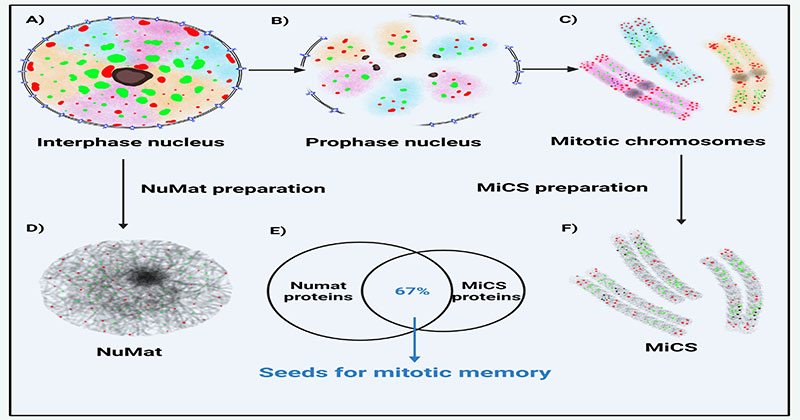
The infographic depicts the stages of cell cycle (A, B and C) and preparation of nuclear matrix and mitotic chromosome scaffold (D and F). It also shows the similarity in their proteomes (E). Commonality in the protein components of the NuMat and MiCS strongly suggests that memory of transcriptional status of interphase nucleus in the chromosome territories is imbedded in the mitotic chromosomes and provides the structural basis of cellular memory.

The infographic depicts the stages of cell cycle (A, B and C) and preparation of nuclear matrix and mitotic chromosome scaffold (D and F). It also shows the similarity in their proteomes (E). Commonality in the protein components of the NuMat and MiCS strongly suggests that memory of transcriptional status of interphase nucleus in the chromosome territories is imbedded in the mitotic chromosomes and provides the structural basis of cellular memory.

FacebookTwitterWhatsAppTelegramEmail

Researchers from the Centre for Cellular and Molecular Biology (CSIR-CCMB) have identified the proteins that make up the interphase nuclear scaffold called the Nuclear Matrix (NuMat) and the Mitotic Chromosome Scaffold (MiCS).

Like humans, the life of all complex organisms originates from a single cell called the zygote. During development, the cells grow in size and divide to give rise to daughter cells through mitosis. When a cell divides, the entire genetic material of the cell is replicated to make two copies and equally distributed to the daughter cells. During mitosis, the nuts and bolts of the cell and the nucleus are dismantled; after mitosis, they are automatically reassembled. While undergoing division, the cell must remember the mother cell’s organisation to reorganise the daughter cells in the same fashion.

After a particular stage of development, the fate of these cells is predetermined. A set of specific cells give rise to specific function cells in a particular organ. If and when the cells divide, their functionality must be replicated in the daughter cells. However, the mitotic memory essential for such precise functioning has yet to be discovered.

“What makes the two daughter cells identical to the mother cell is not only their physical organisation and function but also the organisation of their genetic material in the control room of the cell, the nucleus. Our lab, along with several other labs in the world, has been trying to understand the architecture of the nucleus and what could be the structural basis of mitotic memory,” said the researchers while talking to India Science Wire.

NuMat is supposed to be the underlying biomolecular scaffold that provides structural organisation and functional compartmentalisation of the nucleus. However, during cell division, the nuclear envelope and matrix essential for the structural and architectural integrity of the interphase nucleus are disassembled, and chromosome territories are condensed into mitotic chromosomes, only to be reassembled and re-established in the daughter nucleus.

“We have identified the proteins that make up the interphase nuclear scaffold called the NuMat and the MiCS. Comparing the proteins that make up the NuMat and MiCS, we found that more than two-thirds of the proteins are the same. This means, during the process of condensing the genetic material for cell division, the proteins of the nuclear matrix are packaged and passed on to the daughter cells in the form of a mitotic chromosome, which now serves as a form of mitotic memory for the precise re-establishment of mitotic memory,” researchers point out.

The researchers compared the interphase nucleus’s qualitative and quantitative protein compositions and the mitotic chromosomes from fruit fly cell lines using techniques such as Liquid Chromatography with tandem mass spectrometry (LC-MS/MS). The data analysis using bioinformatic approaches to identify the proteins in the NuMat and MiCS revealed a two-thirds overlap between them.

“Based on several studies from our lab over the years, we propose a new hypothesis to address the molecular and structural basis of mitotic memory. Our hypothesis states that the proteins that make the nuclear matrix of the interphase nucleus, during cell division are disassembled and packaged into the mitotic chromosomes and these serve as mitotic memory to guide the re-establishment of nuclear architecture in daughter cells,” researchers explain.

The study provides several new leads for a candidate-based approach to understand how the nuclear architecture dismantled during mitosis is reorganised to reproduce a cell that is structurally and functionally similar to the mother cell.

The researchers also speculate that the constituents of mitotic memory are critical for normal functioning and that their dysfunction may lead to misregulation of the cells, causing abnormalities such as cancers and developmental diseases or disorders.

The research team comprised Mamilla Soujanya, Ashish Bihani, Nikhil Hajirnis, Rashmi U Pathak, and Rakesh K Mishra. The study has been published in Springer Nature.

(India Science Wire)

Topics: mitosisdevelopmental diseasesCancermitotic memory
Share11TweetSendShareSend
✮ Subscribe Organiser YouTube Channel. ✮
✮ Join Organiser's WhatsApp channel for Nationalist views beyond the news. ✮
Previous News

Telangana: Dr Preethi at Kakatiya Medical College, commits suicide due to continuous harassment by Dr Ali Saif

Next News

Nanaji Deshmukh: Swa Se Swarajya and Aatmanirbhar Bharat

Related News

Representative image

Childhood exposure to bacterial toxin can trigger Colorectal cancer among the young: Study

Representative image

Study finds critical relationship between stem cells, mechanical signals

Breakthrough ‘3-in-1’ antibody offers promising new approach for targeted cancer treatment

Representative image

Study finds how antidepressants have potential for treating brain tumours

Representative image

Researchers discover how body’s natural killer cells protects from cancer

Representative image

Diet can be risk factor for colon cancer in younger adults, finds study

Load More

Comments

The comments posted here/below/in the given space are not on behalf of Organiser. The person posting the comment will be in sole ownership of its responsibility. According to the central government's IT rules, obscene or offensive statement made against a person, religion, community or nation is a punishable offense, and legal action would be taken against people who indulge in such activities.

Latest News

PM Modi presents Putin with Bhagavad Gita, chess set, and silver horse

Cultural ties strengthened: PM Modi presents Putin with Bhagavad Gita, chess set, and silver horse

Image for representational purpose only, Courtesy Vocal Media

Bihar to get ‘Special Economic Zones’ in Buxar and West Champaran

Thirupparankundram Karthigai Deepam utsav

Andhra Pradesh: AP Dy CM Pawan Kalyan reacts to Thirupparankundram row, flags concern over religious rights of Hindus

23rd India-Russia Annual Summit

India-Russia Summit heralds new chapter in time-tested ties: Inks MoUs in economic, defence, tourism & education

DGCA orders probe into IndiGo flight disruptions; Committee to report in 15 days

BJYM leader Shyamraj with Janaki

Kerala: Widow of BJP worker murdered in 1995 steps into electoral battle after three decades at Valancherry

Russian Sber bank has unveiled access to its retail investors to the Indian stock market by etching its mutual fund to Nifty50

Scripting economic bonhomie: Russian investors gain access to Indian stocks, Sber unveils Nifty50 pegged mutual funds

Petitioner S Vignesh Shishir speaking to the reporters about the Rahul Gandhi UK citizenship case outside the Raebareli court

Rahul Gandhi UK Citizenship Case: Congress supporters create ruckus in court; Foreign visit details shared with judge

(L) Kerala High Court (R) Bouncers in Trippoonithura temple

Kerala: HC slams CPM-controlled Kochi Devaswom Board for deploying bouncers for crowd management during festival

Fact Check: Rahul Gandhi false claim about govt blocking his meet with Russian President Putin exposed; MEA clears air

Load More
  • Privacy
  • Terms
  • Cookie Policy
  • Refund and Cancellation
  • Delivery and Shipping

© Bharat Prakashan (Delhi) Limited.
Tech-enabled by Ananthapuri Technologies

  • Home
  • Search Organiser
  • Bharat
    • Assam
    • Bihar
    • Chhattisgarh
    • Jharkhand
    • Maharashtra
    • View All States
  • World
    • Asia
    • Africa
    • North America
    • South America
    • Europe
    • Australia
  • Editorial
  • Operation Sindoor
  • Opinion
  • Analysis
  • Defence
  • Culture
  • Sports
  • Business
  • RSS @ 100
  • Entertainment
  • More ..
    • Sci & Tech
    • Vocal4Local
    • Special Report
    • Education
    • Employment
    • Books
    • Interviews
    • Travel
    • Health
    • Politics
    • Law
    • Economy
    • Obituary
  • Subscribe Magazine
  • Read Ecopy
  • Advertise
  • Circulation
  • Careers
  • About Us
  • Contact Us
  • Policies & Terms
    • Privacy Policy
    • Cookie Policy
    • Refund and Cancellation
    • Terms of Use

© Bharat Prakashan (Delhi) Limited.
Tech-enabled by Ananthapuri Technologies