Tibet’s struggle for Independence from China is also for national security for India and for world peace
June 30, 2026
  • Read Ecopy
  • Circulation
  • Advertise
  • Careers
  • About Us
  • Contact Us
Android AppiPhone AppArattai
Organiser
  • ‌
  • Bharat
    • Assam
    • Bihar
    • Chhattisgarh
    • Jharkhand
    • Maharashtra
    • View All States
  • World
    • Asia
    • Europe
    • North America
    • South America
    • Africa
    • Australia
  • Editorial
  • International
  • Opinion
  • RSS @ 100
  • More
    • Op Sindoor
    • Analysis
    • Sports
    • Defence
    • Politics
    • Business
    • Economy
    • Culture
    • Special Report
    • Sci & Tech
    • Entertainment
    • G20
    • Azadi Ka Amrit Mahotsav
    • Vocal4Local
    • Web Stories
    • Education
    • Employment
    • Books
    • Interviews
    • Travel
    • Law
    • Health
    • Obituary
  • Subscribe
    • Subscribe Print Edition
    • Subscribe Ecopy
    • Read Ecopy
  • ‌
  • Bharat
    • Assam
    • Bihar
    • Chhattisgarh
    • Jharkhand
    • Maharashtra
    • View All States
  • World
    • Asia
    • Europe
    • North America
    • South America
    • Africa
    • Australia
  • Editorial
  • International
  • Opinion
  • RSS @ 100
  • More
    • Op Sindoor
    • Analysis
    • Sports
    • Defence
    • Politics
    • Business
    • Economy
    • Culture
    • Special Report
    • Sci & Tech
    • Entertainment
    • G20
    • Azadi Ka Amrit Mahotsav
    • Vocal4Local
    • Web Stories
    • Education
    • Employment
    • Books
    • Interviews
    • Travel
    • Law
    • Health
    • Obituary
  • Subscribe
    • Subscribe Print Edition
    • Subscribe Ecopy
    • Read Ecopy
Organiser
  • Home
  • Bharat
  • World
  • Operation Sindoor
  • Editorial
  • Analysis
  • Opinion
  • Culture
  • Defence
  • International Edition
  • RSS @ 100
  • Magazine
  • Read Ecopy
Home World

Tibet’s struggle for Independence from China is also for national security for India and for world peace

During the Shimla convention between Tibet, China and British India the representatives of China refused to sign the treaty because Tibet had raised the issue of those areas of Eastern Tibet which China had occupied and Tibet demanded their return

Vijay KrantiVijay Kranti
Feb 15, 2023, 05:00 pm IST
in World
Follow on Google News
FacebookTwitterWhatsAppTelegramEmail

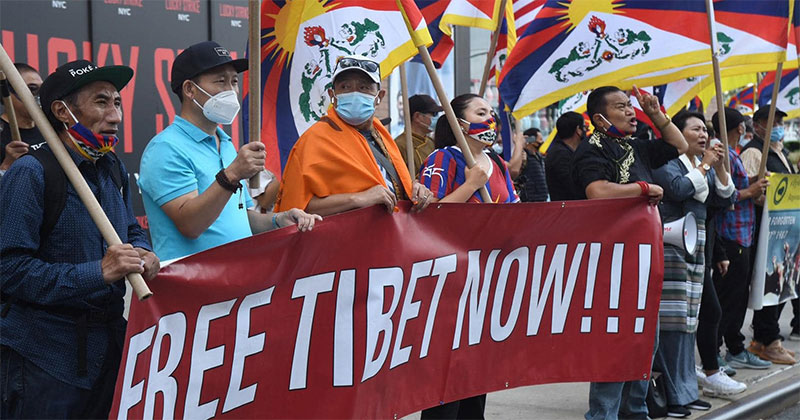
While people of Tibet and other colonies of China are struggling for freedom of their countries from Chinese occupation, their struggle is also aimed at ensuring national security of countries surrounding China, especially for India, and peace for the rest of world from a belligerent China.

This was a common observation of experts and advocacy groups who shared a common platform to commemorate the 110th anniversary of the ‘Declaration of Independence of Tibet’ by the 13th Dalai Lama in 1913.

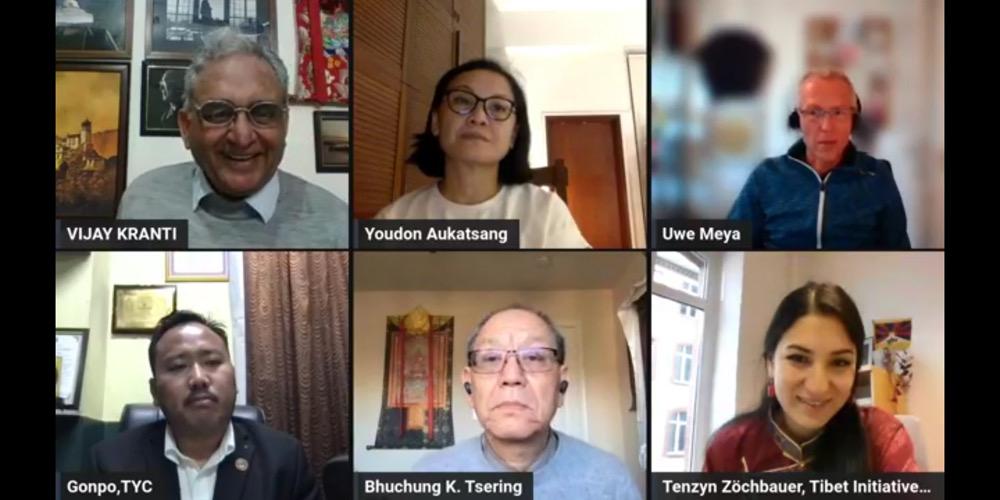
The webinar was organized jointly by the Centre for Himalayan Asia Studies and Engagement (CHASE) and Tibetan Youth Congress (TYC) on the evening of February 13. The experts who presented their perspectives were Mr Bhuchung Tsering, Interim President of International Campaign for Tibet who participated from Washington DC; Dr Uwe Meha member of the Board of Swiss Tibetan Friendship Association GSTF who participated from Switzerland; Ms Youdon Aukatsang, Member of Tibetan Parliament who participated from Singapore; Ms Tenzyin Zochbauer, Executive Director of Tibet Initiative Deutschland (TID) who participated from Berlin; and Gonpo Dhundup, President TYC who joined in from Dharamshala.
Bhuchung Tsering dwelt upon all the five points emphasised by the 13th Dalai Lama in his Declaration. He said that the Declaration not only reiterated the independent status of Tibet but it also presented a much larger vision of the Dalai Lama about the future of Tibet. “While the point-4 declared that Tibet had regained its independence after a short spell of Manchu army’s invasion of Tibet, points-1 and 2 emphasised over preserving and promotion of Tibetan national identity. Similarly points-3 and 5 explained how the Tibetan officials should govern Tibet and work for social welfare of Tibetan masses”, he said.

He said the historic declaration of 1913 becomes far more significant when considered along with the Shimla Agreement between Tibet and British India and his 1932 prophecy about future of Tibet.

During the Shimla convention between Tibet, China and British India the representatives of China refused to sign the treaty because Tibet had raised the issue of those areas of Eastern Tibet which China had occupied and Tibet demanded their return. In his 1932 prophecy the 13th Dalai Lama had warned the people of Tibet about the lurking danger from the Chinese communists and carelessness of Tibetan officials about governance and the national interests.

Dr Uwe Meya in his presentation underlined the danger of world community borrowing the Chinese narrative on Tibet without examining or challenging it. He said, “In the media, and also in political debates, ‘Tibet’ is mostly referred to, if at all, as ‘TAR’. Even worse, many media use official Chinese language when reporting on Tibet and just call it ‘a region in southwestern China’. They are unaware that with this, they implicitly and unknowingly acknowledge that Tibet has been part of China for all the time. Moving to politics, we notice that most governments now do not challenge China’s “one-China” standpoint and thereby fall into the trap of accepting to treat Tibet as China’s “internal affair” and thereby weakening the Tibetan position in negotiations.

Moreover, Beijing uses these statements as ‘evidence’ for its claim and uses the international community’s statements as substitute for legitimacy to rule over Tibet. The other trap that the Western world – politicians, the media and general public – falls into is calling the Tibetans a ‘minority’ and using euphemisms such as ‘the Tibet issue’. We must realise that Tibetans were made a minority only by the Chinese occupation.”

Ms Youdon Aukatsang reminded the people that when the 13th Dalai Lama declared Tibet’s independence it was after defeating the Manchu army which was not ‘Chinese’. She said that over the history the relations between the Manchu kings and Tibet were of patron and the priest and did not mean that the Manchus were the rulers of Tibet. This simply means that this was a friendly relation. Giving modern example of Bhutan and India relations she said that although Bhutan is a protectorate of India but both countries respect each other as independent countries. She said although China claims that it ‘liberated’ Tibet but the reality is that Tibet is an occupied country.

Ms Tenzing Zochbauer said that this day would be celebrated in the best way if the Tibetans use it to counter the Chinese propaganda and inform the world that Tibet was never a part of China. She emphasised the need of educating and training the young Tibetan generation about the true history of Tibet.

She spoke about the campaign of her organisation TID which has been successful in enrolling more than 450 German city councils to hoist Tibetan flag on their office buildings every year on 10th March. She said that Tibetans and Tibet supporters are working towards a day when the flag of free Tibet will be hoisted on Potala palace and the Dalia Lama will return to a free and independent Tibet.

Gonpo Dondup in his presentation and his vote of thanks said, “TYC and all Tibetans are celebrating this historic day which very clearly underlines that Tibet has been always an independent country and that the Chinese occupation of Tibet is illegal. China is using its propaganda machinery to establish a false narrative in the international discourse against the truth of independent status of Tibet.

It is therefore the duty of every Tibetan, whether in exile or those living under the colonial occupation of Tibet, to fight back this Chinese propaganda. While people of Tibet are struggling for a Free-Tibet they are actually fighting for the national security of India and other countries surrounding China and also for the restoration of peace for the rest of world”, he said.


Topics: ChinaTibetTibet's struggle for IndependenceIndependent Tibet
Vijay Kranti
Vijay Kranti
Senior Journalist, Tibetologist and Chairman of Centre for Himalayan Asia Studies and Engagement [Read more]
Share5TweetSendShareSend
✮ Subscribe Organiser YouTube Channel. ✮
✮ Join Organiser's WhatsApp channel for Nationalist views beyond the news. ✮
Previous News

Delhi Excise Policy Case: CBI Questions AAP Minister Satyendar Jain in Tihar Jail

Next News

Indian Army officer develops tool to track troops, assets being used in Turkey relief ops

Related News

Chinese President Xi Jinping

From Economic Miracle to Authoritarian Revival: Why Xi is rewriting China’s social contract

Renaming the Indo-Pacific Command as US Pacific Command: Decoding the strategic calculus of US & stakes for India

(Left) Damage to Beijing's CITIC Tower (Right) Aircraft wreckage (right) after a small plane crashed into the city's tallest skyscraper.

Aircraft Crashes into China’s highly secured CITIC Tower: Residents question Beijing’s air defence radar system

Mounting debt and shrinking revenues are forcing Beijing to rethink the size and structure of its sprawling bureaucracy

China’s Economic Crisis Reaches the Bureaucracy: Beijing downgrades officials amid debt and fiscal strain

Chinese President Xi Jinping

China Back to Mao Era? Xi unveils new doctrine of party supremacy over state and people

Yoga Day celebrations in Shanghai, China

International Yoga Day: Global celebrations echo the message of health, well-being and timeless ancient Indian wisdom

Load More

Latest News

Snana Purnima concludes peacefully in Puri

Odisha: Snana Purnima concludes peacefully in Puri; Lakhs witness sacred bathing ritual ahead of Rath Yatra

The Indian women's cricket team has qualified for the LA28 Olympics as the ICC confirmed the qualification pathway for cricket's historic Olympic return

Cricket’s return to the Olympic Games is a landmark moment: ICC Chairman Jay Shah

President Droupadi Murmu paid tribute to the heroes of the Santhal rebellion on the occasion of Hul Diwas

Hul Diwas: President Murmu pays tribute to heroes of Santhal rebellion, says their sacrifice will inspire forever

A representative image

Escalating unrest and civilian casualties in Pakistan Occupied Jammu and Kashmir: A 15 year overview

A representative image

Twelve years of pension reforms: Over 3.28 lakh PPOs issued through Bhavishya platform

Representative image made using AI

Religious festival or display of violence? 12 incidents of killings and attempts to kill Hindus during Muharram

A representative image

Nirbhay Chetna: Govt launches world’s largest gender sensitisation drive for women, targets 17.5 lakh representatives

A representative image made from AI

From Digital Consumer to Technology Powerhouse: How India is building technologies that are shaping Viksit Bharat 2047

Representative image

FCRA Amendment Bill 2026: Why evangelical groups are rattled over India’s oversight on foreign funding

Sir Dinshaw Maneckji Petit Birth Anniversary: Remembering Bombay's Textile Pioneer

Birth Anniversary of Sir Dinshaw Petit: The visionary who built Bombay’s textile empire

Load More
  • Privacy
  • Terms
  • Cookie Policy
  • Refund and Cancellation
  • Delivery and Shipping

© Bharat Prakashan (Delhi) Limited.
Tech-enabled by Ananthapuri Technologies

  • Home
  • Search Organiser
  • Bharat
    • Assam
    • Bihar
    • Chhattisgarh
    • Jharkhand
    • Maharashtra
    • View All States
  • World
    • Asia
    • Africa
    • North America
    • South America
    • Europe
    • Australia
  • Editorial
  • Operation Sindoor
  • Opinion
  • Analysis
  • Defence
  • Culture
  • Sports
  • Business
  • RSS @ 100
  • Entertainment
  • More ..
    • Sci & Tech
    • Vocal4Local
    • Special Report
    • Education
    • Employment
    • Books
    • Interviews
    • Travel
    • Health
    • Politics
    • Law
    • Economy
    • Obituary
  • Subscribe Magazine
  • Read Ecopy
  • Advertise
  • Circulation
  • Careers
  • About Us
  • Contact Us
  • Policies & Terms
    • Privacy Policy
    • Cookie Policy
    • Refund and Cancellation
    • Terms of Use

© Bharat Prakashan (Delhi) Limited.
Tech-enabled by Ananthapuri Technologies