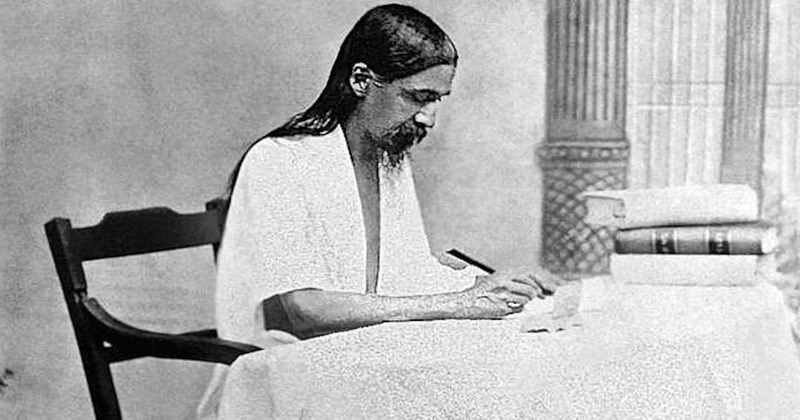
As we celebrate the 150th centenary of Sri Aurobindo, we’re also, in a beautiful coincidence, commemorating the 75 years of India’s independence in the form of Azadi Ka Amrit Mahotsav. Interestingly Sri Aurobindo didn’t think it was a coincidence. In a declaration he made on the significance of the Indian independence day he wrote “As a mystic, I take this identification, not as a coincidence or fortuitous accident but as a sanction and seal of the Divine Power which guides my steps on the work with which I began life.” Those who are unfamiliar with his works may find this statement rather arrogant and egoistic but those who’ve understood his genius and his contribution in the freedom movement will consider this bold proclamation as apt and befitting.
A decade before Mahatma Gandhi began the major non-violent movements in India, a radical or as the British would like to put it, “extremist” group was forming in the Congress. The mastermind behind this uprising was the young, firebrand Congress leader called Aurobindo Gosh. While one faction of Congress wanted to continue dilly dallying with the British, the other side consisting Aurobindo Gosh and Bal Gangadhar Tilak began spreading the idea of Purna Swaraj or complete independence across the breadth and length of India. While Tilak looked after the political proceedings, Sri Aurobindo was seen as the priest of nationalism. Sri Aurobindo in his calm demeanour and fire-breathing words gathered large anticipating crowds, his extensive writings which were written in the language that the British best understood, sent a chill down their spine, so much so that he soon earned the tag as “the most dangerous man” in India. In one of his many speeches he defined Purna Swaraj in these words: “We of the new school would not pitch our ideal one inch lower than absolute Swaraj, self-government as it exists in the United Kingdom.” To strive for anything less than Swaraj, he said, “would be to insult the greatness of our past and the magnificent possibilities of our future.” In his brief political life, 1906 to 1910, he shattered the status quo, woke a slumbering nation with the cries of Purna Swaraj. He convinced his countrymen that this country was not a mere piece of inert land, but a living entity, a mother in deep anguish. He instilled a sense of pride in Bharat’s history, its culture, its Hindu religion and its sanatana dharma. His insatiable love for his Motherland and his ability to spiritualize a movement have left an indelible mark in India’s freedom struggle and inspired thereafter a generation of freedom fighters to embrace martyrdom with a smile on their face.
But like a meteor that flashes and perishes in the night sky, Sri Aurobindo’s active political life came to an abrupt end in 1908 with his arrest in the Alipore Bomb Case. This imprisonment, orchestrated by the British with a sinister plan to get rid of this Aurobindo Ghose once and for all, turned out to be a blessing in disguise for the fire-brand freedom fighter. He used his time to dig deeper into his raison d’etre, he implored God to give him an answer and a purpose to his life. After days of penance and meditation, God finally spoke to him “The bonds you had not the strength to break, I have broken for you, because it is not my will nor was it ever my intention that that should continue. I have had another thing for you to do and it is for that I have brought you here, to teach you what you could not learn for yourself and to train you for my work.” In the that followed he let go of all doubts and apprehensions and rivelled in the loving embrace of Sri Krishna around him and saw Vasudeva in the walls of the prison, in the worst of men living around him, in the jailor who stood outside his gate and even in the magistrate and the Prosecuting Counsel who would later pronounce the verdict. Day after day, Sri Krishna displayed to him His wonders and made him realise “the utter truth of the Hindu religion”. When he was finally out of prison he was a changed man with a different mission for India and the world. He was assured by none other than God Himself that the freedom of India is a certainty but what India does with its freedom is more important. In the Uttarpara speech he gave right after his release where he spoke about the message or the Adesh that he received from God in what his work would be hereafter “I have given you a work and it is to help to uplift this nation…” It was this same guidance that brought Sri Aurobindo away from the tumult of the political British India to the shores of French ruled, little town called Pondicherry.
Although Sri Aurobindo moved away from politics, politics never left him. He closely followed the freedom movement and the two World Wars and even attempted to influence political decisions through letters appealing to the top leadership at the time. But in essence, the last forty years of his life he spent in his spiritual journey while also paving a new spiritual path that would steer India and the whole of humanity in times to come.
Sri Aurobindo’s spiritual thoughts are hard to summarise in a few words purely because of the fact that his gospel is vast, complex and ingenious. His yoga is also known as integral yoga, can be seen as a break away from the traditional yogic practices and also as a continuation of the great spiritual works of the past. The title itself betrays the very essence of this path – integral. The integral yoga is a synthesis of the gyana yoga, bhakti yoga and karma yoga. In Sri Aurobindo’s experience, an exclusive path that takes up only one of these paths is bound to have an imperfect or limited experience of the Divine. The essence of Integral Yoga is the transformation of the entire being, one’s entire human nature. This entails the various elements of one’s make-up: the physical, the vital/emotional, the mental and the psychic/spiritual moving together towards a harmonious perfection, a vaster truth, freedom and light. It means becoming aware of every nook and cranny of our being, finding the minutest imperfections and working on oneself constantly towards self-perfection and a complete offering at the altar of the Divine.
The integral yoga also breaks away from the ideas such as moksha and mukti, as the ultimate aim of spiritual life. The thrust in this yoga is not merely a liberation but a transformation of one’s consciousness. An escape into the isolation of the Himalayas can temporarily help in gaining spiritual realisations but it’s by being in this world and fighting its battles that one can bring about meaningful changes and truer solutions to problems of life. In his magnum opus “The Life Divine” he describes in great detail how this very life, subject to innumerable miseries, can be one day transformed into a Divine life.
The Life Divine culminates with the radical idea of the superman and the supramental world. While this has brought him the tag of a foolish dreamer by some spiritual stalwarts of our country, Sri Aurobindo sees it only as a logical end to the evolutionary process of nature. Just as nature has taken great pains and billions of years to bring about the mental man, similarly there will come a day a new species will be created who will embody the supermind. Man, according to Sri Aurobindo is not the ultimate and end creation of nature but only a transitional being. Just as the monkey could not conceive the idea of man, man in his present state cannot conceive the advent of the superman. The superman of Sri Aurobindo is not the superman of Neitzchse, where he is still a man with superhuman abilities, but a different being altogether with a different physical form, abilities, consciousness and way of life.
Sri Aurobindo and the Mother, his spiritual collaborator, have not conceived the idea of the supramental world with fancy whimsies of the mind but have perceived this world in their spiritual visions and have taken great pains to live a life Divine. In their last days they’ve even assured us that the force of the supramental is already at work in the world and those with a deeper vision can perceive the churning and changes that it is bringing forth.
The works and words of Sri Aurobindo may have escaped the ears of generations that have gone by but as the mind and consciousness of man rises, as nations and their leaders seek for a different world order, the wisdom of Sri Aurobindo is bound to act as guiding light for centuries to come.
Sri Aurobindo in his endeavour to bring about something new, had his foundations strongly rooted in our culture and our spiritual past. His writings are strewn with references to the Vedas, Upanishads, Puranas, Bhagavad Gita and several other great scriptures of our civilization. As a young man he ignited a generation with the radical ideas of Purna Swaraj, as a yogi he has lit a new lamp in the ever expanding, ever adapting paradigm of Sanatana Dharma.