
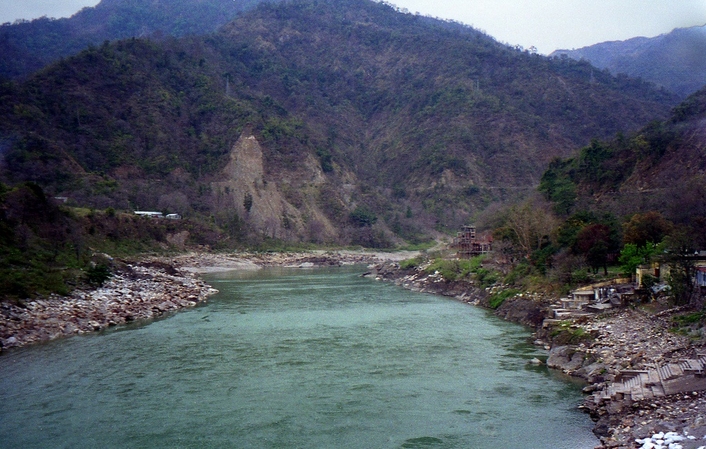
Over centuries, India’s unique river network has sustained the life and livelihood of millions of people across the country. The magnificent river system has provided people with a cool climate, food, mineral-rich water, fish, forest and the much-needed moisture to keep the soil healthy, and it lets the tourism and pilgrim sectors flourish. The rivers had once stimulated the imagination of lakhs of artisans and weavers across the country who created many world-famous handicrafts and the finest quality handmade fabrics. Those products were once the most sought-after objects in the foreign countries. India continues to export handicraft and handloom products. Until 1700 AD, India was the world’s largest economy with 24.4% of the global share because it had combined agriculture, trade, industries, weaving and handicraft sectors in the right proportion to build a miracle economy. The river network provided India with the much-needed resilience for growth and prosperity.
In fact, rivers are like living beings, each having a distinct spiritual aura, personality, character and nutrient carrying capacity. They are the natural infrastructures which were built and perfected by nature. They are like mothers who provide food and nutrition and support a wide range of economic activities. They create the perfect backdrop for the spiritual growth of people. India’s 13 major rivers have given India a fertile basin area of over 18.90 lakh sq km, which constitutes 57.45% of the geographical area of the country, the major rivers, including 202 tributaries, spread over 42,830 km. The Union Government plans to develop a forest in 7400 sq kilometres on the river banks, rejuvenating 13 major rivers crisscrossing over 24 states. An estimated Rs 19000 crore will be spent in the next five years for rejuvenating the rivers. “The projects will alleviate growing water stress and help achieve national goals related to sustainable development,” said Gajendra Singh Shekhawat, Environment Minister.
In the past few years, the developed countries have woken up to revive the rivers for their immense economic benefits. According to research by Frontier Economics, the world’s ten most populous river basins will account for almost a quarter of global GDP by 2050. The report says almost 8% of global GDP will be generated along China’s Yangtze River by mid-century. India has the added advantage of having a wide and vibrant river network. Managing this river network will give an inclusive economic growth revolution in India.
Europe’s largest river, the Rhine, linked Germany, Switzerland, France, the Netherlands, Austria and Liechtenstein. The Rhine is associated with Europe’s history, culture and traditions. The environmental degradation of the Rhine had threatened the agriculture, economy, culture and social life of Europe. A part of the river burning due to hazardous chemicals from the industries has been revived after a decade-long effort and dedicated joint monitoring by International committees. Today, the famous salmon fish have returned to its stream, and the river is now suitable for swimming. It has happened because the leaders in those countries have understood the economic, social and cultural value of a river. Bringing back a river to life takes a long time and a huge expenditure. The question arises when the cost of repair of a river is so huge, why damage it?
The revival of the Rhine is an eye-opener, and it has inspired river revival in many countries. The river experts said it is impossible to avoid flooding resulting from natural causes, and the dikes can never be absolutely foolproof. The only solution is to make it possible for floodwater to spread out. To achieve this aim, the remaining flood plains must be maintained and improved to retain as much water as possible upstream.
The river development vision document of the Union Government has put together what our saints and seers have told people in layman’s language, “worship river like your mother, it will take care of you.” Though the common man does not understand the hidden economic benefits of a healthy river, he worships rivers as goddesses, and in the process, he takes care of the rivers. Indian saints and seers, with their immense yogic power, visualized the economic, social and spiritual benefits of rivers. Environmental scientists now understand the positive impacts of rivers on human beings.
The river rejuvenation program should become a mass movement, the awareness about the multiple benefits of rivers should be created among people. When people get themselves involved in river revival, it will save huge government expenditure. People will volunteer to give regular “Sramdan” to revive the rivers flowing through their own state. The elected representatives cutting across the party line should go on a padayatra to create awareness among people.
In 2014, the Union Government launched the Namami Gange program to save the sacred river Ganga from pollution. The program aimed to revive bio-diversity, create environmental awareness among people and develop Ganga Grams for the economic and spiritual development of villagers, etc. The Prime Minister, Narendra Modi, said that it was his “destiny to serve Maa Ganga”. The effort to save Ganga has become intense in the last five years as more and more volunteers, philanthropists, politicians, youth, saints and seers are interested in saving the mother, Ganga. The Allahabad High Court said the Namami Gange Programme “has revitalized India’s efforts in rejuvenating the river Ganga”. The river Ganga in her 2,500-kilometer journey from the Himalayas to the Bay of Bengal provides livelihood to millions of people. It lets the world’s richest biodiversity survive and inspires artists, poets, philosophers and painters to create their pieces of art.
The good news is that the river Ganga has become healthy again in many places. The vibrant aquatic life in the river is an indicator of its way to revival. The playful Gangetic dolphins have returned to their stream. As per a survey by the Wildlife Institute of India (WII), there were 21 dolphins in the Ganga stretch of Varanasi. Now, as per an assessment, dolphins have increased at the Ganga-Gomti confluence point, and there should be 35 to 39 dolphins here at present. The world’s most spectacular cultural event, the Kumbh Mela, is celebrated on its banks. The river Ganga is the heart and soul of Hinduism, as it creates a spiritual kingdom for those who pursue God. The Allahabad High Court has said that the future of India to a “large extent” will depend on the well-being of the river Ganga and that it is “imperative that every effort should be made to revive the river and make it pollution-free”. The revival of the river Ganga has also triggered the save river movement across the country.
Under the guidance and supervision of the internationally famous Yoga Guru, Sri Sri Ravi Shankar, the Art of Living community has reportedly revived 43 rivers in Maharashtra, Karnataka, Tamil Nadu and Kerala, benefitting 5,084 villages. The world’s largest number of volunteers, social workers, saints and seers live in India and they can turn the river rejuvenation project into a mass movement for India’s growth and prosperity.