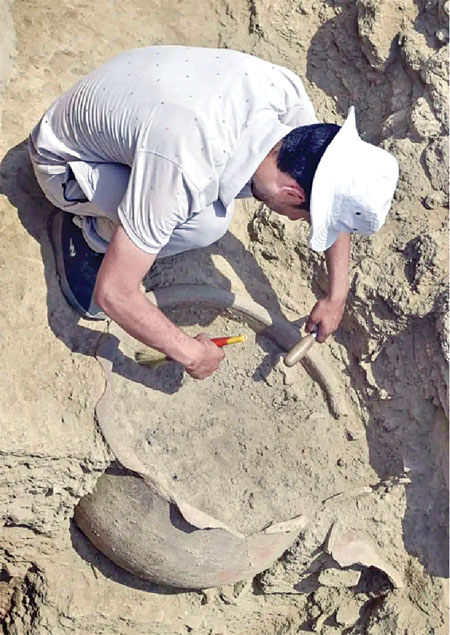
A slew of recent discoveries, including the discovery of a jewellery making unit, have revealed the existence of a Bronze Age Metropolis in Rakhigarhi. Copper and gold jewellery were also manufactured. The site revealed remnants of a planned township with mud-brick houses, streets, a cemetery, and a proper drainage system
Rakhigarhi site spanning eleven mounds is spread across nearly 350 hectares, covering the present villages of Rakhi Khas and Rakhi Shahpur in Hisar in Haryana. In 2021, archaeologists discovered eleven mounds in total at Rakhigarhi, which have been named RGR-1 to RGR-11. Until then, Mohenjo Daro, which covers 300 hectares, was considered the largest Harappan metropolis in south Asia. The Rakhigarhi site ranks among one of the “five iconic sites” declared by Union Finance Minister Nirmala Sitharaman during her budget speech in February 2020. The other sites are Hastinapur in Uttar Pradesh, Sivasagar in Assam, Dholavira in Gujarat and Adichanallur in Tamil Nadu. Nirmala Sitharaman also announced the government’s decision to fund five on-site museums, including the under-construction museum launched by the Haryana government at Rakhigarhi.
Five major metropolitan sites—Mohenjo-Daro, Harappa and Ganweriwala, all in Pakistan, and Rakhigarhi and Dholavira in India—have been identified as regional centres of the Indus Sarasvati Civilisation. Rakhigarhi surpassing other sites, has emerged as the most significant Bronze Age metropolis in South Asia. At Rakhigarhi, the current excavation team consists of researchers from Pt. Deen Dayal Upadhyaya Institute of Archaeology, Greater Noida and the ASI’s Excavation Branch-II.
Excavation work has been going ahead at Rakhigarhi since the last three decades. Currently, it made one of its biggest discoveries at Rakhigarhi with the excavation of a 5000-year-old jewellery factory. Copper and gold jewellery were also manufactured at the site. The site revealed remnants of a planned township with mud-brick houses, streets, a cemetery, and a proper drainage system. Currently, remains of houses and a kitchen complex have also been discovered, which shows that the site must have been a prestigious metropolitan trade centre.
Hearths, kilns, steatite seals, unbaked terracotta sealing with relief of elephants and Harappan script, animal figurines such as dog and bull made of terracotta and steatite, a large number of jasper, agate and steatite beads, beads of other semi-precious stones and shell bangles, include some of the extensive antiquities recovered from Rakhigarhi.
Dr Sanjay Manjul, Additional Director General (ADG), ASI, said they had done a lot of work on Sinauli, Hastinapur and Rakhigarhi in the last 20 years. Manjul said the people of Rakhigarhi were the ancestors of the people of Hastinapur, and from this, the culture got development and momentum.
The link shows the connectivity between Bronze Age Rakhigarhi in the Sarasvati basin and the Age Hastinapur on the Ganga Yamuna doab. In April 2022, in his written reply to a question in the Rajya Sabha, Minister of Culture G Kishan Reddy said archaeological sites and remains at Masol in Mohali, Punjab; ancient mounds 6 and 7 at Rakhigarhi in Hisar, Haryana; and Kaleshwar Mahadev Temple at Kalesar in Kangra district, Himachal Pradesh, are among the 19 sites identified by the ASI that is going to be notified as “Sites of national importance”.
Copper and gold jewellery were also manufactured at the site. The site revealed remnants of a planned township with mud-brick houses, streets, a cemetery, and a proper drainage system
The ASI and the Haryana Government have undertaken this prestigious project. An agreement is in process between the two, under which antiquities from Rakhigarhi will be displayed at a large museum under construction by the Haryana state for Rs 23 crore.
After RS Bisht and Amarendra Nath of ASI, Professor Vasant Shinde of Deccan College marshalled the excavations at Rakhigarhi. Professor Shinde observed that Rakhigarhi is an ideal site to believe that the diffusion of the Harappan civilisation took place in the Sarasvati—Drishadvati basin and gradually proliferated from here. It will be interesting if we get the confirmation because the origin would have taken place in the Sarasvati basin in India and spread to the Indus valley, as observed by Professor Shinde.
Excavations at Rakhigarhi revealed various occupational phases beginning from the Early to mature Harrapan period, covering the time from 5th millennia BCE to 3rd millennia BCE based on the radiocarbon dates obtained from various layers. Professor Shinde said the excavations prove that Rakhigarhi doesn’t have the Late Harappan phase. It collapsed around 2000 BC. This sudden demise can be explained by the drying up of the Saraswati in 2000 BC (India Today, May 22, 2015).
After reports suggested that a study on skeletal remains of Harappan-era inhabitants at Rakhigarhi has revealed that there is no evidence about migrations to corroborate the Aryan invasion theory, media man Tony Joseph dismissed it as misreporting.
International lobbies and their satellites in India planned to hijack Rakhigarhi to fix it within their political framework. With the progress in excavations at Rakhigarhi, the Aryan controversy was launched in 2017. In an article, ‘How genetics is settling the Aryan migration debate’, Tony Joseph, the former editor of Business World, argued that the population of the Caspian, Central Asian and Indian regions share a common DNA (The Hindu, June 16, 2017). Endorsing the Aryan Migration Theory, Joseph contended that Indo-European language speakers, who called themselves Aryans, streamed into India sometime around 2,000-1,500 BC when the Indus Valley Civilisation ended. They brought the Sanskrit language and a distinctive set of cultural practices.
Joseph insisted that India is a multi-source civilisation, not a single-source one, and draws its cultural impulses, tradition and practices from various lineages and migration histories. While the left historians remained silent, the left parties were exuberant. CPI(M) general secretary Sitaram Yechury gleefully Tweeted: “The historical evidence of Aryan migration and India’s confluence. Brilliant piece by @tjoseph0010”.
Appreciating Tony Joseph’s article, Yechury observed: “Akin to the proverbial last straw that broke the camel’s back, some recent findings based on scientific investigations on the genetic data suggest that there was, indeed, an Aryan migration into India around 3,500 to 4,000 years ago” (‘Battle Against Post-truth’, Frontline, June 21, 2017). Yechury argued that the latest scientific study suggests that Aryans came to India from somewhere near the Caspian Sea in Central Asia/Europe, which has shattered the fascist agenda in India.
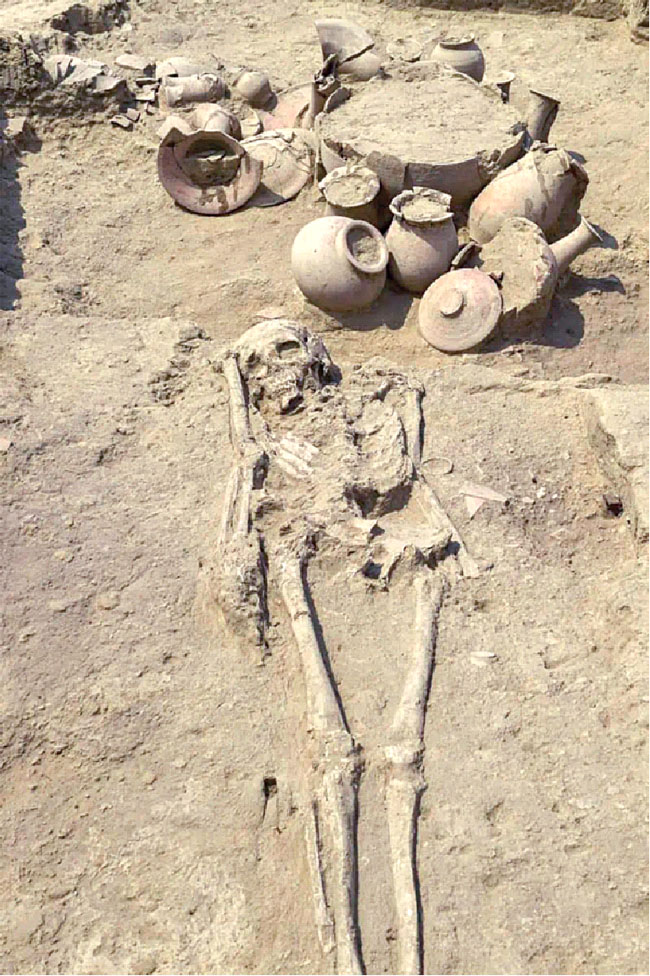
The findings by Vasant Shinde, Vagheesh M Narasimhan, Nadin Rohland, Nick Patterson, Niraj Rai, David Reich and the team was published in Cell on October 17, 2019, titled An Ancient Harappan Genome Lacks Ancestry from Steppe Pastoralists or Iranian Farmers. The study suggests that in South Asia and Europe, the advent of farming was not mediated directly by descendants of the world’s first farmers who lived in the fertile crescent. The first study of DNA samples of the skeletal remains excavated from the Rakhigarhi site finds no traces of Iranian farmer or Steppe pastoralist ancestry and questions the Aryan invasion and migration theories, according to Prof Vasant Shinde. Instead, South Asia began farming without the large-scale movement of people into these regions. First, farmers of the Fertile Crescent contributed little to no ancestry to later South Asians. The population has no detectable origin from Steppe pastoralists or Anatolian and Iranian farmers, suggesting farming in South Asia arose from local foragers rather than large-scale migration from the West.
According to Professor Shinde, for the first time, this research has established that the people of the Harappan civilisation are the ancestors of the population of South Asia. For the first time, the study indicates the movement of people from east to west. The Harappan people’s presence is evident at sites like Gonur in Turkmenistan and Shahr-i-Sokhta in Iran. As the Harappans traded with Mesopotamia, Egypt, Persian Gulf and all over South Asia, people’s movements are bound to be mixed genetic history” (The Week, September 6, 2019). These revelations assume political significance as there have been demands to rewrite the history books to say that Vedic people were the country’s original inhabitants and did not come from Central Asia. “Our premise that the Harappans were Vedic people thus received strong corroborative scientific evidence based on ancient DNA studies,” according to Shinde.
In 2018, Vindicating the Outlook cover story, ‘We are all Harappans’, Harvard philologist Michael Witzel observed that India had seen several migrations, including the Aryans and the Veda was no continuation of the Harappan religion (After Meluhha, The Melange, Outlook, August 2, 2018). The Outlook story claimed that the Harappan site of Rakhigarhi in Haryana has roots in the Fertile Crescent of West Asia and exhibits more affinity with Ancestral South Indian Tribal Population.
Excavations at Rakhigarhi revealed various occupational phases beginning from the Early to mature Harrapan period, covering the time from 5th millennia BCE to 3rd millennia BCE based on the radiocarbon dates obtained from various layers
Witzel’s lack of understanding of Vedic literature and his attempts to align it with Abrahamic texts to trace the routes of Aryan migrations into India stands questioned. Prof. Stefan Arvidsson has recently discussed various ideological interests that shaped ‘Aryan’, such as the Indo European perceived “creative centre” of the Judaeo-Christian dominant strain of Western culture and the Hebrew claim to stand at the “origins of history,” as described in the Bible.
Besides the studies by Professor Vasant Shinde and team in 2019, earlier biologists such as V Tripathy, A Nirmala, and BM Reddy pointed out in 2008 that many genetic studies betray “a lack of anthropological insights into Indian population structure as many of the papers have been written by people of non-Anthropology (especially Indian Anthropology) background.”
Eminent physical anthropologists Kenneth AR Kennedy, John Lukacs and Brian Hemphill have observed no evidence of “demographic disruption” in North-West India between 4500 and 800 BCE. American biological anthropologist Todd R Disotell found that migrations into India “did occur, but rarely from western Eurasian populations”. Estonian biologist Toomas Kivisild, with fourteen co-authors from various nationalities, opted for a very slight separation of the two branches rather than a population movement towards India.
Indian scientists led by Susanta Roychoudhury studied 644 samples and identified a fundamental unity of mtDNA lineages in India, despite the extensive cultural and linguistic diversity. Studies by Indian biologist Sanghamitra Sengupta revealed a minor genetic influence of Central Asian pastoralists in India. This study also indirectly rejected the Dravidian authorship of the Indus-Sarasvati civilisation. The data are more consistent with a peninsular origin of Dravidian speakers than a source with proximity to the Indus-Sarasvati Valleys. Prof. Lalji Singh, molecular biologist and former chief of the Centre for Cellular and Molecular Biology, Hyderabad, said studies effectively denounce the argument that Dravidians were driven to the peninsula by Aryans who invaded North India.
The Indian Institute of Technology-Kharagpur’s 2022 calendar is based on the theme of “evidence” for “rebutting the Aryan invasion myth”. Published by the IIT’s Centre of Excellence for Indian Knowledge Systems, which Education Minister Dharmendra Pradhan inaugurated on December 18, the calendar aimed to “ bring out the truth”, according to Professor Joy Sen, chairperson of the Centre. The latter is the brain behind the “concept and research” of the calendar.
Rakhigarhi sparked global controversy in early 2014 when eminent South Asian archaeologists criticised the intervention of foreign lobbies on this important archaeological site and funding by an opulent NGO, Global Heritage Fund. Its founder, Jeff Morgan, is a former Silicon Valley entrepreneur. Many eminent Indian archaeologists were taken aback by the NGO intervention and funding at Rakhigarhi.
Veteran archaeologist Prof. Dilip Chakrabarti, in his work Nation First: Essays in the Politics of Ancient Indian Studies (2014), cautioned that “from now on, there will be increasingly successful attempts to take over Indian archaeology from the Indians, by miscellaneous groups of racially arrogant people masquerading as archaeologists under the umbrella of various foreign NGOs.” Chakrabarti’s comments have much significance in the Rakhigarhi context.