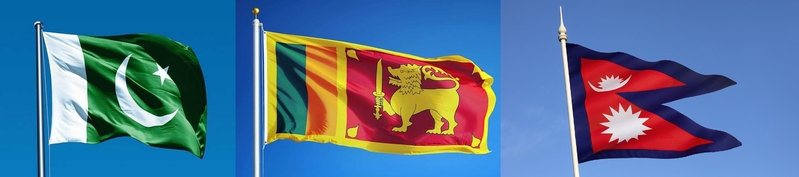
Apart from the war in Ukraine, the past few days have seen a flurry of activities in South Asian politics, which are being characterized by diplomatic visits and financial assistance. Pakistan is facing a fresh political crisis, Sri Lanka is seeing its economy tanking down to the worst, and Nepal is attempting to adhere to a policy of neutrality and is striving to maintain relations with both China and India, the two key powers of the region who are locked in a competition for maintaining their influence over the entire region.
It is undoubtedly clear that China is trying hard to maintain its clout in the three countries. The recent development in Pakistani politics and the dissolving of the Pakistan Assembly by PM Imran Khan has again led the country into factional strife, which has tensed Beijing’s nerves. The Chinese have urged restraint and have said that Pakistan’s development and stability should not be hampered. It is unlikely that Pakistan, irrespective of the change in government, would abandon Beijing since, firstly, China enjoys the support of the Pakistani military, and second, Pakistan’s overall foreign policy, even if guided by a civilian leader, isn’t likely to be anti-Beijing, considering the overall scenario regarding the entire region.
No signs are emerging that Islamabad is attempting to pursue an independent foreign policy, trying to balance the West and China. Taking a cue from New Delhi’s hostility with Beijing and its reinvigorated relations with the West, Pakistan has chosen to counter its adversary by going southwards. It is even attempting to cultivate a partnership with Russia, and one look at Moscow’s future after its decision to invade Ukraine is enough to consider that it would have to depend more on Asian countries for support. Russia would surely have a hard time balancing the concerns of India and China, with the latter using Pakistan to make the situation even harder.
The anti-American rhetoric of Imran Khan and his accusation of the United States of masterminding a plot to oust him is only to grow further since the recurrent elections are going to see this point raised
frequently by him, and the growth in anti-Western sentiments isn’t an anathema for Beijing, which is bent on making Pakistan a source of valuable raw materials for its own industry and an integral part of Xi
Jinping’s prized Belt and Road Initiative (BRI).
The BRI’s effects are being felt in some doses in Sri Lanka, where the government is on the verge of bankruptcy. The island nation, which had sought to make Chinese backed infrastructural development the foundations of its own growth, is now being touted as an example of the BRI, which China doesn’t want the world to see. Though internal issues in the form of corruption and mismanagement are credible factors, it cannot be denied that ready money from China has become a trap for Colombo since all that came in loans, and is now struggling to pay back. Its recent request that China restructure its debt hasn’t been heeded till now.
All these points that Sri Lanka shall look towards India for assistance, which New Delhi has provided but is still reluctant to involve itself heavily since not only does it varies in supporting the Rajapaksas, who are facing the ire of a large section of the population, but it also isn’t considering to invest heavily in the island as this indirectly shall benefit Beijing, which has its feet perched securely. And it might not be necessary because India already has Andaman and Nicobar Islands as well as a reliable partner in the Maldives, and these two considerations are enough to prevent any adverse circumstances. But the refugee problem cannot be sidelined, and that lays a disadvantage, not to mention that further instability could bring back the LTTE to life, and this India shall not be wanting. Therefore, India’s response in its entirety to the crisis in Sri Lanka is likely to be measured and would be partly based on future developments in Sri Lankan politics. If all bodes well, Sri Lankan leaders might attempt to improve the balance between India and China.
The word ‘balanced policy’ makes it imperative to mention Nepal, which is attempting to do just the same. It might not be wrong to say that Kathmandu has shown some prudence in its policy towards China and has sought to offset it by healing, to some extent, the partially fractured ties with New Delhi. The BRI projects in Nepal are still to be brought to life since Kathmandu is insisting that the projects should be backed by grants and not loans. The recent visit by Chinese Foreign Minister Wang Yi to Nepal was more to ensure that the small Himalayan country remained committed to its word. Though nine projects and agreements were signed during his visit, those were equalized by those made by the Nepalese Prime Minister Sher Bahadur Deuba during his recent India visit, which included the inauguration of Nepal’s only railway link with India and increased cooperation in the energy sector, in which New Delhi has agreed to purchase electricity from Nepal.
China, however, has succeeded to some extent in fermenting anti-American feelings in Nepal. The recent decision to approve a $500 million grant by Washington D. C. received criticism from Beijing. But it was also opposed domestically on the grounds that engagement with the USA would entangle Kathmandu in the rivalry between China and the USA. This, to state in clear terms, doesn’t signify that Beijing is viewed favourably either. The heavy trade deficit between Nepal with China and Beijing’s actions to prevent the importation of Nepalese goods has given rise to protests by traders against China, and the Nepalese government is finding it hard to tackle this imbalance. Moreover, the ‘leak’ and not the release of a government report holding into account China for the encroachment of Nepalese territory shows the pressure which Nepal is increasingly facing, where it wants to keep China at a respectable distance but sees it crossing the line.
It would not be a mistake to say that South Asia is now facing the heat of global politics. Any new event in the South Asian countries is bound to involve foreign powers. The worrisome point is the choices that these countries have to make for their development. An independent foreign policy is needed, but the question is: will it be easy to achieve or maintain?
(The writer is a student & blogger)