In the early 1970s, Jayaprakash Narayan wrote, "Since Independence, a period of self-denigration set in during which educated Indians, particularly those educated in the West took the lead weather in the name of modernisation, science or ideology, they ran down most, if not all, things Indian. We are not yet out of this period." Had he been alive today, he would have been pained to see that even after 50 years of his aforementioned observation, we are still going down deep into the marshy self-denigration.
Last week, we witnessed an incident that showcased the self-denigrating spirit of a section of Indians in a very awfully shrilling fashion.
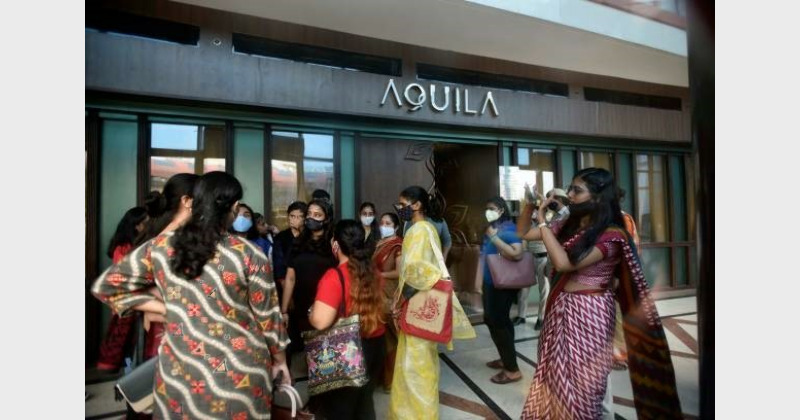
An elitist restaurant in South Delhi denied entry to a woman customer because she was wearing a saree. The women shot a video of the incident, in which the employees of the restaurant were seen telling the woman that a saree does not count as a smart dress. The video became viral on social media. It generated many reactions from many people who were feeling hurt and insulted by such snobbish behaviour in the restaurant.
Saree, as a dress, has a deep cultural and emotional connection with Indian women. In nearly all the parts of India, Saree is the most usually worn dress for women. Especially on life events like marriage, Indian girls always choose saree over other kinds of dresses. The very imagery of mother for most Indians like us is integrally associated with a divine source of unceasing affection clad in some or the other form of saree.
For us, our Bharat Mata is also a saree-clad divine mother. Lakshmi, who is worshipped by all the households and businesses on Diwali, wears a saree. Maa Durga, for whom we will be celebrating Navratri next month, is also a saree wearing warrior-mother. For 'people of letters' and students, nobody is more sacred than Maa Saraswati, who too wears a saree.
Saree is not only the most popular, but it is also the most culturally rooted fabric in the Indian subcontinent. And when saree is seen down as unsmart and hence unacceptable in India, we already know that we are dealing with a section of Indians who are ideologically and educationally brought up in an environment of self-hate and self-denigration.
This small incident represents a very big cultural prejudice against the symbols and practices that are seen as identifiers of Bhartiya. This prejudice has neither sprung all of a sudden and nor it has sprung out spontaneously. It is the result of a long perpetuated mental conditioning which was originally undertaken as a colonial project starting in the 19th century, but tragically, it kept continuing even after the Whites departed in 1947.
Understandably, the British government of colonial India would want Indians to feel bad about themselves and their history. For this reason, they presented India as a deeply divided mediaeval society that needed to be civilised by exposure to the social and scientific values invented by modern Europe. The feeling of demoralisation and embarrassment among the Indians helped the British in India by rendering them the much needed moral legitimacy to rule India on the grounds of being a superior culture.
What is not understandable is the scenario that emerged Post-Independence, when Indians were ruling Bharat. The political arm of the Indian State always fostered a hegemonic elitist section that used to look down on the fellow citizens as culturally lesser-beings. Unfortunately, this small elitist stratum was, by and large, unconnected from the cultural and social life of the commoners. But they went to occupy the most key decision-making positions as a direct function of their political and social privilege. This hegemonic stratum formed the core centre of power in the country, the establishment.
The establishment in our country practised the politics of agenda-setting as well as the politics of thought-control. Policy-making institutions designed the linguistic and educational policy, which ensured the preservation of elitist taste of the lifestyle, exactly on the lines of the imagination of Thomas Babington Macaulay. In the view of the new power elites of Independent India, our society was pitiable for its backwardness. These elites saw themselves as the benevolent saviours of the ignorant, diseased, superstitious and ever-needy population.
More or less, the same mindset percolated to our youth, batches after batches coming out of educational institutions. The literary community and the films also carried the same narrative of a backward society living in antiquity that needed to be shown the light of progressive thoughts, which requires showered with imported modernity. Operational over so many decades of Independence, the educational curricula, literature, movies, and other such sources maybe not so consciously created a condition where it was perfectly normal to attack the Bhartiya symbols.
This started showing too soon after the Independence when Vande Mataram was attacked. The Sanskrit language was attacked. Hindi was stigmatised as a weak and unaesthetic language. Our history became a story of invaders' benevolence and our defects. Our cuisines, architecture and art became a magnificent gift of Mughals to India! Cultural traditions were mocked. All the Dharmic practices were declared superstitions. It became a normalised practice to express unabetted contempt towards everything, which is identified as Bhartiya. The special disdain is reserved for those symbols, conventions and ideas whose origin and nature is attributed directly to Hindu thoughts. The resultant ideology emanating from such a mindset would be accustomed to self-denigrating.
The incident at the south Delhi restaurant must be seen in the light of the self-denigrating mindset that Jayaprakash Narayan had hinted about. The people of this mindset are being called wokes these days. They are known for being rebellious without an informed cause and being unnecessarily loud and vocal on every issue with no substantial preparedness for any subjects. Among the wokes, the influence of Frankfurt school-sponsored neo-Marxist vocabulary is perceptible. Only that it has been coupled with endless escapism provided by a convenient interpretation of Post-Modernism.
However, a pleasant turn of events occurred in this particular incident when hundreds of female students from JNU and the University of Delhi gathered unapologetically wearing saree outside the restaurant. They staged a protest demonstration on the spot, giving speeches about the faults in the restaurant policy book. Eventually, the restaurant had to apologise for its cultural crime of being disrespectful towards the saree.
Let this incident be a template for the much-needed change of perspective. The self-denigrating mindset has to go away for the spirit of qualified self-respect to set in.
(The writer teaches political science at the University of Delhi)