Vibhawari Bidve
Democracy and the resulting values like personal liberty and freedom of speech are considered as the achievement of the freedom struggle we fought and the constitution we framed. But later, there were many occasions when we again saved the democratic values from arbitrary and dictatorial actions. Declaration of Emergency during 1975-77 was such a dark period that the Nation cannot forget. The Indira Gandhi Government set it in motion on 25th June 1975 and was in place until 21st March 1977 i.e. for 21 months. 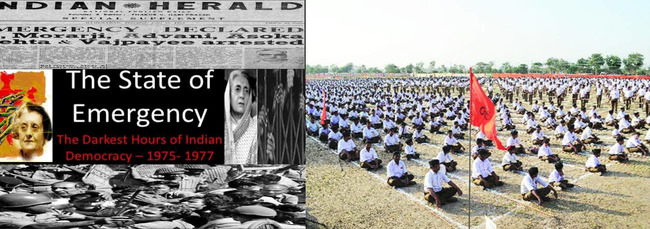
Officially, ‘internal disturbance’ was the reason which was put forth. However, it allowed for the suspension of elections and the restriction of civil liberties. Fundamental rights were suppressed, political arrests took place under the Maintenance of Internal Security Act, and an atmosphere of fear prevailed. The Press Advisor told all newspapers in the country to get permission before publishing anything. All the opponents of Smt. Gandhi, like the then Janata Party leader LK Advani, Bhagat Singh Koshyari, Madhukar Dattatraya Deoras, Arun Jetly, student leaders, social activists, journalists, were arrested.
Rashtriya Swayamsevak Sangh, organizing the protests against the Government, was also banned. Thousands of its workers were imprisoned. The RSS defied the ban, and thousands participated in Satyagraha i.e. peaceful protests against the ban and the curtailment of fundamental rights. Later, when there was no letup, the volunteers of the RSS formed underground movements for the restoration of democracy. Literature was censored in the media. But it was published and distributed on a large scale, and funds were collected for the movement. Networks were established between leaders of different political parties in the jail and outside for the coordination of the movement. ‘The Economist’ described the movement as “the only non-left revolutionary force in the world”. It said that the movement was “dominated by tens of thousands of RSS cadres, though more and more young recruits are coming”. Talking about its objectives, it said, “its platform at the moment has only one plank: to bring democracy back to India”.
Total 23,015 people were arrested under MISA and D.I.R. out of which 16,383 people were the Swayamsevaks and Karyakartas of RSS, Janasangh, Rashtriya Sevika Samiti, VHP, ABVP, etc. 44965 people were arrested for fighting and agitating by Satyagraha out of which 35310 were from the above said right-wing organizations. Indeed, democracy was saved and protected by raising the voice in such a dark period by these fighters.
Finally, it ended on March, 23, 1977. The MISA Act got repealed when Smt. Indira Gandhi lost the general election. Apart from the result, it is noteworthy to see the women’s participation in the said Satyagrahas. Whenever RSS is blamed for not having women Karyakartas, one overlooks that during such an ‘emergency’ women activists were seen to be taken part along with Swayamsevaks. Many girls and women from the offshoots of RSS like ABVP, Rashtriya Sevika Samiti, VHP, etc. along with women leaders of Jansangh got arrested for Satyagraha and under MISA Act. A total number of 2424 women were arrested for holding Satyagraha, and Maharashtra was leading in the number.
I always ask about the aftermaths of protests and agitations. Yells such as “Hame Chahiye Ajadi” and “Afzal Guru” faded quickly. We neither see anything productive coming out from such screams. But how do the protestors next pursue their fight? I was doubtful till I got acquainted with Mrs. Anjali Parchure – Deshpande, one detainee of Satyagraha against emergency.