Bharat’s strategic response vis-a-vis China has to be two-fold. Our military has to be ready against any Chinese misadventure. Tibet should be trump card against our bugbear

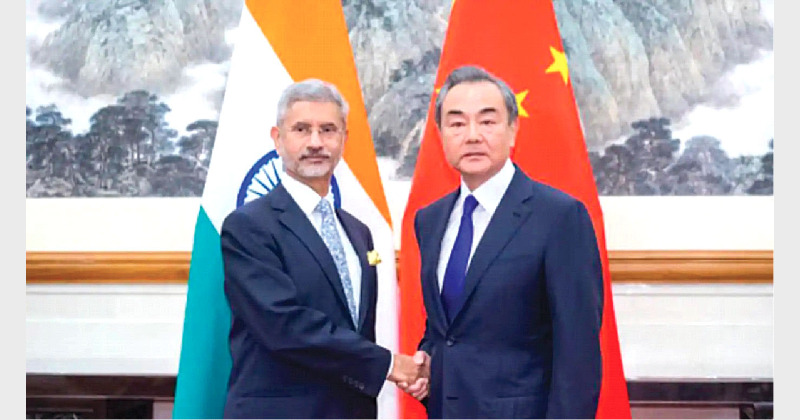
Minister of External Affairs S Jaishankar’s with Chinese counterpart Wang Yi (file photo)
Despite ongoing series of talks to resolve the contentious military stand-off in Eastern Ladakh, the Chinese incursions and aggressiveness continue on the borders. Close on the heels of the construction of a village in the disputed territory in Upper Subansiri District of Arunachal Pradesh came the news of the Chinese incursion in the area of Naku La in North Sikkim. All this at a time when there appears to be no positive development in resolving the ongoing stand-off. The relations between the two nations are deteriorating by the day with chances of a confrontation on the border appearing more likely soon after the snow melts. While the Dragon’s treachery continues unabated, India needs to prepare herself militarily, politically and diplomatically to halt the Chinese expansionism, a product of its Middle Kingdom Complex being pursued vigorously by the Chinese Communist Party (CCP) under the garb of China Dream of its overambitious leader Xi Jinping.
Ever since, the emergence of Communist China or the People’s Republic of China (PRC), the Indian leadership beginning with Pandit Nehru desired to have friendly and cordial relations with China under the hope that it would contribute towards world peace, oppose colonialism and form the pillars of a pan–Asian order. India was among the first few nations to establish diplomatic ties with the PRC on April 1, 1950. Pt Nehru had introduced China at an international stage during the first-ever multi-national Afro-Asian Conference at Bandung in 1955. India was instrumental in getting China the permanent membership of the United Nations Security Council. Unfortunately, Nehru failed to read Mao’s mind which at its back was filled with Sinocentrism (an ideology that China is the cultural, political or economic centre of the world) and Chinese Nationalism focussed on a modern, powerful Chinese nation.
Mao’s ideology manifested in China emerging on the world scene as a “Revisionist” power aiming to change the existing status quo. It resulted in the annexation of Inner Mongolia, Xinjiang and Tibet. Subsequently, India also became a victim of Chinese expansionism.
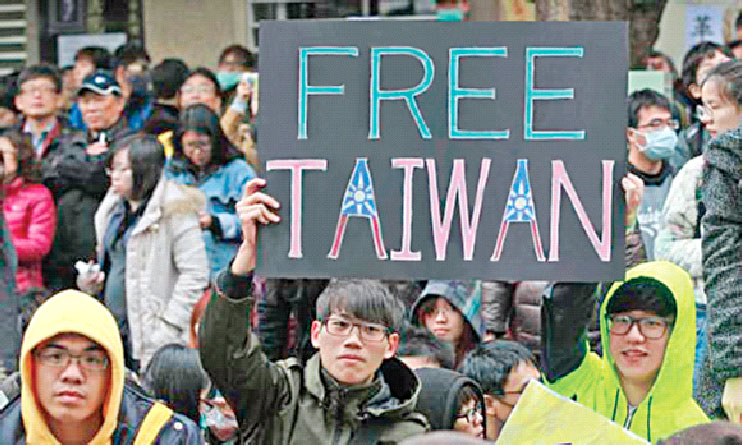
There is growing global support for Taiwan as it is viewed as a victim of growing Chinese expansionism that wants to impose the Communist ideology on a democratic nation. The Chinese sensitivity to Taiwan is growing by the day, and CCP considers cosiness to Taiwan by any other country as a direct assault on its sovereignty
Eyeing Sikkim
Chinese greed showed no signs of subsiding. Apart from its adventurism in the South and East China Seas, it has been steadily extending its claim lines across Ladakh to include more and more Indian territories, while repudiating Indian sovereignty over Arunachal Pradesh. Of late, it has included Sikkim also in its growing lists of disputes with India. China’s stubborn posture in the current stand-off has proved beyond doubt that China considers India as its rival but will not tolerate any rivalry. Therefore, it has decided to put India in its place buoyed by its mighty Comprehensive National Power (CNP).
It has established beyond doubts its greed for expansionism and hegemony over its neighbours. India has decided to contest the Chinese revisionism and expansionism. It has refused to bow down to Xi Jinping’s machinations for which it has received considerable global support. India needs to strategise to exploit the Chinese vulnerabilities which are in plenty. The CCP is, however, very sensitive to the two “Ts” namely Taiwan and Tibet.
As a consequence of the civil war in China, the nation was divided into two parts in 1949 two years after India attained Independence. Mao’s communist government retained control of mainland China forcing the Republic of China (ROC) government to relocate to Taiwan. Since then, the ROC has continued to exercise effective jurisdiction over Taiwan’s main island and a number of outlying islands while Communist China also known as PRC continues to claim it as its (23rd province). China’s official position on Taiwan is uncompromising. It claims that Taiwan is, was and always has been an inseparable part of China, and that international law supports China’s claim. CCP wants outright reunification, sooner, the better, seeing the island’s recovery as the final chapter in the civil war and end of past humiliations when China was forced to cede territory to foreigners.
On the other hand, there is growing global support for Taiwan as it is viewed as a victim of growing Chinese expansionism that wants to impose the Communist ideology on a democratic nation. China at the same time threatens that “Taiwan shall not be referred to as a ‘country’ (‘nation’) or “Republic of China” or the leader of China’s Taiwan region as “President”, so as not to send wrong signals.” The Chinese sensitivity to Taiwan is growing by the day, and CCP considers cosiness to Taiwan by any other country as a direct assault on its sovereignty.
Nehru’s Blunder
The other Achilles Heel of CCP is Tibet, the region that shares a border with India and has had historical ties with India since centuries. With the end of the Chinese Civil War, the newly-established communist regime openly stated its intention of ‘liberating’ Tibet, but the Indian establishment paid no heed.
To maintain control over Tibet, the PLA entered Tibet on October 7, 1950, and subsequently annexed it. Thus eliminating India and China’s traditional buffer. India displayed an utter lack of strategic thinking by dismissing Tibetan pleas for help instead of insisting on Tibetans to settle the issue peacefully with China. Nehru was too enamoured with his image of Shanti Doot (messiah of peace) and “Hindi Chini Bhai-Bhai” façade and committed a big folly in 1954, when, under the Panchsheel Agreement, we surrendered in Tibet all our military and other facilities, to China. Chinese responded with an attack on Assam Rifles outpost in Longju in the Central Frontier of erstwhile North-East Frontier Agency (now Arunachal Pradesh) and building a road through Indian territory of Aksai Chin in Ladakh. Nehru still did not realise the gravity of the situation till China backstabbed India in 1962.
It is worth to remind the readers that at the time of Independence in 1947, India did not share a common boundary with China in the north, but with two hitherto independent nations—Sinkiang (present-day Xinjiang) and Tibet. The northern border was considered settled in accordance with the Shimla Convention of 1914 with the Tibetan nation being a signatory to the convention. The Shimla Convention defined the boundaries between Tibet and China proper, and that between Tibet and British India (the latter came to be known as the McMahon Line). The boundary between Jammu and Kashmir (which merged with India in October 1947) and Tibet was established vide Treaty of Chushul signed in 1842 and between Sikkim (which merged with India in 1975) and Tibet was agreed under the Anglo-Chinese Convention 1890 and physically demarcated in 1895. Had Tibet not been forcibly annexed by PRC there would have been no boundary dispute on our northern borders.
The PRC on assuming power renounced all earlier foreign agreements as unequal treatises imposed on it during the ‘century of humiliation’ and demanded renegotiation of all borders.
Tibet is China’s fundamental vulnerability viz a viz India. However, India made a cardinal mistake of accepting Tibet Autonomous Region (TAR) as part of China, thus permitting China to share a border with India. China time and again defied India’s hopes of a peaceful co-existence through treacherous acts by showing scant respect to mutual treaties and international conventions.
Time has come to junk the One Nation policy of China by paying it back in the same coin. India needs to consider to derecognise Tibet as part of China and recognise Taiwan as an independent nation. To begin with, India needs to enhance commerce and cultural relations with Taiwan and increase military cooperation.
Atrocities on Minorities
To ensure Hans supremacy, CCP has been subjecting the other ethnic minorities to suppression and subjugation. There is growing unrest in Tibet and Xinjiang against increased Chinese atrocities. China also plans to change the population along the Sino-Indian border by establishing Hans populated villages. To counter it, India should take off the gloves and give up its timid Tibet policy. India should assist the Tibetan resistance movement within Tibet and give the Dalai Lama and his government a free hand to espouse the cause of Tibetan freedom from Indian soil. It should also draw international attention to increased human right violations inside Tibet comparable to the atrocities being committed on Uighur Muslims.
India should shed all apprehensions and play its trump card—Tibet, against China.
While Taiwan and Tibet should form two main pillars of India’s strategic response to Dragon’s treachery, Xinjiang, Hong Kong and Inner Mongolia should also remain on its radar. Tibet and Xinjiang are China’s two largest provinces. Without them, the total land area of China would be reduced by over 30 per cent.
India should also invest heavily in improving and maintaining good relations with peripheral nations of the South China Sea and the nations in the Indo-Pacific region. Strengthening Quad into an alliance has become a strategic necessity to checkmate growing Chinese belligerence and Xi Jinping’s bloated ego and ambition to become the world’s most powerful leader.
Thus, our strategic response to treacherous Dragon has to be two-pronged in case we desire lasting peace with China. In keeping with the maxim, “If you want peace be prepared for war,” a strong military to defend ourselves, and ready to impose heavy costs on the PLA in the event of military adventurism is the foremost change needed coupled with a political will to be pro-active to exploit Chinese vulnerabilities and let China respond to our moves rather than the other way round.
(The writer is a Jammu-based veteran political commentator, columnist, security and strategic analyst. The views expressed are entirely personal)