Covid-19 lockdown influenced local weather: IITM Study reveals
July 2, 2026
  • Read Ecopy
  • Circulation
  • Advertise
  • Careers
  • About Us
  • Contact Us
Android AppiPhone AppArattai
Organiser
  • ‌
  • Bharat
    • Assam
    • Bihar
    • Chhattisgarh
    • Jharkhand
    • Maharashtra
    • View All States
  • World
    • Asia
    • Europe
    • North America
    • South America
    • Africa
    • Australia
  • Editorial
  • International
  • Opinion
  • RSS @ 100
  • More
    • Op Sindoor
    • Analysis
    • Sports
    • Defence
    • Politics
    • Business
    • Economy
    • Culture
    • Special Report
    • Sci & Tech
    • Entertainment
    • G20
    • Azadi Ka Amrit Mahotsav
    • Vocal4Local
    • Web Stories
    • Education
    • Employment
    • Books
    • Interviews
    • Travel
    • Law
    • Health
    • Obituary
  • Subscribe
    • Subscribe Print Edition
    • Subscribe Ecopy
    • Read Ecopy
  • ‌
  • Bharat
    • Assam
    • Bihar
    • Chhattisgarh
    • Jharkhand
    • Maharashtra
    • View All States
  • World
    • Asia
    • Europe
    • North America
    • South America
    • Africa
    • Australia
  • Editorial
  • International
  • Opinion
  • RSS @ 100
  • More
    • Op Sindoor
    • Analysis
    • Sports
    • Defence
    • Politics
    • Business
    • Economy
    • Culture
    • Special Report
    • Sci & Tech
    • Entertainment
    • G20
    • Azadi Ka Amrit Mahotsav
    • Vocal4Local
    • Web Stories
    • Education
    • Employment
    • Books
    • Interviews
    • Travel
    • Law
    • Health
    • Obituary
  • Subscribe
    • Subscribe Print Edition
    • Subscribe Ecopy
    • Read Ecopy
Organiser
  • Home
  • Bharat
  • World
  • Operation Sindoor
  • Editorial
  • Analysis
  • Opinion
  • Culture
  • Defence
  • International Edition
  • RSS @ 100
  • Magazine
  • Read Ecopy
Home Bharat

Covid-19 lockdown influenced local weather: IITM Study reveals

As a result of the lockdowns imposed by many nations to control the spread of COVID-19 pandemic, a dramatic decline in air pollution was observed across the globe which in turn is found to be affecting the local weather.

Archive ManagerArchive Manager
Jan 30, 2021, 09:44 am IST
in Bharat
Follow on Google News
FacebookTwitterWhatsAppTelegramEmail
COVID_1  H x W:
 
– India Science Wire 
 
New Delhi: As a result of the lockdowns imposed by many nations to control the spread of COVID-19 pandemic, a dramatic decline in air pollution was observed across the globe which in turn is found to be affecting the local weather.
 
Seizing this as an opportunity to investigate some of the longstanding mysteries involving aerosol, cloud formation and their vertical distribution, researchers at the Indian Institute of Tropical Meteorology (IITM, Pune) conducted a study to gain a better understanding of the complex role of air pollution on weather and climate. Height of cloud base and the drop in air pollution is what the researchers tried to correlate in this study.
 
Aerosols are a suspension of fine solid particles or liquid droplets in air or another gas which play an important role in cloud formation. They are also responsible for air pollution. Aerosols may be of natural or anthropogenic origin affecting the weather and climate in different ways through mechanisms associated with scattering and cloud variation. Black carbons are aerosols that absorb radiation from the air and thereby alter the mechanism of instability and convection. Due to the bulk movement of molecules within fluids, the transfer of heat takes place through convection. Convection invigoration is a process that depends on the type of aerosol particles. For example, soot particle aerosols heat up the aerosol-laden atmosphere causing the surface to cool down resulting in an increase in the static stability which in turn reduce the evaporation from surface inhibiting cloud formation due to less moisture content.
 
The microphysical properties of clouds are affected by the type of aerosols that act as Cloud Condensation Nuclei (CCN) modifying cloud albedo, lifetime, warming up for rain initiation, and precipitation. CCN is a critical parameter determining the cloud drop number concentration as cloud formation depends on the availability of CCN. Under a low CCN environment, higher super-saturation is required to generate sufficient cloud base drop concentration. Cloud droplet number concentration is an important factor in understanding aerosol-cloud interactions. As aerosol concentration increases, it is expected that droplet number concentration (Nd) will increase and droplet size will decrease, for a given liquid water path.
 
In this study, researchers studied the height of the cumulus cloud in relation to the drop in air pollution due to the lockdown. Cumulus clouds are mostly the clouds that are formed at an altitude of 1 to 3.3 km during pre-monsoon season with a puffy and cotton-like appearance. These are made up of tiny water droplets that reflect sunlight into space from their white tops. In contrast, clouds at higher altitudes formed from condensed water (contrails) have an overall warming effect as they trap more heat escaping from the Earth’s surface than the heat they reflect into space.
As a result of the complete lockdown imposed by the Government of India to stop the spread SARS-CoV-2 virus from March 25 to April 14, 2020, the highways and streets of cities became almost empty, devoid of any public transport, and workplaces were closed. People were confined to their homes. This has led to an unprecedented reduction of air pollutants which rejuvenated the atmosphere.
 
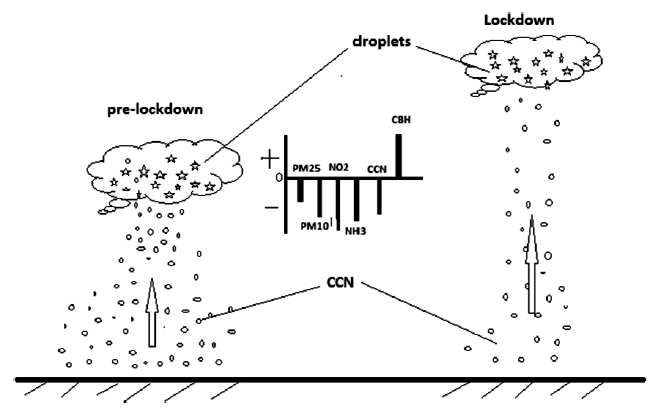
The air became so clean that the Himalayan mountain range became visible through naked eyes from many parts of northern India including Delhi for the first time in 30 years. IITM Scientists observed a massive drop in anthropogenic aerosols over the Delhi region during this first Lockdown and as a result, the concentration of cloud-condensation nuclei (CCN) at lower level decreased. At a higher level, due to lower temperature, super-saturation was achieved with lower number of CCN to produce enough droplets to form a cloud base. (as shown in the diagram above). Thus it appeared that effectively the clouds propagated upwards during the first lockdown period.
The research published in Science of the Total Environment, December 2020 says that ‘lockdown-spiked simulation’ produced a good match with the actual condition that was seen on the ground. “This did feature a reduction in the low-level cloud,” said the main author.
 
Results of the study revealed that the percentage of low clouds with bases located below 3 km above the ground was 63% of the total clouds in the pre-lockdown period while it reduced to 12% during the lockdown. The clouds with a base above 6 km increased from 10% to 48% from pre-lockdown to lockdown. Though little effect on other meteorological parameters like air temperature (AT), relative humidity (RH), radiation (UV), wind speed (WS) etc. were observed, the significant change in cloud base height has occurred due to reduction in CCN with cut off in pollution due to the lockdown. The team used Ceilometer to measure cloud base height profiles. Atmospheric chemistry and meteorology simulations were done using air-pollution data from Delhi between March 25 and April 15, 2020, which was the most stringent lockdown period in India.
 
The study was led by Murthy B.S. and the research team comprised of Latha R., Sandeepan B.S., Rathod A., and Beig G. of Indian Institute of Tropical Meteorology (IITM), Ministry of Earth Sciences (MoES), Pune, Tiwari A., and Singh S. of India Meteorological Department, MoES and Bhanage V. Indian Institute of Technology, Mumbai, India. 

ShareTweetSendShareSend
✮ Subscribe Organiser YouTube Channel. ✮
✮ Join Organiser's WhatsApp channel for Nationalist views beyond the news. ✮
Previous News

Dr Jaishankar, NSA Doval speak to Israeli counterparts, assure security for diplomats

Next News

The Real Reason why ?Jai Shri Ram? repulses Mamata Banerjee

Related News

Posters calling Rahul Gandi "Mafiveer" installed across Delhi

BJP puts up ‘Maafiveer Rahul Gandhi’ posters in Delhi, escalates attack over defamation case

India-Pak ‘Peace Letter’ Under Fire Over Kashmir Proposal

Why the J&K proposal in 60 member India-Pak letter is triggering alarm bells

Representative image made using AI

GAGAN: How India’s homegrown satellite navigation system is transforming aviation and strategic infrastructure

Sunil Ambekar
Akhil Bharatiya Prachar Pramukh informed that Akhil Bharatiya Prant Pracharak Baithak of Rashtriya Swayamsevak Sangh will be held this year at Belagavi

RSS to hold Akhil Bharatiya Prant Pracharak Baithak in Belagavi from July 10-12

Tamil Nadu govt challenges High Court cow slaughter ban in Supreme Court; BJP slams CM Joseph Vijay

Farmer seriously injured in Haveri clash after Islamists attack him; R. Ashoka seeks tough action

Haveri Violence in Karnataka: Islamists severed hand of farmer for bursting crackers before mosque; BJP clams Congress

Load More

Latest News

Posters calling Rahul Gandi "Mafiveer" installed across Delhi

BJP puts up ‘Maafiveer Rahul Gandhi’ posters in Delhi, escalates attack over defamation case

India-Pak ‘Peace Letter’ Under Fire Over Kashmir Proposal

Why the J&K proposal in 60 member India-Pak letter is triggering alarm bells

Representative image made using AI

GAGAN: How India’s homegrown satellite navigation system is transforming aviation and strategic infrastructure

Sunil Ambekar
Akhil Bharatiya Prachar Pramukh informed that Akhil Bharatiya Prant Pracharak Baithak of Rashtriya Swayamsevak Sangh will be held this year at Belagavi

RSS to hold Akhil Bharatiya Prant Pracharak Baithak in Belagavi from July 10-12

Tamil Nadu govt challenges High Court cow slaughter ban in Supreme Court; BJP slams CM Joseph Vijay

Farmer seriously injured in Haveri clash after Islamists attack him; R. Ashoka seeks tough action

Haveri Violence in Karnataka: Islamists severed hand of farmer for bursting crackers before mosque; BJP clams Congress

Chief Minister Mohan Charan Majhi chairs the Cabinet meeting at Lok Seva Bhawan in Bhubaneswar on July 1, 2026

Odisha Cabinet approves landmark KG-to-PG free education scheme, clears 12 key proposals

Dhami Govt rolls out Minority Education reforms, scraps Madrasa Board

Uttarakhand launches ‘Minority Education Authority’ on principle of One Nation-One Education, Madrasa Board abolished

R Ashoka accuses Karnataka Govt of undermining EC through Gruha Jyothi Survey

Karnataka Government using Gruha Jyothi Survey to bypass EC’s voter verification exercise: R Ashoka of BJP

P. Shailaja, Sudha Mohan, Amara Linganna (Left to Righ)

Telangana: Missionary Mayajaalam book probes Christian missionary deception in India’s civilisational narrative

Load More
  • Privacy
  • Terms
  • Cookie Policy
  • Refund and Cancellation
  • Delivery and Shipping

© Bharat Prakashan (Delhi) Limited.
Tech-enabled by Ananthapuri Technologies

  • Home
  • Search Organiser
  • Bharat
    • Assam
    • Bihar
    • Chhattisgarh
    • Jharkhand
    • Maharashtra
    • View All States
  • World
    • Asia
    • Africa
    • North America
    • South America
    • Europe
    • Australia
  • Editorial
  • Operation Sindoor
  • Opinion
  • Analysis
  • Defence
  • Culture
  • Sports
  • Business
  • RSS @ 100
  • Entertainment
  • More ..
    • Sci & Tech
    • Vocal4Local
    • Special Report
    • Education
    • Employment
    • Books
    • Interviews
    • Travel
    • Health
    • Politics
    • Law
    • Economy
    • Obituary
  • Subscribe Magazine
  • Read Ecopy
  • Advertise
  • Circulation
  • Careers
  • About Us
  • Contact Us
  • Policies & Terms
    • Privacy Policy
    • Cookie Policy
    • Refund and Cancellation
    • Terms of Use

© Bharat Prakashan (Delhi) Limited.
Tech-enabled by Ananthapuri Technologies