-Tej N Dhar
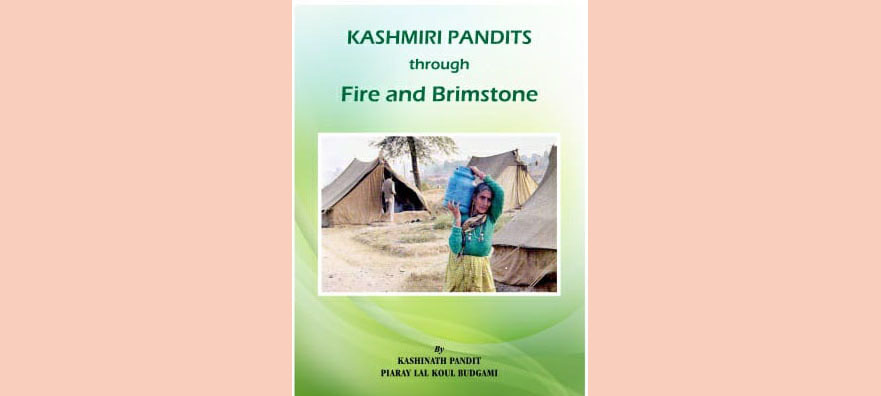
Author: Kashinath Pandit and Piaray Lal Koul Budgami, Publication: Akshaya Prakashan,
Pages: xxiii+150, Price: Rs 295
Kashmiri Pandits through Fire and Brimstoneis an expanded version of Budgami’s book in Urdu, Kashmiri Pandit: Dastan-i-dar o Rasan, which was published in 2016. The authors contend that though the Pandits have been living in exile for more than thirty years, their woeful condition has gone virtually unnoticed, and there is every likelihood that their story of “blood and sweat” will be lost with time. Since their fate is linked with politics within the UT of Jammu and Kashmir, the book, in its Introduction and five Sections, focuses on three major aspects of the Pandit story: the pain and suffering the community has been subjected to for centuries, which took a turn for the worse after 1947; a critical overview of the policies of the State and Central governments, which contributed to their ouster from the Valley in 1990; and the failure of the Pandits to come to grips with their unfortunate situation.
The authors state that the rich Hindu civilization in Kashmir was virtually destroyed with the establishment of Muslim rule in Kashmir, which was strengthened by the massive missionary programme of the father-son duo of Hamadani’s and Shams Araki. During their heyday, the Hindus could live peacefully with the Buddhists for nearly a thousand years, but the Muslims did not let the Hindus live peacefully in their own land. They were either converted forcefully or compelled to flee their homes. The story of their conversions and the destruction of their temples to make way for the construction of mosques are recorded in Baharistan-i-Shahi and Tohfatul Ahbab. This continued even during the Mughal and Pathan rule of Kashmir.
After acceding to the Indian Union in 1947, the state drafted a new constitution, which made no provision for minorities, because of which the Muslim majority enjoyed all the minority rights provided in the Indian constitution. The steady growth of Muslim radicalism in the Valley led to riots in South Kashmir in 1986, in which Pandit houses and temples suffered considerable damage, and the explosive rise of militancy led to their mass exodus in 1990. The vernacular press in the Valley turned hostile towards them and the national media and press remained a mute witness to their pain and suffering. Even the National Human Rights Commission stated that their fate was “akin to genocide but not genocide.”
In their analysis of the state politics and its connection with the central government, which contributed to the compounding of the tragedy of the Pandits, the authors subject their policies and actions to a critical scrutiny. When the Maharajah acceded to India without any preconditions, Nehru succumbed to the pressure tactics of Abdullah and Beig by agreeing to their demand for a special status, even against heavy opposition by the members of the Constituent Assembly. Abdullah also tricked Nehru into believing that Mirwaiz Maulavi Yusuf Shah was anti-India, and was therefore pushed out of Kashmir. When Nehru eventually understood what Abdullah was up to, he was arrested in 1953. Bakhshi worked very hard to normalize conditions in the Valley, gave proof of being a patriot and visionary, but Nehru made a mistake by making him leave his post, because of the pressure of the Left parties.
When Abdullah took control of the State, once again, in 1975, after signing an agreement with the central government, the leaders in New Delhi failed to see his “dubious game.” He openly sympathized with the Jamaatis and established links with the Saudis. He changed the Hindu names of hundreds of villages to Islamic names, and encouraged Jamaatis to establish a strong presence in the public space. Just before his death, he ensured that his son Farooq took control of the state, laying the foundations of a baneful dynastic rule. Because of Farooq’s inexperience and ineptitude and his political chicanery, the militant activity got a boost in the state, which exploded in 1990 and led to the exodus of Pandits from the Valley.
The authors have attempted to show that the seeds of what happened in 1990 had been sown in 1950, when the Jamaat spread its fundamentalist and anti-India ideology in Shupian in South Kashmir, and the first terrorist organization Al Fath came up in 1960. After the arrest of Abdullah in 1953, Beig kept the Plebiscite Front alive as a forum for stoking trouble in the days to come. The PDP that grew from the womb of the Jammat-i-Islami carried forward the work of disruption in the Valley. That is why the authors believe that the BJP move of forming a government in the state with them was no less than a “reckless coalition.” The government allowed Bangladeshi and Rohingiya Muslims to settle in the state, but scuttled attempts to rehabilitate the Hindu and Sikh refugees from PoK or West Punjab and the Pandits.
The authors also document the corruption and loot of funds by the state authorities during the coalition governments of the Congress and National Conference. When Omar Abdullah was the chief minister the state was rocked by a series of scandals in the Board of School Education and Professional Education. Several top officials were involved in sex scandals and several state ministers in cases of land grabbing. The authors write approvingly of the abrogation of Article 370 and 35 A and also suggest a number of measures that the government could take to improve conditions in the state.
Perhaps the most interesting and controversial part of the book relates to the views of the authors about the inability of the Pandits to assess their future in Kashmir, which they think is because of their failure to learn from their painful past. Right from the time of the arrival of Muslim missionaries in the Valley, they suffered torture and humiliation, and several exoduses, and yet yearned to cling to the place. Their hope of a change in their situation in free India was belied by the utterances of the Indian leaders. As early as 1932, Gandhi called Kashmir a Muslim majority region and Nehru in 1946 told the Pandits to learn to mix with the Muslims or get decimated or run away from the state.The state government stole their minority rights. The steady erosion of the secular and democratic forces within the state led to the steady growth of Arabiyat, wahhabiyat, and salafiyat, which turned it into a semi-theocratic state, in which the Pandits had no place. So they were made to quit their homes in 1990, and are still out of them.
In this context, the authors draw attention to the efforts of the Panun Kashmir to plead the cause of the community for their one place settlement in the Valley, and point out flaws in government policies that are arrayed against them, including the denial of the status of the Internally Displaced People to them. In spite of this, the authors maintain that the community needs to come out of its shrunken self, get over its erosion of identity, give itself a good shaking, cast aside its useless customs and traditions, and train its youngsters to get into high administrative positions to influence power structures. They also urge the community to think beyond the craving for a homeland in a flawed state, dream big, and embrace “new climes and lands.”
A short and compact book, Kashmiri Pandits through Fire and Brimstone deals with all the important aspects of the problem of the Pandits, who have suffered persecution and exile in their homeland for centuries, and pleads that they would do well to think of a fulfilling life beyond the borders of the subcontinent. It also provides vital insights into the murky politics of the state and the inept handling of the problems within it by successive governments in New Delhi.