Who is Killing my JNU Culture?
June 5, 2026
  • Read Ecopy
  • Circulation
  • Advertise
  • Careers
  • About Us
  • Contact Us
Android AppiPhone AppArattai
Organiser
  • ‌
  • Bharat
    • Assam
    • Bihar
    • Chhattisgarh
    • Jharkhand
    • Maharashtra
    • View All States
  • World
    • Asia
    • Europe
    • North America
    • South America
    • Africa
    • Australia
  • Editorial
  • International
  • Opinion
  • RSS @ 100
  • More
    • Op Sindoor
    • Analysis
    • Sports
    • Defence
    • Politics
    • Business
    • Economy
    • Culture
    • Special Report
    • Sci & Tech
    • Entertainment
    • G20
    • Azadi Ka Amrit Mahotsav
    • Vocal4Local
    • Web Stories
    • Education
    • Employment
    • Books
    • Interviews
    • Travel
    • Law
    • Health
    • Obituary
  • Subscribe
    • Subscribe Print Edition
    • Subscribe Ecopy
    • Read Ecopy
  • ‌
  • Bharat
    • Assam
    • Bihar
    • Chhattisgarh
    • Jharkhand
    • Maharashtra
    • View All States
  • World
    • Asia
    • Europe
    • North America
    • South America
    • Africa
    • Australia
  • Editorial
  • International
  • Opinion
  • RSS @ 100
  • More
    • Op Sindoor
    • Analysis
    • Sports
    • Defence
    • Politics
    • Business
    • Economy
    • Culture
    • Special Report
    • Sci & Tech
    • Entertainment
    • G20
    • Azadi Ka Amrit Mahotsav
    • Vocal4Local
    • Web Stories
    • Education
    • Employment
    • Books
    • Interviews
    • Travel
    • Law
    • Health
    • Obituary
  • Subscribe
    • Subscribe Print Edition
    • Subscribe Ecopy
    • Read Ecopy
Organiser
  • Home
  • Bharat
  • World
  • Operation Sindoor
  • Editorial
  • Analysis
  • Opinion
  • Culture
  • Defence
  • International Edition
  • RSS @ 100
  • Magazine
  • Read Ecopy
Home Bharat

Who is Killing my JNU Culture?

When I joined JNU in 1990, though there were ideological battles, they were not abusive in words or physically violent. That is the JNU culture I pray for

Archive ManagerArchive Manager
Dec 2, 2019, 03:44 pm IST
in Bharat
Follow on Google News
FacebookTwitterWhatsAppTelegramEmail


a_1  H x W: 0 x
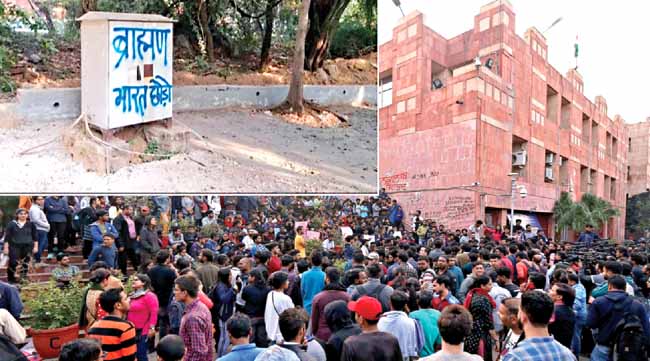
Inside Photo  (Graffiti against Brahimins) JNU students protesting at the admin block of the University


When I joined JNU in 1990, though there were ideological battles, they were not abusive in words or physically violent. That is the JNU culture I pray for


It was the election season in Jawaharlal Nehru University (JNU), my first one there in 1990. I had arrived on JNU campus as a graduate student in Linguistics. JNU had opened a new hostel called Mahanadi. A stone’s throw away from the Indian Institute of Mass Communication, this newly built facility was nestled in the quiet serene section of Poorvanchal. It was designated to be a hostel for married couples but due to shortage of hostel accommodation, some of us non-married students were temporarily lodged there. It was so far away from the Ganga Dhaba and the rest of the action that unless you were a resident of this hostel, you wouldn’t venture out there.
 
 
So one day when a man knocked at our door (I shared my room with two other students) I thought it must be one of our neighbours. But I was surprised to see an unfamiliar face at the door. He was well-built and well-rounded with thick & dark nicely trimmed beard. He must have been in his late thirties, or may be even older. “Hi, I am Subair. I am running for JNUSU President.”
 
 
Throughout my four year stay in JNU, two as a graduate student and then another two as a research scholar, I would see Subair here and there at one of the dhabas where he would burst into an impromptu speech on any given topic under the sun. He always had a point to make—and he articulated it aloud in public—with the slightest of provocation and without bothering if anyone would agree with him or not.
 
 
If JNU represents the individual freedom and freedom of speech of each of its residents, Subair was the true incarnation of this undying spirit. Subair would have never stopped a Makarand Paranjape or an Anand Rangnathan from entering their offices because he was in disagreement with a policy of the JNU administration or the government of the day. He would never object to the rights of a Vivek Angihotri or a Baba Ramdev and prevent them from entering the campus to express their points of view. He would never be condescending and would not move away from the dining hall table if he found out that you were an Akhil Bharatiya Vidyarthi Parishad (ABVP, the student wing of the RSS) sympathiser. Many leftist JNU comrades did not have such decency and ‘tolerance’.
 
 
Subair was a great innovator of ideas when it came to protests. When he once staged a sit-in in front of the JNU Library, he wrote his slogans on the floor with charcoal. That way he attracted immediate attention of those who entered the Library. In JNU everybody went to the Library for one thing or the other. He never vandalized the beautiful red sandstone walls of the campus buildings. Never plastered the wall with ugly, vulgar, and anti-national ‘azadi’ and ‘tukde-tukze’ slogans. Neither did he desecrate any moortis, religious or secular.
 
 
Subair was fiercely secular in its classical sense. His secularism did not make Mata Durga a ‘prostitute’, nor did he ask Brahmins to ‘leave India’. He would attend both ubiquitous Iftar parties during the holy month of Ramzan and the Holi festivities on campus alike.
 
 
Subair was an ‘one man army’. He wasn’t part of any organisation. He was a true ‘libral’ to be able to tread party dictats and for that reason was probably hated by the torchbearers of the ‘liberal’ politics in JNU. In fact they considered him ‘vote-katwa’ as he would always get a significant number of votes in JNUSU elections.
 
 
If JNU has historically been about pamphlets, Subair was for using every centimeter of that paperspread. He left no margins. In that sense he was a true paper saver, a true environmentalist. While making his point, he was never condescending or abusive. No one could ever accuse him of ever being verbally or physically abusive even to his opponents. He never assaulted anyone or held anyone hostage. Nor was he sexually abusive or lewd in his words or deeds.
 
 
Subair was always well-informed and well-rounded and as such all his extempore speeches were a delight to listen to. Subair ran for JNUSU president’s post every year and we would flock to the Ganga Maidan to listen to his electrifying speeches. He weaved through different current happenings—on campus as well as national or international—into his speeches. In that sense he was a true inter-disciplinarian. It is no surprise that JNU prides itself in its interdisciplinary approach to academics. Subair’s lexicon as well as heuristic and ideological repertoire was not restricted to a unifocal homogenous world view or value system.
 
 
Subair was a true “people’s person” too and his friends ranged from the fresh entrants to most senior Ph.D scholars. We called such ‘senior’ scholars ‘saptarshis’—one who have spent seven years or more in their research in JNU. Subair was probably one of them.
 
 
I did not know Subair personally, nor would I call him my acquaintance. All I know is that Subair never aged. JNU of the late eighties and early nineties was completely familiar with him. No one could ever guess when he landed on the campus but everyone knew he would never leave it. I don’t know how he managed his finances (I paid ₹66 for a semester as M.Phil. tuition fee, if my memory serves me right), what family background he belonged to, whether he had any research grants, etc,. But we never saw him complaining about anything. Whenever he came to one of the dhabas we would offer him ‘milk tea’ and he would readily oblige.
 
 
Subair was very brave too. This was evident because he never bothered about what people gossipped behind his back. And people did gossip plenty. Only a JNU-ite would know about the churnings of this JNU rumour mill, especially during JNUSU election. But Subair never cared about his reputation. That was, in fact, a great way to build a reputation!
 
 
It has been nearly 25 years since I left the friendly confines of this great JNU campus. I have no idea where Subair is these days, what happened to him. I do miss him though. May god bless Subair wherever he may be and may god bless the great JNU spirit.
 
 
(The writer is JNU and University of Illinois at Urbana-Champaign alumnus)


ShareTweetSendShareSend
✮ Subscribe Organiser YouTube Channel. ✮
✮ Join Organiser's WhatsApp channel for Nationalist views beyond the news. ✮
Previous News

Dr Ambedkar on Civil Code

Next News

Outrage over rape and murder of Dr Priyanka Reddy and solutions for a decadent problem

Related News

RSS Sarsanghchalak Dr Mohan Bhagwat

The time of Bharat has arrived; we need to expedite our preparation: Dr Bhagwat at RSS Karyakarta Vikas Varg 2

Padma Bhushan awardee and noted industrialist Kumar Mangalam Birla Kumar Mangalam Birla addressing the Samapana Samaroh (Valedictory Function) of the Rashtriya Swayamsevak Sangh Karyakarta Vikas Varg – Dwitiya at Nagpur, on June 4, 2026

“RSS always stood by the society and nation”, Kumar Mangalam Birla at RSS Karyakarta Vikas Varg 2 in Nagpur

Arunachal Pradesh seals all 15 illegal Mosques; Bandh called off by APIYO

MK Stalin with Sonai Gandhi; MK Stalin with Rahul Gandhi (File Photos) (Left to Right)

Tamil Nadu: DMK says no to INDIA Alliance meet in Delhi, blames Congress for political backstabbing

Union Finance Minister Nirmala Sitharaman

Karnataka: All-Women team powers Yadgir’s groundnut revolution; Nirmala Sitharaman inaugurates NABARD Unit

Keralam: Jamaat-e-Islami event features Hamas and Muslim Brotherhood ideologues, raises concerns over Political Islam

Load More

Latest News

RSS Sarsanghchalak Dr Mohan Bhagwat

The time of Bharat has arrived; we need to expedite our preparation: Dr Bhagwat at RSS Karyakarta Vikas Varg 2

Padma Bhushan awardee and noted industrialist Kumar Mangalam Birla Kumar Mangalam Birla addressing the Samapana Samaroh (Valedictory Function) of the Rashtriya Swayamsevak Sangh Karyakarta Vikas Varg – Dwitiya at Nagpur, on June 4, 2026

“RSS always stood by the society and nation”, Kumar Mangalam Birla at RSS Karyakarta Vikas Varg 2 in Nagpur

Arunachal Pradesh seals all 15 illegal Mosques; Bandh called off by APIYO

MK Stalin with Sonai Gandhi; MK Stalin with Rahul Gandhi (File Photos) (Left to Right)

Tamil Nadu: DMK says no to INDIA Alliance meet in Delhi, blames Congress for political backstabbing

Union Finance Minister Nirmala Sitharaman

Karnataka: All-Women team powers Yadgir’s groundnut revolution; Nirmala Sitharaman inaugurates NABARD Unit

Keralam: Jamaat-e-Islami event features Hamas and Muslim Brotherhood ideologues, raises concerns over Political Islam

Representative Image (This is an AI Generated image)

Uttar Pradesh CM Abhyudaya Scheme: Apply for free civil services, JEE and NEET coaching from June 5

House worth Rs 2 crore of drug peddler bulldozed in J&K

Anti-narcotics campaign in J&K: Police demolish Rs 2 crore residential property linked to drug peddler Sheikh Tasaduq

As fuel shortages rippled across Asia, New Delhi expanded supplies to its neighbours while Beijing sought to turn energy security into strategic influence.

The Hormuz Test: How India’s energy assistance outshines China’s conditional approach

Demographic changes in Bharat’s border districts have raised concerns about migration, security, and social cohesion

Demographic Shift in Border Areas of Bharat: The dangerous design

Load More
  • Privacy
  • Terms
  • Cookie Policy
  • Refund and Cancellation
  • Delivery and Shipping

© Bharat Prakashan (Delhi) Limited.
Tech-enabled by Ananthapuri Technologies

  • Home
  • Search Organiser
  • Bharat
    • Assam
    • Bihar
    • Chhattisgarh
    • Jharkhand
    • Maharashtra
    • View All States
  • World
    • Asia
    • Africa
    • North America
    • South America
    • Europe
    • Australia
  • Editorial
  • Operation Sindoor
  • Opinion
  • Analysis
  • Defence
  • Culture
  • Sports
  • Business
  • RSS @ 100
  • Entertainment
  • More ..
    • Sci & Tech
    • Vocal4Local
    • Special Report
    • Education
    • Employment
    • Books
    • Interviews
    • Travel
    • Health
    • Politics
    • Law
    • Economy
    • Obituary
  • Subscribe Magazine
  • Read Ecopy
  • Advertise
  • Circulation
  • Careers
  • About Us
  • Contact Us
  • Policies & Terms
    • Privacy Policy
    • Cookie Policy
    • Refund and Cancellation
    • Terms of Use

© Bharat Prakashan (Delhi) Limited.
Tech-enabled by Ananthapuri Technologies