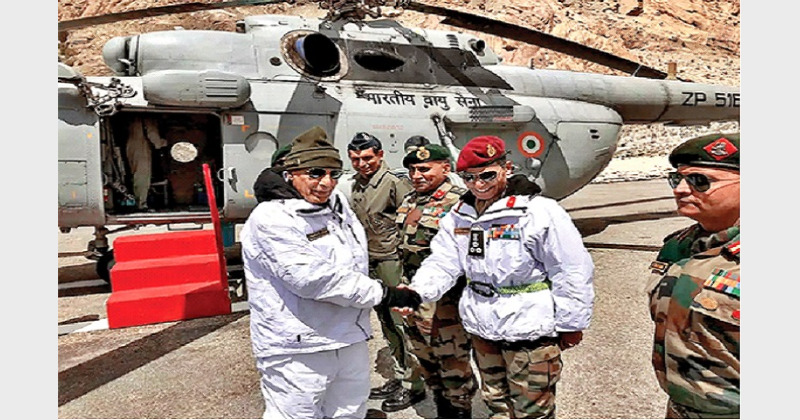
National Security was one of the major poll planks during the 2019 election campaign. To mitigate the emerging internal and external security challenges Modi 2.0 should evolve an integrated National Security strategy
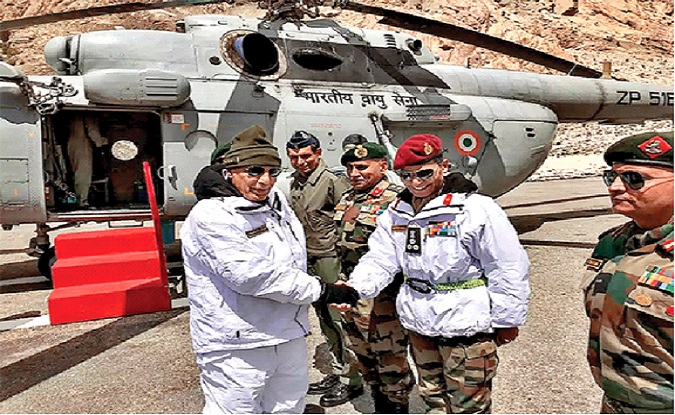
Union Defence Minister Rajnath Singh visited the Siachen Glacier and reviewed the security situation along the borders with Pakistan
The uncertainty over the outcome of election 2019 has ended with the nation reposing its faith on the leadership of Prime Minister Modi and expressing its satisfaction with the performance of the government led by him. The new government which is firmly in the saddle began its work from day one. The nation was watching with expectation as to who will become the four most important members of the cabinet of the Cabinet Committee on Security (CCS). PM Modi nominated the two tallest leaders of the party to head the sensitive departments of Defence and Home while a seasoned diplomat who has a grip on India’s relations with China and India got the External Affairs while an economist and ex-Defence Minister was entrusted with Finance. Everyone hailed the PM’s decision. All these ministries form the pillars of national security and by putting those in capable hands, Modi signalled the intent of his government to ensure national security as paramount importance.
National Security was an important issue during the election campaign. Modi government is keen to prove that it was not mere electoral rhetoric, but the government is very serious and sincere about it. Accordingly, the first meeting chaired by the new Home Minister was about Jammu & Kashmir (J&K) and he also spent considerable time that day with the Governor of the state who is also running the current administration in the State. Similarly, the Defence Minister wasted no time in visiting Siachen and Kashmir to get first-hand views from the operational commanders.
National Security is the responsibility of the government for which it is required to enact a policy to safeguard nation’s territorial integrity, its cultural identity, protect the interests of its nationals across the globe and develop the capability to influence globally as well as regional affairs. National security is all-encompassing, wide-ranging and includes non-military dimensions as well. It includes defence, diplomacy, data security, energy security, economy, climatic issues including water, food security, internal security, national resources (both natural and human resources) security, maritime security, and cyber and space security. Accordingly, the threats, risks and challenges are manifold and across the spectrum.
Unfortunately, we lack a cohesive response due to the lack of a comprehensive national security strategy. India is inching towards becoming a Vishwa Guru and formidable power. It is therefore imperative that the government formulates a National Security Doctrine, to begin with. From the doctrine will flow the National Security Strategy. To stake our claim as a formidable power, we have to ensure that we have enough means militarily and otherwise to provide the protection of our vital national interests and national security objectives. There is a need to identify weaknesses and gaps in our security structure and take measures to plug them. National Security Strategy will enable different stakeholders in the government to carry out an “ends versus means” analysis and prepare the perspective plans for their respective ministries.
National Security Advisor (NSA) plays a crucial role in the enhanced national security structure. He not only acts as the advisor to the Prime Minister but also serves as a coordinator between different ministries to give comprehensive advice to the PM. With wide-ranging spheres of security and some of them overlapping, coordination is needed. The PM has shown confidence in the present NSA and honoured him with a Cabinet rank. The moot question is, should the NSA be accountable to the Parliament also? A national debate on the issue is needed.
There is a need to develop India into military power. Without a strong military, no nation can claim to be a formidable power. Our military suffers from neglect and needs to be modernised. The existing deficiencies and future requirements to cater to newer conventional and. non-conventional threats need to be made up. Procurement procedures need to be made efficient and accountable. We also have to be prepared to meet challenges from the neighbourhood. Any instability in the neighbourhood will affect India as well. We need to develop the capability for regional intervention as well as for regional and maritime projection. Adequate deterrence capabilities across all spectrum from sub-conventional to nuclear will make us an absolute military power. This will also be adequate to meet the threat of two and a half front war. The entire exercise demands a higher allocation for the defence budget. The current distribution of 1.5% of GDP is grossly inadequate; in fact, it is barely adequate for India to remain a military force. To make it a military power higher budgetary support of 2.5-3.5% of the GDP is needed.
‘Integration’ and ‘joint manship’ is the need of the hour as all future wars will be fought jointly. The nation needs a Chief of Defence Staff (CDS) to provide single-point advice to CCS on military matters. To overcome the political differences and inter-services rivalry, the government would be required to take the legislative route as was done in America through Goldwater Nicholas Act. In an integrated tri-service environment, the present system of geographical commands by respective services will lose relevance. Integrated tri-services theatre commands are needed to synergise the capabilities of all the three services. The British inherited command and control structure, including the Ministry of Defence, needs drastic reforms. A total amalgamation of the three service headquarters with MOD to enable the entrance of service officers in MOD to utilise their domain expertise is a big challenge for the government. It was one of the significant recommendations of Kargil Review Committee, but for a few cosmetic changes, no concrete measures have been put into effect to remove the anomaly.
A sound and modernised intelligence network, indigenisation of defence industry, R&D, creation of strategic assets including their command and control, a talented pool of manpower with analytical skills for understanding and interpreting ongoing changes in the world and their implication on India’s security, capabilities to counter hybrid threats and absorption of future technology like Artificial Intelligence (AI), Internet of Things (IoT) and Internet of Weapons (IoW), robotics, cyber and space warfare, historical research and scenario building capability are the other challenges the government will have to address.
As an emerging power, the need is not to only ensure our maritime security but to emerge as a formidable maritime power. Indian Navy has a major role to play in the Indian Ocean. A modernised and net-worked Air Force not only acts as a force-multiplier but also acts as a deterrent.
On the internal security front, the biggest challenge and first priority is J&K. A comprehensive J&K policy to bring permanent and lasting peace in the state to include strategy to counter Pak-sponsored proxy war including terrorism, action against terror support network, terror funding and financing, purging of radical elements in state administration, police and education department, regaining the confidence of Kashmiri youth through good governance, removal of regional disparities and treating Jammu & Ladakh as equal stakeholders. Left-Wing Extremism (LWE), though on the decline, continues to be a challenge.
India is increasingly coming under the threat of global jihadi terror outfits. ISIS is trying to increase its footprint through, and ISIS-inspired local groups. The network is vast and spread across the country. Radicalisation is the root cause.
A comprehensive national policy to counter radicalisation and de-radicalisation is needed urgently. Implementation of the policy and its monitoring would be a big challenge for the government.
Modernisation of state police forces continues to be a weak link in the chain of Home security. Modernised and well-trained forces can act as a trip-wire against sabotage and other internal security threats.
With the changing geopolitical environment, the on-going trade war between China and the US, growing “assertiveness” (my way or highway) of USA and re-emergence of ISIS, makes it imperative for us to give top priority to national security. History bears testimony to the fact that no nation can emerge as a regional and global power through “soft power” only.
( The writer is a Jammu-based political commentator, columnist, security and strategic analyst )