Many states, including Punjab, Kerala, Andhra, Telangana and Maharashtra have either banned Glyphosate or are in the process to ban it. But the companies are opposing the ban saying only the Central government can ban it. In this situation, the Centre needs to intervene in favour of the Indian farmers
In the year 2015, International Agency for Research on Cancer (IARC), an agency of the World Health Organization (WHO), had found in its research that ‘glyphosate’, which is an active ingredient in Monsanto’s RoundUp, is “probably” carcinogenic. The review, conducted by WHO’s International Agency for Research in Cancer, found that glyphosate increased risks for Non-Hodgkin lymphoma as well as DNA and chromosomal damage. A Working Group of 17 experts from 11 countries met at the International Agency for Research on Cancer (IARC) on 3-10 March 2015 to review the available published scientific evidence and evaluate the carcinogenicity of five organophosphate insecticides and herbicides: diazinon, glyphosate, malathion, parathion, and tetrachlorvinphos.
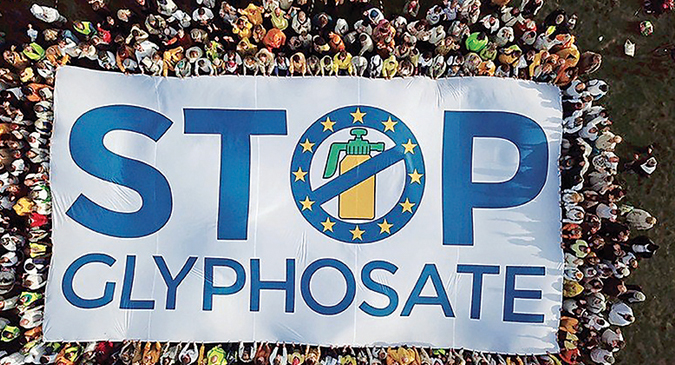
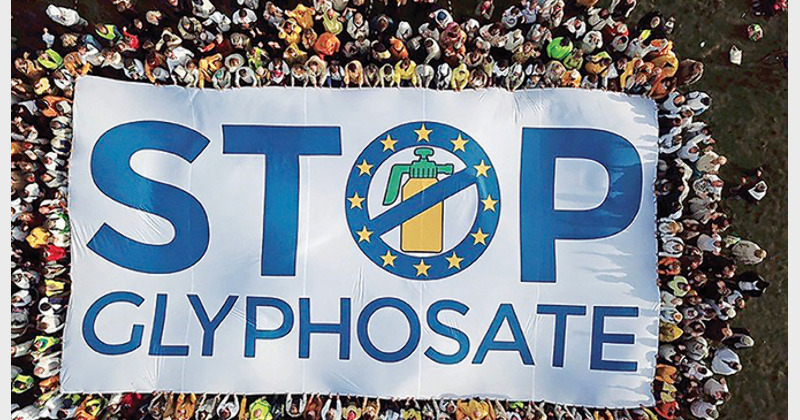
A view of worldwide protest against Glyphosate
IARC also concluded that there was “strong” evidence for genotoxicity, both for “pure” glyphosate and for glyphosate’s mixtures. IARC reviewed about 1000 studies. Some of the studies looked at people exposed through their jobs, such as farmers. Others were experimental studies on cancer and cancer related effects in experimental systems.
Recently, a jury from Auckland, USA, ordered Bayer-Monsanto to pay$ 2 billion (Rs. 14000 crores) to a couple who had suffered from cancer after using herbicide called ‘RoundUp’. This is the third case of such damages on the company. It is worth mentioning that two months ago, the State’s court of Alameda County had ordered the company for a compensation of $80 million (Rs 560 crore) to a person. Similarly, in another lawsuit, the State court of San Francisco had ordered compensation by the same company for a school’s groundskeeper to the tune of $200 million, which was later reduced by another court to $ 78 million (Rs. 546 crore).
Therefore, we find that successively in three law suits, different courts in USA have accepted the allegations of the victims of cancer that their cancer has been caused by the herbicide called RoundUp, produced by Monsanto and has accordingly provided for compensation of significant amounts to the victims. However, matter doesn’t stop here as thousands of such cases are pending in various courts of USA. It’s notable that last year Monsanto Company was taken over by Bayer and since then Monsanto is known as Bayer-Monsanto.
Rising use of glyphosate in India and the World
On the one hand not only cases of cancer caused by glyphosate are coming in light, but the courts have also been giving relief to the victims in this regard. Today, not only in the USA, the incidence of cancer is increasing worldwide. The World Health Organization’s agency IARC, has conclusively said that glyphosate, which is active ingredient of the RoundUp, is probably carcinogenic or in other words cancerous. According to a recent study, the risk of cancer increases by 41 per cent due to glyphosate. This finding is corroborated by the increasing incidence of cancer worldwide.
Whereas the people around the world are reeling under the risk and suffering due to glyphosate, the makers of the weed killers with glyphosate as main ingredient are not ready to accept the fact. Despite being convicted by the court every time, they continue with legal appeals due to their strong financial muscles. The reason for this is that all their business hinges on these weed killers and herbicide tolerant GM crops. It is worth noting that most GM seeds are herbicide tolerant (HT).
Notable, that the world has used 8.6 billion kg of glyphosate by 2014, since 1974. In 1995, the total use of glyphosate was only 51million kg, it increased to 775 million kg in 2014 i.e. a 15 times increase. Even in India, 8.7 lakh kg of glyphosate had been used by 2014.
Why do farmers use glyphosate?
The weeds and unwanted vegetation have to be removed because they are not good for the crop as well as for the growth of it. They can be removed by two ways. The first method is the manual process of identifying and removing weeds. Second method is to use the herbicide to destroy the weeds. The farmers prefer herbicide because it is a cost-effective method. The farmer is not aware of the health hazards associated with the use of herbicides. Moreover, herbicide manufacturing companies intentionally hide the health hazards associated with them. In America it was proved in various courts that the companies intentionally hide the dangers associated with the use of glyphosate.
GM crops and glyphosate
It is a well-known fact that Monsanto and Bayer have been trying to promote the GM crops. Recently, seed companies illegally introduced herbicide tolerant (HT) BT cotton seeds in the market. According to some estimate, HTBT Cotton is being cultivated in approximately 1 lakh hectares. It is obvious to understand that this is being done to increase the market for RoundUp and glyphosate in India. It is also clear that this is entirely beneficial for companies selling RoundUp in the market. The main aim of these companies is not the welfare of the farmers, but their own selfish interests. It is imperative to stop the production of GM crops in India since it promotes the use of cancer-causing glyphosate.
Imperative to ban glyphosate
After being conclusively proved that glyphosate causes cancer, many countries have taken a decision to ban it. Following the IARC report in 2015, more than 400 cities and towns have banned Glyphosate in Argentina. In the similar manner, glyphosate has been banned in many towns and cities in Australia. Many EU countries including France, Belgium, Greece, Luxemburg, Slovenia, Malta and European Union have raised concerns about the ill effects associated with glyphosate. Thereafter the process of banning has been initiated by many countries. Bermuda has put a ban on private and Agricultural usage of glyphosate but has permitted its usage on sides of roads by government. Brazil has put a ban on the registration of chemicals made of glyphosate. And also, 8 states in Canada have banned glyphosate in one or the other way. In the same way Columbia, Czech Republic, Denmark, El Salvador, Germany, Greece, Netherland, New Zealand, Portugal, Scotland, Sri Lanka, Sweden, Vietnam etc. either banned or limited its usage.
In India, many states attempted to ban glyphosate. In Punjab the sale of glyphosate has been prohibited since October 2018. Similarly, in February 2019 Kerala prohibited the usage of glyphosate. Andhra Pradesh and Telangana have already prohibited the use of glyphosate. Maharashtra is also attempting to ban glyphosate. In many states, companies are trying to oppose the ban on the argument that only Central government has an authority to register and ban the glyphosate. But, the Central government hasn’t initiated the process to ban the use of glyphosate. But the supporters of ban have contended that the government has permitted the use of glyphosate only for tea gardens and non-agricultural purposes. And in the absence of tea gardens, states are allowed to ban it. It is imperative to ban the usage of the ‘Cancer causing glyphosate’ which has been proved worldwide.
(The writer teaches Economics at PGDAV College, University of Delhi)