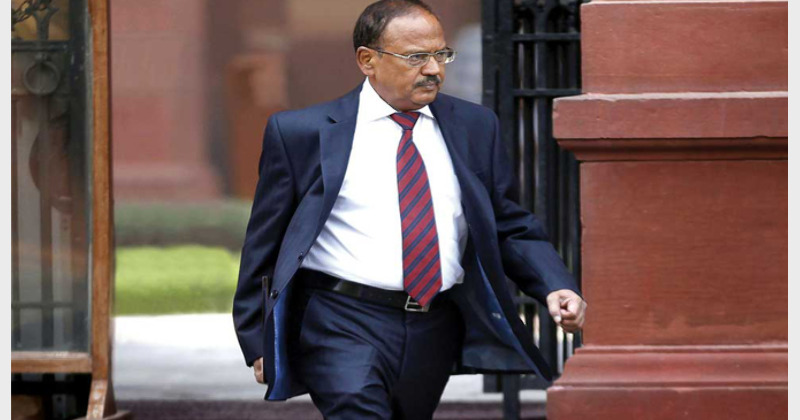
In a speech delivered in 2014, Ajit Doval, the present National Security Adviser, had stressed the need for a paradigm shift in Indian strategic thinking. The punitive action after the Pulwama Fidayeen Jihadi attack underlines the same shift
With India’s ‘Modi’fied strategy turning Islamabad excessively defensive yet again after the Uri surgical strike, the unprecedented upper hand we have got in our relentless war on terror underscores a paradigm shift in India’s strategic doctrine. The befitting air attacks deep into Pakistani territory after Pulwama Fidayeen Jihadi attacks, have sent a clear signal to Pakistan and the world that India has set a new precedent in countering the Islamabad-sponsored terror attacks on Indian soil.
A proactive strategy to neutralise Pakistan’s policy of using terrorism as an instrument of the state policy was a long overdue for a decade, especially before and after the 2008 Mumbai attacks. India suffered a series of terror attacks in the mainland before and after the Mumbai attacks, until 2014. Each time, India had to go on the defensive against ‘Bleed India with a Thousand Cuts’ doctrine of Pakistan, with the successive governments following the traditional Standard Operating Procedures of futile diplomatic exercises, refusing to explore a permanent solution to the menace of terrorism.
Since the Narendra Modi regime came to power in 2014, there has been a phenomenal change in the country’s military strategy, which experts call a paradigm shift, wherein the country sought to hit the epicentre of terrorism beyond the Line of Control (LoC) in pursuit of defining a proactive policy to contain growing Jihadism.
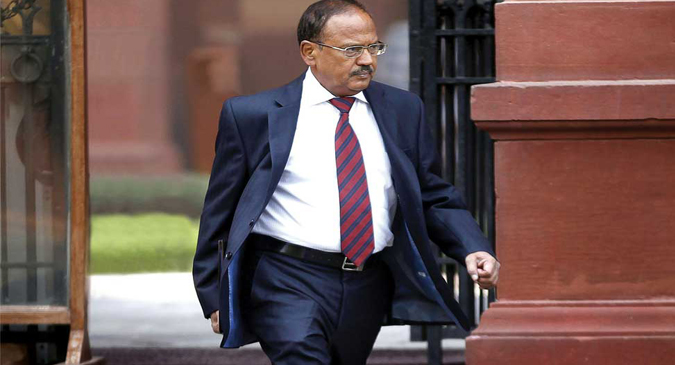
The new doctrine, which is essentially offensive, is named after India’s super sleuth, the National Security Advisor Ajit Kumar Doval ushered in the much-awaited shift from defensive to offensive defence. If the surgical strikes in Myanmar and Uri were defining moments when the country was at crossroads, the Balakot and its aftermath set a hugely important precedent to future India.
Though Ajit Doval had talked much about it earlier, way back in 2006, soon after his retirement as chief of the Intelligence Bureau, he has explained it lucidly in the Nani Palkhiwala memorial lecture delivered at the Sastra University on February 21, 2014. He was the director of the Vivekananda International Foundation (VIF), a New Delhi based think tank, that time after his long stint in the Intelligence Bureau. It would not be an exaggeration to call it a summary of his approach towards tackling India’s perpetual threat, i.e. Pakistan, which later laid the foundation to the nation’s changing strategic response to terrorism.
Doval began his speech by narrating an anecdote when the newly elected government was eager to repeal POTA after 2004 polls, when he was the chief of IB. He said the then political establishment had placed politics above national interests. His requests to the then government not to repeal the only anti-terror law in the country was eventually downplayed and ignored, while admitting that it was a toothless law when compared to anti-terror laws in the West.
In an important observation, that would later fill a significant lacuna of our unrealistic and romanticised Pakistan policy, he asserts, ‘You can never defeat an enemy that you cannot define’.
Posing a question ‘what makes Jihadi Terror a strategic threat?’, Shri Doval said, “The biggest reason jihadi terrorism is a threat is because it’s sponsored by a country which harbours a compulsive hostility towards India, and right from day of its Independence, all its policies have had one objective.” That Pakistani objective, he said, is: “India is the enemy, destroy it. That is indeed Pakistan’s objective, let us make no bones about it. Don’t buy Pakistan’s argument that Pakistanis are well wishers, they are not. They will continue to bleed us with a thousand cuts,” Doval had said.
Warning that no one should underestimate ‘jihadi terrorism’, he stresses the need to accept the pan-Islamic dimension to the problem of terror. The ideology of terror has found some takers in Islam due to propaganda and insecurities of the community in several areas of the world. He underscores the fact that the 17 crore Muslim population in India is largely patriotic, but the exposure to the internet and the ability of some individuals to connect and sympathise with global causes and incidents puts our Muslim citizens at risk of radicalisation.
Terrorism, he says, is a tactic to achieve a political and ideological objective. Terrorists do not target the dead people in the act of terror. The people who see the death of those who die are the actual targets. This is a means to bend the enemy to accept the political or ideological objective.
Separating Islam as a religion from Jihad, he says Jihad has more to do with political agenda. He calls this agenda driven fundamentalism as ‘Political Islam’ which dates back to 13th Century, a time when a scholar named Ibn Taymiyyah issued the infamous Mardin Fatwa. This Fatwa glorified Jihad even against Muslims (in this case Mongols) to achieve a political agenda during his times. Taymiyyah was rejected during his times, but his idea lived on. The same scholar has inspired dreaded terrorists like Osama bin Laden and SIMI.
Unlike defensive strategy of giving dossiers and proofs or unlike an all-out offensive response – where nuclear war becomes a possibility – ‘offensive defence is when you go and attack the place where the offence is coming from’, he said. In this case, he clearly indicates that it is much beyond just crossing the LoC.
“In the offensive defence, we work on the vulnerabilities of the enemy. This could include diplomatic isolation, exposing the terror sponsorship and making management of internal politics difficult for the enemy. In the defensive mode, we can either get hurt or end up in a stalemate. There is no chance of victory. In the offensive defence mode, the enemy will find it unaffordable for them to continue the asymmetric terror war,” he explains.
This ‘shift’ Doval had said should have been made a long time ago. If India had gone into even a partial offensive defence, it could have “probably reduced casualties” a lot more over the years.
When India started addressing Pakistan’s atrocities in Balochistan for the first time, it was a remarkable change in India’s foreign policy. His speech also shed light on his views on the same when he said, “Pakistan’s vulnerability is many many times higher than that of India’s. Once they know India has shifted to offensive defence they will find it is unaffordable for them. You can do one Mumbai you may lose Balochistan.”
The suggestions by Doval, which is called ‘Double Squeeze Strategy’, is premised on the clear understanding of Pakistan. Externally, Doval recommends that India should give a hard-hitting response to terrorists and their masters. Simultaneously, India should make Pakistan bear the cost of terrorist acts sponsored by its deep state.
Doval concluded his speech with asserting the need for “A strong, decisive leadership to give a strong message to terrorists and its sponsors and provide security to the citizens.”
After five years, India’s response to Pakistani terror is no more defensive. With the Indian Air Force avenging the Pulwama terror attack, India has proved it once again that for each terrorist attack hatched by Pakistan on Indian soil, ‘the place where the offence is coming from’ will have to pay a very heavy price.