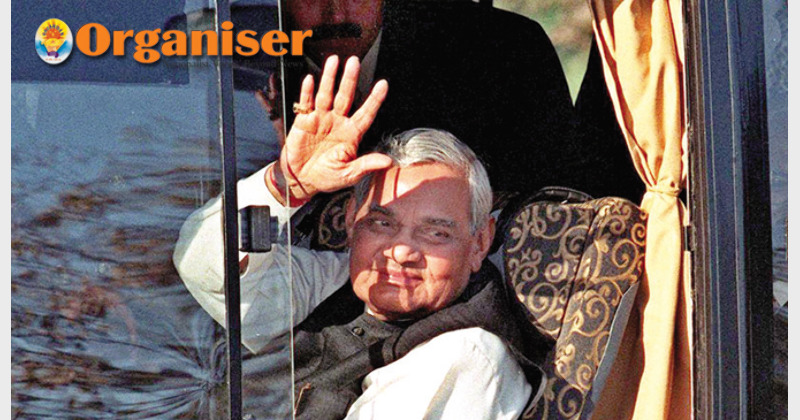
The contributions of Shri Vajpayee in the domestic and international growth of Indian nation become obvious as one analyses them in detail
Shri Atal Behari Vajpayee was a rare political figure with infinite patience and the ability to carry people with him. This was symbolic of his strong convictions combined with empathy, which saw the launch and success of his ambitious programmes, forged through his deep reading of the situation at hand, dialogue and synthesis of ideas. A pragmatic political visionary, he became the first Prime Minister ever to lead a coalition government successfully till the end of its tenure.
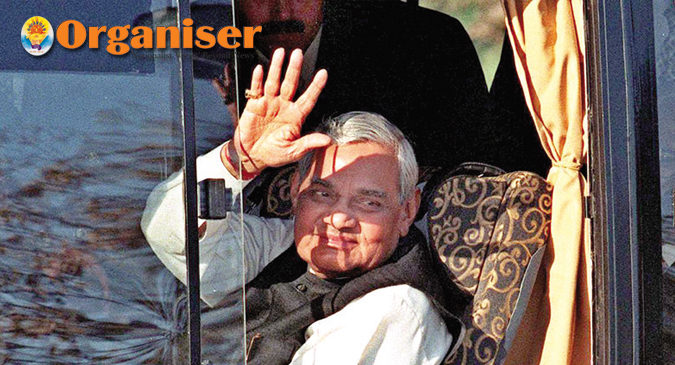
Lahor Yatra
The contributions of Shri Vajpayee in the domestic and international growth of Indian nation become obvious as one analyses them in detail. For example, it was Vajpayee’s belief in the civilisational values, which India had developed over 5000 years, which enabled him to envision India as a country destined for a superpower status in the world and to be treated, deservedly, at par with others for its uniqueness. Recognition of this sort from the world community entailed that the country must grow socially and economically so that it eliminated discrimination and poverty. It was important for India—recovering from centuries of foreign domination—to forge its identity as a country able enough to defend itself against any attack on its sovereignty. This led Vajpayeeji to dream of a stable government internally and the development of strategic prowess externally.
Economic reforms were an immediate priority for the Vajpayee government. Initiated by the Narasimha Rao–Manmohan Singh duo in 1991, they spluttered from 1993. Rigid and unrealistic licencing terms had stifled the mobile telecom system from growing and providing services to the people at affordable rates – call charges per minute was Rs 16, and was applicable for incoming calls also. Companies were becoming bankrupt since business was not growing. The Vajpayee government, in the face of strong resistance from within the government and outside, decided to restructure the sector by replacing high, fixed licence fees with revenue sharing. This brought about a telecom revolution in the economy, proving wrong sceptics who predicted that the companies would simply walk away with the money. On the infrastructural side, Vajpayeeji understood the priority of road connectivity as a key facilitator of economic development. This led to the launching of the Golden Quadrilateral and the North-South, East-West National Highways development projects. To this project was later added the Pradhan Mantri Gram Sadak Yojana to include rural integration within the scope of his development vision. These linkages freed the rural labour and the small producer from the tyranny of their local markets. Reforms like the privatisation of public sector units and the simplification of taxation, which went a long way in reducing transaction costs of business and in improving economic efficiency.
On the other hand, when aiming to establish the stability of the nation through its strategic prowess, the 1998 nuclear tests were the logical step forward even as the Vajpayee teams were painstakingly aware of the consequences which this would generate. When the world, and in particular the United States of America, imposed economic sanctions upon India for becoming an overtly nuclear state, the government not only survived the mounting international pressure to give up its right for further testing and sign the controversial Comprehensive Test Ban Treaty, but also for the first time in the history of Indo-US relations, create space for the two “natural allies” to engage in the longest, productive dialogue between them. This not only reflected the new reality of American recognising India as a as a major power, one whose potential should be built up in the interest of global peace. Ultimately, it laid the bedrock of trust which enabled the succeeding governments to sign the landmark Indo-US nuclear deal in 2008 and become a strategic partners despite having refused to sign both the NPT as well as the CTBT.
Part of this drastic change in the relations between the two countries can be explained by the ways in which the Vajpayee government responded to the recurrent Pakistani infiltrations in the Kashmir Valley, the Kargil war, the hijacking of the Indian aircraft and the terrorist attacks on the Indian Parliament. The United States, until these events, had seen the BJP government as a party full of hardliners, without appreciating the circumstances facing India. However, the exceptionally prudent restraint exercised by the Vajpayee Government in the face of severe national pressure for action against the repeated notorieties of Pakistan, that tilted the American stance in favour of India. Even as Vajpayeeji ordered the military action to throw out the Pakistani infiltrators, he knew he had to deal with Sharif in ways which should not precipitate a blow to the Pakistani democracy. Hence, when advised to put greater pressure on Nawaz Sharif, his reply was classic- put yourself in Sharif’s shoes. Realising the importance of a stable government in the neighbourhood, Vajpayeeji was able to develop very close personal equation with Nawaz Sharif. Both leaders aimed to end the state of hostility and move towards peace as good neighbours. Vajpayeeji would often remark, “You can choose your friends but not your neighbours”. Thus, despite the bumps in the road, Vajpayeeji endeavoured to keep the Lahore initiative alive even as these diplomatic strategies meant putting his personal reputation at stake and fending off pressure from domestic constituencies. The Clinton Administration actively stepped up its pressure on Pakistan to withdraw its support of terrorist activities and infiltration in India. The 4th of July diplomatic efforts of the American Government at Blair House in support of India’s stand which eventually forced the Pakistani government to withdraw all forces from Kargil, is evidence of the dramatic change in American perception towards the role India was capable of playing in ensuring political stability of South Asia, a result of the Vajpayee government’s patience and persistence.
There is an interesting anecdote which would demonstrate Vajpayeeji’s efforts at strengthening of India’s democratic and social fabric. Given that any Indian language lacks a word, or even a concept to describe ‘religion’, Vajpayeeji used to publically postulate that the State had no role to play in an individual’s choice of ‘Upasana Paddhati’ (forms of worship). This, he believed, meant that there could be no discrimination, and no use of force, in the choice of belief systems, for this approach alone qualified as real secularism. Thus, conversions were a phenomenon which came to deeply concern him, especially post his visit to Gujarat’s tribal-dominated district of Dangs in the wake of reported attacks on Christians by non-Christian tribals. His solution was to encourage a national debate on conversions and strengthen inter-community relations through dialogues. While the opportunity did not arise in the wake of media exaggerations and the brutal murder of the missionary Graham Staines and his son, Vajpayeeji on the contrary was criticised, wrongly I would argue, as someone whose statements posed a threat to the secular fabric of India. In reflection, it could be questioned, if a culture of public debates on religious issues could have been started by the government then, could not the face of India’s communal tension have been less ugly? One would never know. He was not just a politician but a patriot of the highest order.
(The writer is a Director General of Nehru Memorial Library and Museum and was Joint Secreary in PMO when Atalji was PM)