Bharatiya culture spread from West to East. From Celtic and Yazidian cultures, now we move on to examine the Bharatiya impressions of South-east Asia
The last article attempted to explore the footprints of Bharatiya culture to the West of Bharat. The footsteps of Bharatiya culture are prominently evident through the excavation like Benerike project, display of the Celtic and Yazidian cultures and remains of Bharatiya objects in many museums.
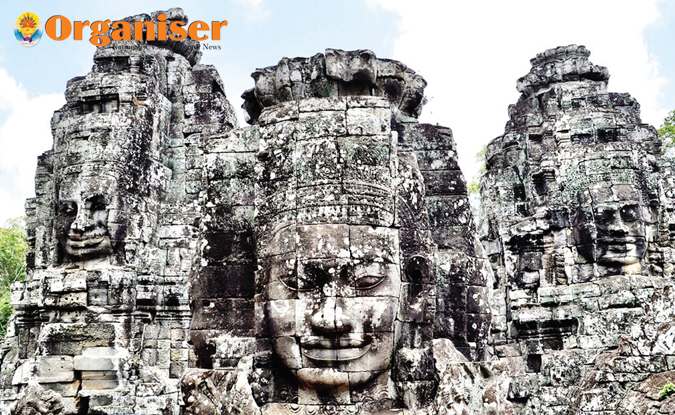
Angkor Vat—the best of the temple complexes in Siem Reap, Cambodia
However, the situation in the Eastern part of Bharat is a little different. There is no need to search for the signs of the existence of ancient Indians there. The world’s largest place of worship like ‘Angkor Wat’ itself is giving strong proof of this to the world. And a country like Cambodia is proudly exhibiting there evidences by placing a Hindu temple like Angkor Wat on its national flag!
Literally thousands of temples, thousands of inscriptions, thousands of sculptures, many documents are presenting the evidences of Indian civilisation spread on south-east Asia. The unfortunate for us is that our school going children know of Columbus, they know America discovered by him, they know the cities in America, they know Napoleon, they know Vasco Da Gama; but they do not know capital of Cambodia, that boasts of our culture! Words like Java-Sumatra, Yavadweep, Srivijaya, Yashavarman, Angkor Wat etc. appear to them to be Greek or Hebrew. Because they are never told of our vast cultural-religious empire!
Looking at the East
Our Bharatiya culture is prominently visible even today in southeast Asia. However, there is no concrete information available about since when the Indian culture started influencing this region. Some inscriptions provide insights, but no evidence is found as to when the first Indian person arrived in this area.
Cambodia is a country approachable from India through the land as well as sea. Brahmadesh (Myanmar) lies to the east of Bharat, Thailand is adjacent to it and then comes Cambodia. A story is told about how Indians entered this country, known previously as Kambuj, which is very popular in this area.
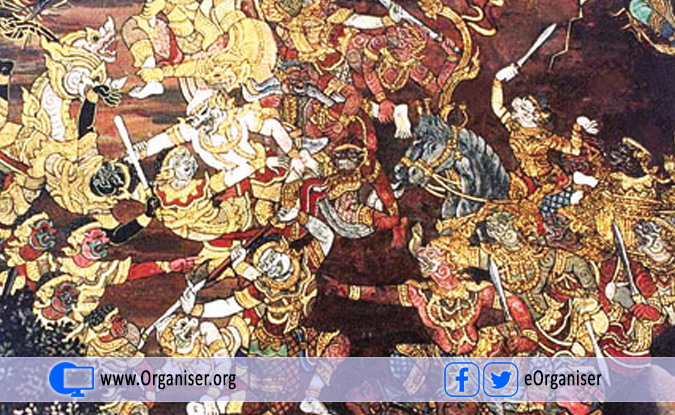
All around the Temple of the Emerald Buddha in Thailand are murals telling the story of Phra Rama- Ramayana
A Bharatiya Brahmin called Koundinya came here with some people about 200 BCE. This ‘Shailraj Koundinya’ did not want to fight and the Naga people there were surprised at this. The Princess of Nagas fell in love with this Koundinya and Koundinya became the son-in-law of that country. He later became the King and it is said that it was he who gave his Hindu culture to the country. The capital of the kingdom established by Koundinya was Vyadhapur. Some inscriptions in this regard have been found there. It is written on the inscription found in the world famous temple—Angkor Wat.
Chinese historians have written a lot about Koundinya. Therefore, this does not remain to be a fictional story. The Chinese name of the state established by Koundinya is ‘Funan Empire’. Its Hindu name is not available. Hence, it is known as ‘Funan Empire’ in the world history. References have been found that this Funan Empire was in existence till about 613 CE. Records have been found that many youths from India settled in this empire during this period and married local Naga girls. During the same time, these Indians utilised their knowledge in agriculture and dug canals in the empire and brought prosperity to the country through good farming. These canals are still visible today in the satellite pictures taken from above Cambodia.
The Funan dynasty witnessed anarchy in the early 7th century due to which a Kshatriya named Kambu, who had gone there from India, took over the power. Since then the country came to be known as ‘Kamboj’. Later on, it became Cambodia. The Kamboj dynasty ruled the country for 300/350 years. Great warrior kings like Bhavvarman and Mahendravarman were there in this period. After that, Jayavarman II established the Khmer Empire in the 9th century. His grandson Yashvarman established a new capital called Yashodhara. Emperor Suryavarman from the same dynasty built Angkor Wat, the world’s largest Hindu temple.
Thus, the Hindu culture thrived and flourished in this vast empire, proudly and richly, for 1000-1200 years after the first century AD. Sanskrit graced this country, far away from Bharat, as court language for 600/60 years. The verses of Vedas resonated here for a thousand years. Big yagnas were performed and magnificent temples were built. Holy books like Upanishads, Puranas, Ramayana, Mahabharata, Geeta etc. became integral parts of every house here. This powerful, glorious and knowledgeable Hindu nation thrived happily for 1000-1200 years. But we are such wretched that none told us anything of these things ever nor taught us! We, who recite history and geography of even tiny countries from Europe, could never know this glorious history of ourselves!
This is true for Kamboj nation as well, same with Yavdweep which is Java. It is a part of today’s Indonesia that was completely Hindu once upon a time. Yavadweep finds mention in even Ramayana and Brahmapurana. Here also, no concrete history is available as to when Indians exactly came here to settle. However, the influence of Hindu culture is found here for at least thousand years. People of Java believe that Ajishak, a brave warrior who came from India, killed their king of demon god and created a mighty dynasty.
What is true for Java is true for Sumatra. The region was known as Suvarnabhumi or Suvarnadweep in the ancient times. Today, it is the largest island in Indonesia. The island had the ‘Srivijaya empire’ of Hindus from about 7th century to 13th century. It is a great misfortune for us that the modern world knew nothing about this extremely glorious and rich empire until the 1920’s. A French researcher brought this empire before the people in 1920. After that, people’s attention moved to it and newer information started coming to fore through various mediums.
Related News