Bharat needs to reorient her statecraft and governance according to her socio-cultural make-up. A revisit and rejuvenation of the ancient Dharmik wisdom is warranted today more than ever
The frailty and ineffectuality of various political systems are becoming clearer than ever before. Time and again, elements of many medicines in Western system are updated by bringing in alternatives where side-effects of the medicine are reduced, if not erased. Similarly, political systems such as Communism, Islamism and American Democracy are being evaluated and observed now!
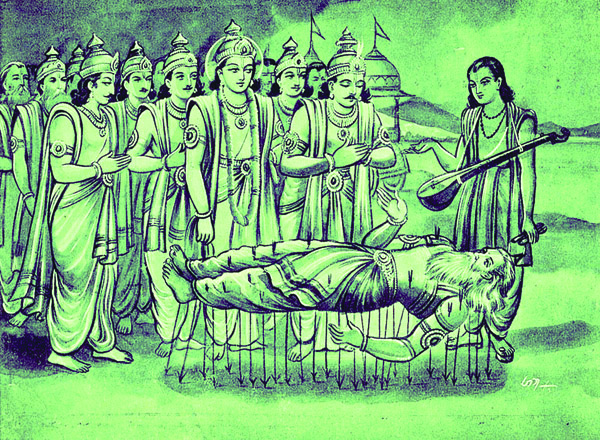
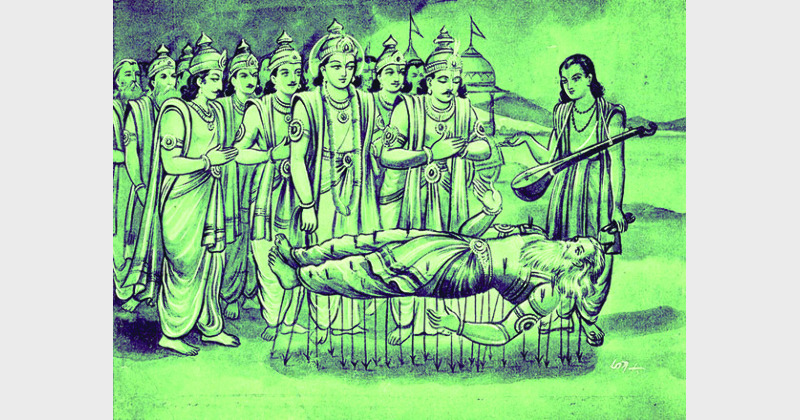
Shanti parva in Mahabharat recites a theory of governance and duties of a leader. This theory is outlined by dying Bhishma to Yudhishthira and his brothers
Communism gave a clarion call of creating an exploitation free society, but ended up magnifying cruelty and callousness. Islamic State system characterised by its hidebound approach had ceased to exist hundreds of years ago. However, at present it has again escalated many events for all the wrong reasons. In the last few decades, the Islamic system failed to even find any considerable mentions in the academic and political discourse. Lastly, we arrive at the American Democracy, which has accounted itself for many unerring practices, but equally devastating consequences. While freedom, equality and rule of law can be counted as efficacious results, surge in crime, uncoordinated economy, unchecked coercion of nature, cataclysmic pollution, and the spiraling self and spiritual alienation in human beings, have been many problems which were unintended results of this system.
Pitfalls of Western Democracy
Western democracy is not without its pitfalls. The “White Man Religion” of Christianity garnering more significance over others and nexus of muscle power and money in forging political dominance has been the characterising feature of this system. The Western Democracy has been shaped up by a narrowly defined outlook towards human beings, society and nature. The system suffers from grave limitations, and without addressing them any repetitive follow-up of the system is not going to help. For example, we have ‘rule of law’ in Bharat today, but twisting and breaking of laws is a dominant feature of everyday living in the country.
Sri Aurobindo has called the western democracy a ‘little child’, who having filled with energy and enthusiasm breaks the toys he plays with. He does so because he still does not understand what is right or wrong for him. Compared to this young energised child, the ancient and long experienced Asian civilisations seem to be tired and less on luster. However, these civilisations have a wealth of knowledge and wisdom, both materially and spiritually. Even when Mahatma Gandhi termed the British Parliament a ‘prostitute’ and a ‘barren woman’, he was intending to expose the inherent pitfalls in that political system. Bharat is actually experiencing the manifestation of those pitfalls today.

Bhagavad Gita, a 19th century manuscript
It is worth mentioning that many vices and malpractices entered the Bharatiya samaj because of intervenig forces coming from outside. Mughals, before the British, devastated the Bharatiya State-system significantly. The intervention resulted in a long drawn process of social hatred, animosity, a systematic exploitation of peasantry, social inequality, etc. Enslaving systems such as Mansabdari, Jagirdari, Zamindari, etc. were never a product of the Bharatiya State-system but they were Mughal interventions which were imposed on us forcefully. The British colonialism persisted with the same systems, modified them and updated them in the process. Mughals converted the whole apparatus of a welfare State-system into a military regime by forcefully amending the lives of peasants merely as a tax and revenue source. The British Raj amended the Mughal system in place according to their demands.
After having achieved the political independence, the State structure in Bharat claimed to abolish the Zamindari system, however, the administration, law, economic policy and education system persisted in the same structural vessel of State domination and control. Most of our social and political problems today, stem out from this fact alone. The system of State-control which was imposed on Bharatvasis by the subsequent foreign rules in history is not in sync with our Dharmic conscience and therefore it is uncoordinated.
Dharmic State and Hindu Polity
In the Bharatiya intellectual tradition, there has always been an inherent balance and coordinated philosophy of life. The same approach of coordination and harmony has guided the State-centered philosophy and thought process. Their valuation today can be corroborated be a Western scholar only. Max Weber, the great sociologist, in his famous lecture ‘Politics as a Vocation (Munich University, 1919) identified four sources which establishes the connections between politics and ethics. Interestingly, out of the four sources which Weber identified, three are Bharatiya, namely, Upnishad, BhagvadGita, and Kautilya’s Arthshastra. Weber failed to spot such a sophisticated interlink between politics and ethics anywhere, but Hindu thought and literature.
The above example is just one-point case. Factually, a very in-depth and sophisticated analysis of the State-policy is found right from the Vedic literature only. Many texts such as, RigVeda, Mahabharat (especially Shanti-Parva), Brihaspati Sutra, Aasvalyan Grihya Sutra, Shukraneeti-Saar, Panchtantra, Dharmashastra, Neetivakyamrit, Veer Mitroday Rajneeti, Rajneeti Mayukh, Daas-Bodh, Rajneeti Kalptaru, etc. can come handy while studying the Bharatiya Statecraft thought.
Sri Aurobindo has called the western democracy a ‘little child’, who having filled with energy and enthusiasm breaks the toys he plays with
A significant text such as Arthashastra by Kautilya is misunderstood for Economics. The text is actually related to the issues of co-operative life approach in which the author himself defined Arth as ‘the land and the people’. Moreover, the text was not singularly written by one author, it is actually one in a series of many texts written on the same issue. Similarly, treatises on Dand and Dharma were misunderstood even though they were written by a host of authors dealing with multiplicity of the involved issue.
It is unfortunate that the newly formulated laws in Bharat and system of administration based on them never considered the old wisdom of any use. The neglect of the ancient texts led them to their erasure from public memory and social practices.
Possibilities of Rejuvenation
The Bharatiya thought on the Statecraft and State-system can come back to us for good. The insights and wisdom in the Bharatiya literature on the State-policy and practices can well re-establish itself in the future because the other prevalent systems are getting exposed for their pitfalls. The most popular and well acceptable system of Western democracy is failing to resolve many issues facing it today. Islamic autocracy in its theocratic gesture is only perpetuating violence, hatred and chaos in the world. Communism has put itself in a self-destruction mode because of its devastating and destructing mode of operation. Therefore, it is quite possible that the knowledge legacy of an ancient, wisdom carrier and lively civillisation can rejuvenate itself for the betterment of the whole humanity.
Secondly, State-policy is an element belonging to the social realm. It implies that unlike natural sciences, it cannot have a universal and standarised application and acceptance in the diversified human experiences. Therefore, having a State-policy which is not in sync with the peculiar social make-up, mentality, Dharma, culture, and values cannot really work out itself.
In the independent Bharat, under the Nehruvian, Marxian and European influence, the collective wisdom of ancient Hindu literature and thought process was discarded after being termed as ‘communal’ and ‘sectarian’. This blunder needs an urgent rectification! Hindi novelist and story teller Nirmal Verma rightly pointed out that any civilization does not possess the wealth of thinking and intellectual output as we do. However, we have thrown those jewels away misunderstanding them as pebbles.
We need to evaluate and sincerely work out the dynamics of our State-policy according to the thought process. It can be only achieved when we work through the Bharatiya insights. Having done so, we can study the political systems and different insights on Statecraft and governance across the different experiments.
(The writer is a well known political scientist and an expert on Indic political thought)