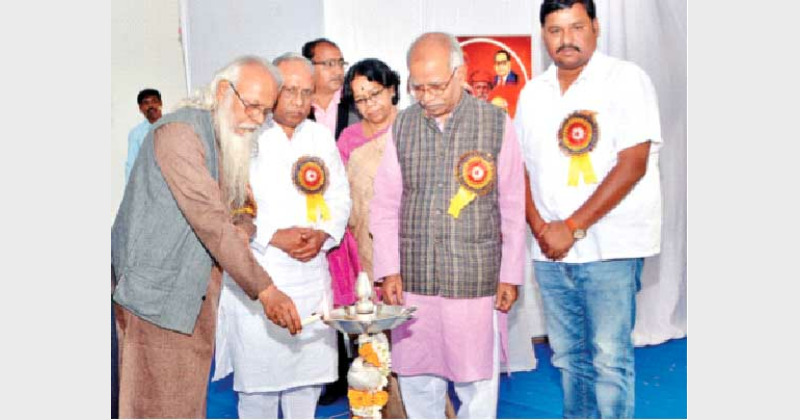
 Pardhi is one of the Janjati communities which has been castigated as criminal for generations. The Criminal Tribes Act, 1871, enacted by the British Government, proclaimed them to be criminals by birth. Though, the law was abolished in 1952, these people are still regarded as usual suspects in any crime committed in the vicinity. The life for Pardhis in Maharashtra has been the same for generations. Pardhis being dragged by police like animals was not an uncommon sight in Maharashtra till some years ago. Bhatke Vimukta Vikas Parishad (BVVP), which stood against this inhuman practice in 1991, has played a pivotal role in changing the mindset of the police and the society at large in this respect. The man behind this change has been Shri Girish Prabhune, who is today synonymous with the Janjatis and nomads in Maharashtra. Recently he presided over this year’s Samarasata Sahitya Sammelan at Ahmadnagar. On the sidelines of this Sammelan, Organiser representative Devidas Deshpande spoke to him. Shri Prabhune emphasised that nomads are the true bearers of the traditional Bharatiya knowledge. Excerpts:
You have dedicated your life for upliftment of nomadic communities. How do you feel to preside over a literary convention related to them?
Actually, I felt a bit awkward. Many stalwarts before me have graced this chair and my work is nothing before them. In fact, even though I am not a member of any nomadic community, the organisers allowed me to preside over it, and this is really a bold step on their part in today’s atmosphere. Tendency of reading is not decreasing; just the centres of that culture are shifting. Number of people participating in the work after reading the book is increasing. We have to reach them and I took this opportunity to share my experiences in this regard. The nomadic people need to be seen in the context of Bharat and the world. This is what I have been doing for the last 25 years through my work and writing. The exploration of these communities is exploration of knowledge.
You said the literature of nomadic people carries the essence of Bharatiya soil. What do you mean by it?
See, today whatever we are doing is based on Macaulay”s system. That is why all literature and intellectual work is based on that thought. However, the true literature of nomadic people is free from the influence of the English and it has been preserved since pre-Islam, nay ancient Vedic, era. The Vedas, Upanishadas and the literature of all saints itself is literature of the nomadic people. It is the true reflection of Bharatiya life. The nomads have recently started writing. Some of them have expressed their grief through the literature, but they still have no place in the mainstream literary world. Those who write are also confused by the baseless Aryan-non Aryan theories. As such, there is a huge scope for research and writing in this field.
All these castes and communities have a treasure trove of oral literature, the history of every caste and community is breaking away with advent of modern (Western) education. The literature created by labour class has always been the best. The richness of their works is manifested at places like Ajanta and Ellora. Confused by Western outlook, we call them as deprived, but after seeing lives full of literature and art, one is forced to wonder whether they should be called ‘deprived’. They are not deprived section of the society, but the means of spreading Bharatiya knowledge and art all over the world.
Would you please elaborate it more?
See, the Western concept of history sees it dating back to 10 to 15,000 years. In Bharat, our history goes back over to one lakh years. All the ages in history – Stone Age, Bronze Age, Iron Age and Golden Age – have to be redefined in our context. During all this time, each of the castes, tribes and communities that is branded as nomadic today, possessed some or other knowledge. They excelled in skills like making iron ores, jewellery, woodwork and they provided their services everywhere. The ancient treatise Shalbasutra provides us description of their skills. These were the people who built grand gopurams, buildings and drew cave arts. In Ajanta, members of 22 communities served in carving, painting, plastering works and all of them were from different regions.
Before Islam appeared on the scene and Britishers came here, these people roamed all over the world. This is why Gypsies in Europe are called Romani that are called Lamani in Bharat. Lamanis (Lamans) were actually traders who codified Bharatiya knowledge in their languages. Their present sorry state came after Islamic forces started their aggression and when the sense of higher-lower castes entered among them. Some of them converted to Islam and Christianity but their languages and customs give unmistakable clues to their Bharatiya origins. All modern researches suggest that knowledge and culture went to entire world from Bharat and these were the people who carried them. Many Janjatis in Afghanistan, Russia, Iran etc. even today have uncanny semblance to the languages spoken by nomadic people.
What would you say to rehabilitate these people?
We call it habilitate and not rehabilitate. The education level among them is high, but modern education itself is a problem. The youths do not return to their roots once they are educated. Our schools do not teach skill, while these people are highly skilled. Government is now speaking of Skill Development, but the skills should be imbibed from primary level and not at college level as is done presently. For example, Lohars are masters in iron work, Wadars are experts in stone carving, Vaidyas are expert in forest herbs and Otaris have marvellous knowledge in casting. Even modern engineers do not posses these skills. These skills should be encouraged in present education system.
What is the BVVP doing to ‘habilitate’ the nomadic communities?
The BVVP has taken up the work of transforming nomadic communities. It started with a hostel at Yamgarwadi under Solapur District in 1993, where today about 450 students are pursuing education. Later, the similar work began in Anasarwada in Latur and Samarasata Punarutthan Gurukulam in Chinchwad (Pune) where about 350 students from nomadic tribes are studying.
What difficulties do you face while working among them?
When I started working among these people, I knew nothing about them. Gradually, I understood their lives with every incident. Then I realised that these people have no country of their own. Sometimes I wondered whether this was life all about. But then it became clear to me that the lives of these people contain the history of India.
The members of nomadic communities have started expressing themselves which is evident in this convention. The convention is an attempt to provide a platform to the section of the society that was kept out of the boundaries of the villages. n