Who is a religious minority and who deserves protection needs to be discussed State-by-State and District-by-District
Dr J K Bajaj
Hindus are indeed a minority in the Muslim-majority states of Jammu & Kashmir and Lakshadweep, in the Sikh-majority State of Punjab and in four states of north-east—Mizoram, Meghalaya, Manipur and Nagaland— that have seen large-scale conversion to Christianity after Independence. The list where Hindus are in minority also includes Arunachal Pradesh, where Christians have come to acquire the largest share in the population in recent decades.
In some of the eight states mentioned in the PIL filed in the Supreme Court in first week of November 2017, Hindus form not only a minority but also a miniscule and
endangered minority. In the tiny Union Territory of Lakshadweep, Muslims form nearly 97 per cent of the
population and the share of Hindus is less than 2.8 per cent. In Mizoram also, Hindus form merely 2.75 per cent of the population, while Christians form nearly or more than 90 per cent of the population in all districts except Lawngtlai, Lunglei and Mamit, where Buddhists continue to hold a significant share in the population.
In Nagaland and Meghalaya, Hindu presence is
somewhat higher, but still rather low at 8.75 and 11.53 per cent, respectively. In both these states, Christians
dominate the population in every district. In Nagaland, Hindus are confined almost entirely to Dimapur and Kohima, though they remain a small minority in these
districts also. In Meghalaya, the share of Hindus has been falling rapidly from decade to decade and they indeed look like an endangered community.
The situation is somewhat different in Manipur, where Hindus still have a substantial share of 41.39 per cent in the population. But almost all of the Hindus are confined to the valley districts of Bishnupur, Thoubal, Imphal West and Imphal East, while the hill districts have been nearly fully Christianised. Christians form more than 90 per cent of the population of the hill districts of Manipur, but they continue to enjoy the privileges of a minority in both, the valley and the hills.
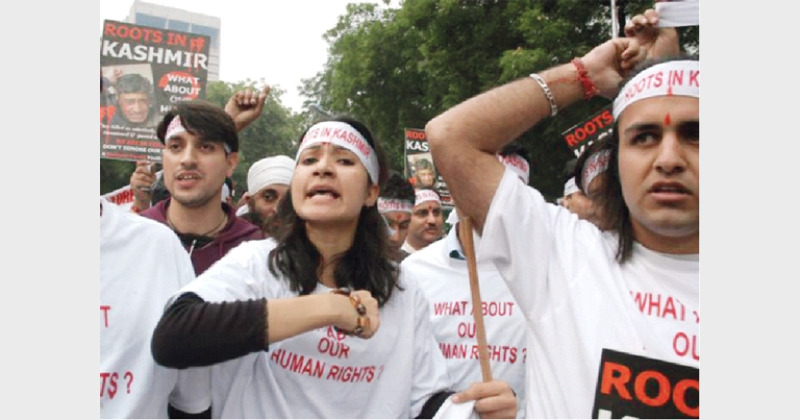
In Jammu & Kashmir, the situation parallels Manipur. Like in Manipur, Hindus form a substantial minority in the State. They have a share of 28.44 per cent in the population of the State. But, their presence is limited almost entirely to a few districts in Jammu region. In Kashmir Valley, they comprise an inconsequential minority of just 2.45 per cent. Muslims form 96.41 per cent of the population in the Valley. They are also in a majority in Doda, Ramban, Kishtwar and Reasi districts of Jammu region and in Kargil of Ladakh. Even so, it is they who continue to enjoy the privileges of a minority in every region of the State.
In Punjab, Sikhs are in majority community. Hindus form 38.49 per cent of the population. In some of the districts their presence is much lower than this average. In Taran Taran District, there are only 5.40 per cent Hindus. Hindus do form a small majority in Jalandhar, Hoshiarpur and Shahid Bhagat Singh Nagar. But they are treated as a majority in the whole State, and minority privileges accrue to the majority Sikh community.
Arunachal Pradesh forms a class of its own. The State has experienced rapid, visible and perhaps forced conversion to Christianity during the last three decades. This has resulted in the share of Christians in the
population rising from almost nothing in 1971 to more than 30 per cent in 2011. Several communities and districts of the State have now become Christian majority. Yet the Hindus, who along with the tribal religions of the State are the subjects of conversion, are treated as a majority and the proselytising Christians get to enjoy the privileges and protections of a minority.
In the eight states mentioned in the PIL, Hindus are in a numeric minority in the aggregate population. But there are several other districts in the country where Hindus form a small minority, though they are in a majority in the State as a whole. There are about 30 such districts in the country. The most noteworthy of these are Mewat in Haryana, where Muslims form nearly 80 per cent of the population and where Hindus are in obvious need of protection to survive. There is Kishanganj in Bihar, where Hindus now form only 31.43 per cent of the population. In Kishanganj and the neighbouring districts of Katihar, Araria and Purnea in Bihar and in Sahibganj and Pakur of Jharkhand, Hindus are continuously losing ground and are in as much need of protection as in Mewat. Hindus are in a minority in 6 districts of Jharkhand including Pakur. In Simdega, Christians are now in a majority.
Hindus are in a minority in 9 districts of Assam and in the
neighbouring Uttar Dinajpur, Maldah and Murshidabad District of West Bengal. In all these districts, the share of Hindus in the population has been declining sharply for several decades and in some of the blocks in this region their absolute numbers have declined. In Dhubri, Hindus now form only 19.9 per cent of the population and in Murshidabad their share is reduced to 33.2 per cent. Hindus of this region, of course, deserve the protection and privileges due to a minority, but ironically it is not them, but the advancing Muslim majority that gets to be treated as a minority.
Serious Situation
The situation is equally serious in some of the districts of Western Uttar Pradesh and neighbouring Uttarakhand. In Rampur District of this region, Hindus are in a numerical minority; in many others they are likely to reach that status in a couple of decades, if not earlier. There are persistent reports of the out-migration of Hindus from the towns of this region. Yet the protection and the privileges that the State of India extends to its minorities accrue not to them, but to the Muslims.
Kerala is another state, where Hindus are under great stress. Their share in Malappuram is only 27.6 per cent, and they are in a minority in three Christian-dominated districts. But while both Christians and Muslims in the state enjoy minority privileges, Hindus are left to fend for themselves in a situation where their share in the population is rapidly shrinking.
Gajapati and Kandhmal of Odisha are facing a similar situation. Hindus are not yet a minority in these districts, but are likely to become so in the near future. In Gajapati, Christians already form 38 per cent of the population. Hindus are clearly in need of protection in the face of the fast growing Christian presence.
In Kanyakumari, Christian presence has been growing rapidly over the last several decades and, by all estimates they shall come to form a majority within a few years. But it is the Hindus, the victims of the situation, who are treated as a majority here. The question of who is a religious minority in India and who deserves protection thus needs to be discussed State-by-State and District-by-District. It needs to be remembered that the protections that the Constitution of India extends to the minorities are qualitatively different than those extended to deprived groups like the Scheduled Castes and Scheduled Tribes. The latter protections are designed to assure a share for these groups in the polity. Thus, the Constitution mandates special treatment for them both in the political power structure and in employment.
For the minorities, the Constitutional protections are of a different nature. Their objective is to ensure that linguistic and religious minorities are given the freedom to protect their language, culture and ways of worship. Such protections cannot be limited to any specific group. Any group that finds itself in a minority in any part of the country would deserve to be given special protection and treatment to ensure that it enjoys the freedom to protect its language, culture and way of life in a situation where the milieu is dominated by another language, culture or religion.
It is probably because of the region-specific and perhaps time- specific nature of who is a religious or linguistic minority that the Constitution does not attempt to name the minorities. The Congress governments of 1990s have clearly erred in naming certain communities as national
minorities and specifically leaving out Hindus, irrespective of their numbers and situation in different parts of the country, from that fold. This has led to a situation where the dominant communities end up enjoying special protections and privileges, while the community that is under most stress and is need of protection to preserve its culture and religion gets to be treated as a majority. The state thus seems to be standing with the strong instead of the weak, which seems to be entirely contrary to the intent of the founding fathers. It is time a comprehensive review of the situation is done and the gross injustice towards the vulnerable Hindu communities in several parts of India being perpetrated because of the clearly inequitable laws enacted at a certain time in the recent past, is corrected.
(The writer is Director, Centre for
Policy Studies)