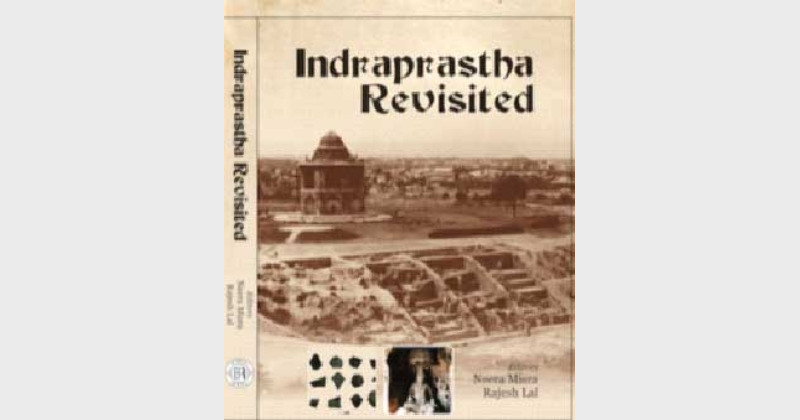
 Indraprastha Revisited (Hardcover); Om Publication, Edited by Neera Misra and Rajesh Lal; Rs 3000 Indraprastha Revisited (Hardcover); Om Publication, Edited by Neera Misra and Rajesh Lal; Rs 3000 |
Indraprastha needs to retrieve its ancient dignity which has been sadly overshadowed and suppressed by the Muslim historicity
Ajay Bhardwaj
When did Delhi come into being? Where exactly was Indraprastha located? Does it have roots in the Mahabharata times or is it a latter phenomenon?
The book, “Indraprastha Revisited”, delves deep into the matter and seeks to establish on the basis of archaeological and other pieces of evidence that the present-day Delhi has, in fact, its genesis in the Mahabharata times.
The 150 page academic book, which has a look of a coffee table book, engages and engrossess you. Its subject is of abiding interest as it takes the reader back to the Mahabharata times. It helps us trace the cultural roots up to the epic times. Of course, in the process, it becomes a compulsive reading for a comprehensive understanding of the contentious issue.
Editors Neera Misra and Rajesh Lal have compiled more than two dozen research papers presented at the first International Conference on Ancient Indraprastha organised by the Draupadi Dream Trust in 2016.
Scholars from the diverse fields of archaeology, art, science, Sanskrit, astronomy have presented an insight into the governance, culture, history and legacy of the Mahabharata period asserting the need to showcase Indraprastha so that Purana Quila history can go beyond the Mughal period. Prominent contributors include BB Lal, former DG National Museum, Dr BR Mani, KN Dikshit, chairman, Indian archaeological society, Prof. Sushmita Pande, chairperson, National Monuments Authority, KK Muhammad, director Monuments, ASI (Retd)
As Indraprastha is said to be the capital of Yudhishtir’s empire, the tone of the book is set by touching on the historicity of Mahabharata? Some of the moot questions hover around the period attributed to the Mahabharata war and Lord Krishna.
A widely-acclaimed archaeologist BB Lal raises some basic questions like if Krishna was a real figure he could not have been after Buddha, that is 3rd or 4th century BC. Yet part of the text could be as late as the 4th-century AD, as it refers to Huns and Romans and Greek.
According to him, Mahabharata was originally called Jaya and had 8,000 verses before it assumed the form of Bharat with 24,000 verses. And finally in its present form of 100,000 verses with reference to Huns, Greeks and Romans it explains a yawning gap between the time when it was first conceived and when it finally took shape as we see it today. And incidentally it was never meant to be a history book, but an epic, Prabandha Kavya, as he describes it.
He underlines the fact that quite a few cities named in the Mahabharata times still exist with the same names. Be it Kurukshetra, Mathura, Kampilya, or Indraprastha.
He reaffirms the Identification of Indraprastha on the basis of pioneering archaeological work that he spearheaded in 1954-55 by digging the mound near Purana Quila where the remains of Painted Grey Ware culture were found which as an archaeological evidence confirms that what goes as Purana Quila was indeed Indraprastha.The PGW remains are also found at other Mahabharata sites.
Another prominent archaeologist AK Sharma talks about how in the 1st or second century Ptolemy marked Daidala on his map located close to Indraprastha. Delhi, according to him, acquires its nomenclature in the eighth century when a Rajput clan of Tomaras ruled over the region. He avers that the earliest settlement around Delhi is Indraprastha between Kotla of Firoz Shah and Humayun Tomb.
Extensive Indraprastha
Neera Misra in her paper titled, Indraprastha: The legacy of Pandavas highlights that Alexander Cunningham, Surveyor General, ASI, (1862-65), was one of the earliest archaeologists to survey the region of Delhi.
He detailed in ASI’s early reports,“Indraprastha, the city of Yudhishthira” was built along the bank of river Jamun?” and “the name of Indraprastha is still preserved in that of Indrapat, a small fort which is also known by the name of Purana Qila or the old fort”.
Cunningham must have concluded this after a proper study of related factors of this area. In fact, Carr Stephens (Archaeology and Monumental Remains, 1876, p8) observed. “Ancient Dilli was founded on the site of Indraprastha, once the capital of a powerful empire, and that Anang Pal I, thought it better suited his ambitious views to restore this ancient city than to found a new one; this opinion is supported by Abul Fazl, and it has since been followed by every native historian of reputation.
That in the account of the early Muhammadan kings, Purana Qil’ah is also called Qila Indrapat, is in support of the theory adopted by the traditionary party”.
She argues that “all this logically suggests that the stretch of ancient Indraprastha capital city areas covered a substantially large expanse of current NCT Delhi. So, Purana Qila is Indraprastha, but Indraprastha is not just Purana Qila but almost, at least the whole stretch from Mehrauli to Rajghat to Naraina to Raisina. According to Carr Stephen,“tradition points to the walled village of Indrapat as the inheritor of the name and a portion of the site of Indra Prastha,” He further says, “It is generally believed to have occupied the extensive piece of ground which covers the site of Indrapat, and stretches northward to the Delhi gate of modern Delhi.
BM Pande also underlines how Alexander Cunningham refers to Indraprastha or Inrapat as the kingdom of Yudhishtir.
Vishnu Kant, in his paper, talks about how the river Yamuna flowed once close to Purana Quila, but it shifted two km off its course from Pandavon Ka Quila. Excavations undertaken in 2013-14 at Purana Quila take us to PGW deposits, he argues.
In another interesting papar Jijith Nadumuri Ravi elaborately touches on the Saraswati-Yamuna link which formed the Kuru empire region.
Both the editors, Rajesh Lal and Neera Misra have an abiding interest in restoring dignity to our ancient culture and is reflected in the compilation done in the book.
Neera, who is Chairperson of the Draupadi Dream Trust and has focused on Vedic and Mahabharata period history and culture, while Rajesh Lal, retired Air Vice Marshal, who has authored the book, ‘Glimpses of India: Some 5000 Years Ago’, giving an insight into India’s rich cultural heritage. n