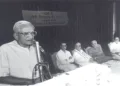
BMS national general secretary B Surendra speaks about his recent visit to China
P Sandeep Kumar
BRICS Trade Union Forum meeting was held from July, 24 to 25, 2017 in Beijing, China. Labour and Employment Ministers Meeting was also conducted from July 26 to 27 at Chongqing. The delegates from India, Brazil, Russia, China, and South Africa participated in the meeting. Six delegates belonging to various trade unions represented India in these conferences. B Surendra, the national organising secretary of BMS was a part of Indian delegation.
On being asked about the BRICS trade union conference and its objectives, Shri Surendra said that the major thrust of the meeting was on the preparation of agenda for labour and employment ministers’ conference. Based on which, a broad outline for draft declaration was prepared. The representatives of trade unions and managements are part of labour and employment ministers’ conference. The trade union representatives’ meeting has discussed the sustainable development agenda for 2030 as its main agenda. Further, challenges at global level to achieve this objective, road map and mission of trade unions, the future course of action etc. were also discussed.
Apart from which topics like, how trade unions should function, how to respond to the emerging situations at the global level, co-operation between trade unions of BRICS countries etc. were also debated in the meeting. The All-China Federation of Trade Unions (ACFTU), the Chinese trade union body brought in a draft declaration in the meeting, in which they hailed the economic globalisation and coined a new terminology “Economic globalisation with protectionist measures”. But the Indian delegation opposed it and argued that globalisation is not limited to economic arena alone and it can’t be selective. Its implications are much larger and it has wider ramifications. Hence, the Indian delegation objected to the adoption of this declaration, and due to this the Chinese side was forced to drop it, Shri Surendra said.
While answering another question about issues like One Belt One Road (OBOR), he said that there was a split among Indian delegation members when a declaration on OBOR came for discussion. According to him the Communist trade unions (CITU) and the Congress trade union (INTUC) supported the Chinese position on OBOR. But, the BMS opposed the Chinese declaration on OBOR. The threat of China–Pakistan Economic Corridor (CPEC) posed to India’s territorial integrity and sovereignty was the main reason behind contention of BMS. Further, the established position of government of India is also opposed to OBOR and CPEC. Meanwhile, the arguments of Communist and Congress trade unions were based obsolete slogans like Panchsheel and Hindi, Cheeni Bhai Bhai. When asked about whether Chinese tried to influence the Indian delegation particularly the Left and Congress trade union leaders he said that the Chinese tried to convince them by narrating the benefits of the OBOR, probably they could have been convinced. Nevertheless, the declaration was dropped due to the objection of BMS. He also added that the INTUC delegate criticised the Indian government in this forum by raising issues which are not relevant to the BRICS conference. Normally nobody will make such remarks about own country in an international forum, he further added.
On the other hand the Chinese are extremely nationalistic; they will not make even a small remark which will defame their country. The Chinese always talk about their culture,
tradition and Chinese pride. They motivate their workforce by inculcating nationalist pride in them. They are not talking about internationalisation. On the contrary, the communist trade unions of India in the name of internationalisation always undermine nationalism and our national symbols.
In his opinion the economic progress of China has not eradicated poverty from its rural areas. The plight of rural and migrant workers indicates this hard fact. He also quoted a Chinese official as saying ‘We have both brightness and darkness; we are trying to mitigate the darkness’. The accepted minimum wage of ordinary Chinese worker is not much higher than that of his Indian counterpart. The infrastructure developed for skill education, policies for the development of traditional industry, automation of industries including small scale industries etc. of China need to be noted, Shri Surendra added.